Meeting of the
Hawke's Bay Regional Council Māori Committee
Date: Wednesday 3 September 2025
Time: 11.00am
|
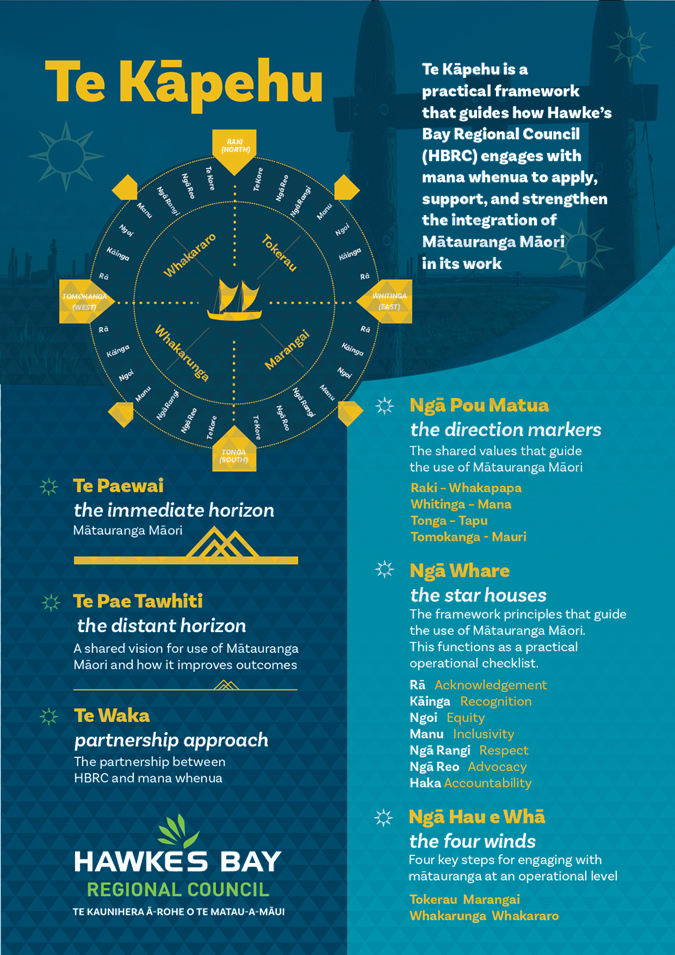
Venue:
|
Council
Chamber
Hawke's
Bay Regional Council
159
Dalton Street
NAPIER
|
Agenda
Item Title Page
1. Welcome/Karakia/Notices/Apologies
2. Conflict
of Interest Declarations
3. Alternate
member appointments 3
4. Confirmation of Minutes of
the Māori Committee held on 5 March 2025
5. Call
for minor items not on the Agenda 5
Decision
Items
6. 2022-2025
Reflections and Insights for Incoming Council 7
Information
or Performance Monitoring
7. August
2025 Statutory Advocacy and Resource Management reform update 9
8. Māori
Partnerships Projects 17
9. Treaty
Settlement Commitments 19
10. Mātauranga
and Monitoring Update 21
11. Three
Yearly State of the Environment Report 27
12. Hawea
Park Update 33
13. HBRC
Chair and CE's verbal updates on current issues
14. Take
Ripoata ā Takiwā – Taiwhenua representatives' verbal updates
15. Discussion
of minor items not on the Agenda
Parking
1.
Paid
parking is available on Vautier Street adjacent to the HBRC Building & on
Raffles Street.
2.
There
is free all-day parking further afield – on Munroe Street or Hastings
Street by Briscoes.
3.
There
are limited parking spaces (3) for visitors in the HBRC car park – entry
off Vautier Street – it would be appropriate that the
“visitors” parks be available for the members travelling distances
from Wairoa and CHB.
4.
If
you do pay for parking elsewhere, please provide your receipt with your tavel
claim for the meeting.
NB: Any
carparks that have yellow markings are NOT to be parked in please.
HAWKE’S BAY REGIONAL COUNCIL
Māori
Committee
Wednesday
03 September 2025
Subject: Alternate member appointments
Reason for report
1. The Māori Committee
Terms of Reference makes allowance for short term replacements (alternates) to
be appointed to the Committee where the usual member/s cannot attend.
Recommendation
That
__________________ be appointed as a member of the Māori Committee for the meeting of 5 March 2025
as a short term replacement on the Committee for ____________.
Authored by:
|
Leeanne Hooper
Team Leader Governance
|
|
Approved by:
|
Desiree Cull
Strategy & Governance Manager
|
|
HAWKE’S BAY REGIONAL COUNCIL
Māori
Committee
Wednesday
03 September 2025
Subject: Call for minor items not on
the Agenda
Reason for
Report
1. This item provides the
means for committee members to raise minor matters they wish to bring to the
attention of the meeting.
2. Hawke’s Bay Regional
Council standing order 9.13
states:
2.1. “A meeting may discuss an item
that is not on the agenda only if it is a minor matter relating
to the general business of the meeting and the Chairperson explains at the
beginning of the public part of the meeting that the item will be discussed.
The meeting may not make a resolution, decision or recommendation about the
item, except to refer it to a subsequent meeting for further discussion.”
Recommendations
That the Māori Committee accepts
the following minor items not on the agenda for discussion as item.
HAWKE’S BAY REGIONAL COUNCIL
Māori
Committee
Wednesday
03 September 2025
Subject: 2022-2025 Reflections and
Insights for Incoming Council
Reason
for report
1. This agenda item provides the
opportunity for committee members to share their reflections of the
2022–2025 triennium as tāngata whenua representatives on the
Māori Committee.
2. The Committee’s reflections will
be recorded and provided to support the onboarding of the incoming Regional
Council following the 2025 elections.
3. This paper also allows the Committee,
should it wish, to offer a recommendation highlighting the importance of
tāngata whenua representation in HBRC’s governance arrangements for
the 2025–2028 triennium.
4. A similar reflections session was held
with the full Council on 27 August 2025.
Next steps
5. Following the local body elections,
the new Regional Council will decide its committee structure.
6. The Māori
Committee’s reflections and any recommendation will be documented and
included in the onboarding programme for elected members.
Decision-making
considerations
7. Council and its committees are
required to make every decision in accordance with the requirements of the
Local Government Act 2002 (the Act). Staff have assessed the requirements in
relation to this item and have concluded:
7.1. The decision does not
significantly alter the service provision or affect a strategic asset, nor is
it inconsistent with an existing policy or plan.
7.2. The use of the special
consultative procedure is not prescribed by legislation.
7.3. The decision is not
significant under the criteria contained in Council’s adopted
Significance and Engagement Policy.
7.4. The persons affected by this decision
are tāngata whenua of Ngāti Kahungunu and associated hapū, who
are represented on the Māori Committee through marae-based Taiwhenua
membership.
7.5. Given the nature and
significance of the issue to be considered and decided, and also the persons
likely to be affected by, or have an interest in the decisions made, Council
can exercise its discretion and make a decision without consulting directly with
the community or others
having an interest in the decision.
Recommendations
That
the Māori Committee:
1. Receives and considers the
2022-2025 Reflections and insights for the incoming Regional Council
report.
2. Recommends to the incoming
Hawke’s Bay Regional Council that its onboarding process recognises and reflects
the importance of tāngata whenua representation in governance, including
through Ngāti Kahungunu, marae-based and Taiwhenua representation, as part
of the 2025–2028 committee structure.
Authored and Approved by:
|
Te Wairama Munro
Te Pou Whakarae
|
|
Attachment/s
There are no attachments for this
report.
HAWKE’S BAY REGIONAL COUNCIL
Māori
Committee
Wednesday
03 September 2025
Subject: August 2025 Statutory
Advocacy and Resource Management reform update
Reason for report
1. This item updates the
status of reports on proposals forwarded to the Regional Council and assessed
by staff acting under delegated authority as part of the Council’s
Statutory Advocacy project. This edition features a new-look style and feedback
on this is invited.
2. The Statutory Advocacy
project centres on local resource management-related proposals on which the
Regional Council has an opportunity to make comments or to lodge a
submission. These include, but are not limited to:
2.1. resource consent
applications publicly notified by a territorial authority
2.2. reviews and changes to
district plans overseen by a territorial authority
2.3. non-statutory strategies,
structure plans, registrations, etc prepared by territorial authorities,
government ministries or other agencies involved in resource management.
3. From time to time, the
Statutory Advocacy project also coordinates the Regional Council’s
feedback on resource management-related proposals from central government
agencies such as Ministry for the Environment, Ministry for Primary Industries
and Parliamentary Committees etc.
4. In all cases, the Regional Council is not
the decision-maker, applicant nor proponent.
5. Copies of formal submissions made by
the Regional Council on resource management-related proposals can be viewed
online at www.hbrc.govt.nz (keyword #hbrcsubmissions).
6. The following summary outlines those
proposals that the Council’s Statutory Advocacy project is currently actively
engaged in. Green text represents an update
since the previous report in March 2025.
7. Summary
|
National
|
·
Programme of new and amended National
Direction (NPSs and NESs) under the RMA
·
Reforming the
Resource Management System – Tranche
Two RMA amendments etc.
·
Local Government
(Water Services)
Bill
·
National standards for discharges from municipal wastewater schemes.
·
Draft National Infrastructure Plan
|
|
Regional
|
·
Napier City
Council Proposed District Plan
·
Marine and Coastal Area
(Takutai Moana) Act
2011 (MACAA).
|
|
Other
|
|
8. Inactive proposal for current
reporting period
(with date of previous report to Committee)
|
·
Central Government’s Climate Change Adaptation Policy
programme
|
February 2025
|
|
·
Application for Water Conservation Order
– Ngaruroro and Clive Rivers
|
May 2025
|
|
·
Reforming the Resource Management System –
Replacement of the RMA
|
May 2025
|
9. Completed proposals (no further reporting)
|
·
Fast Track Approvals Act 2024
|
February 2025
|
|
·
Resource Management (Freshwater and Other Matters) Amendment
Act 2024
|
February 2025
|
|
·
Hastings District Plan Change 6 (Category 3 Lifestyle
subdivision provisions for displaced owners)
|
February 2025
|
|
·
Resource consent application for development at 147 Napier
Road, Havelock North
|
May 2025
|
|
·
Private Plan Change
7 to the Hastings District Plan (Hastings Golf
Course)
|
May 2025
|
10. Active workstreams (see tables below)
|
Name
|
Programme of new and amended National Direction under the RMA
|
|
Proposal
Type
|
National Policy Statements, National Environmental Standards and Regulations
|
|
Owner
/ Lead
|
Ministry for the
Environment (plus other
Ministries)
|
|
Summary
|
On 29 May 2025, the
Government opened consultation on proposals to change and inform the
development of national direction under the resource management system. This
included four consultation packages:
- Package 1:
Infrastructure and development
- Package 2: Primary
sector
- Package 3: Freshwater
- Package 4: Going for
Housing Growth
Package
1 contains proposals for four new national direction instruments and
amendments to four existing national direction instruments, including the
proposed new National Policy Statement for Natural Hazards and National
Policy Statement for Infrastructure.
Package
2 contains proposals for changes to eight existing national direction
instruments, including changes to the National Environmental Standards for
Commercial Forestry and the National Policy Statement for Highly Productive
Land.
Package
3 contains proposals for changes to the National Policy Statement for
Freshwater Management 2020 and the National Environmental Standards for
Freshwater.
Package 4 contains proposals
for freeing up development land and removing planning barriers to promote
housing growth.
|
|
Update
|
|
|
Potential
Impacts for HBRC
|
There are likely to be significant looming impacts on
workstreams across the council resulting from the proposed national direction
packages. These will continue to be worked through as more details of the
proposed national direction instruments are confirmed.
|
|
Actions
arising
|
Staff have submitted feedback on packages 1-4 and have also
provided feedback helping to inform a
submission prepared on behalf
of Te Uru Kahika (the
collective of regional councils and unitary
authorities).
|
|
Important
Dates
|
Consultation on national direction instruments including
Packages 1-3 - which closed on Sunday 27 July, and Package 4
closed Sunday 17 August.
|
|
Further
Information
|
Ministry for the Environment website – Consultation on
updating RMA national direction: https://environment.govt.nz/news/consultation-on-updating-rma-national-direction/
|
|
HBRC
Lead
|
Intermediate Policy Planner - Saul Gudsell
|
|
Subject
|
Reforming
the Resource Management System – Tranche Two of RMA amendments, etc.
|
|
Type
|
Legislation
|
|
Owner
/ Lead
|
Ministry
for the Environment (plus other Ministries)
|
|
Summary
|
On 17 December 2024,
the Resource Management (Consenting and Other
System Changes) Amendment Bill had its first reading
and was referred to the Environment Select Committee. This bill amends the RMA to progress Government priorities,
including making it easier to consent new infrastructure, encouraging investment in renewable energy, and making medium-density residential standards optional for councils. Proposed
amendments include:
empowering the
Minister to direct
a council to initiate plan
changes, and empowering the Minister to direct the
type of planning process councils must
use to implement national direction
changes to s70 of the RMA to enable
the continued management of discharges through
permitted activity
rules, in circumstances where significant adverse effect on aquatic life exist
clarifying the
circumstances in which
regional councils can control fishing methods to achieve biodiversity outcomes
strengthened compliance and enforcement powers
changing how applications to change the
conditions of a marine aquaculture permit are to be
assessed and extending durations for coastal permits for Ports to 2046
changes to enable a 35-year consent
duration as the default presumption for long-lived infrastructure
and renewable energy projects
one-year consent
processing timeframes for renewable energy
and wood processing consents
changes to the national Freshwater Farm Plan system to enable industry organisations to
undertake certification and audit processes
changes
to better enable regulation-making powers following emergencies
changes giving
councils greater authority to decline land
use consents in areas at risk of significant natural hazards (similar
to s106 RMA already applicable to subdivisions).
|
|
Update
|
Staff provided feedback to inform
preparation of a submission by Te Uru Kahika (the
collective of NZ’s 16 regional councils and unitary authorities). A submission
on behalf of HBRC alone was not made.
The Bill had its second reading on 15 July 2025. The
Government has now progressed, by an amendment paper to the Bill, changes to
stop councils from progressing regional plan and regional policy statement
changes. The Bill passed into law on 20 August 2025.
|
|
Potential
Impacts for HBRC
|
There
are likely to be significant looming impacts on workstreams across the
council resulting from further RMA amendments. Thes will continue to be worked
through as respective Bills work through Parliamentary processes and as
more details of the proposed national direction instruments are confirmed.
|
|
Actions
arising
|
Staff will actively monitor progress of the Bill
through its remaining stages in readiness for when the Bill
passes into law. Staff will also remain actively involved in various regional
government sector working groups.
|
|
Important
Dates
|
|
|
Further
Information
|
Ministry
for the environment website - https://environment.govt.nz/what-government-is-doing/areas-of-work/rma/changes-to-resource-management/
|
|
HBRC
Lead
|
Principal
Advisor Strategic Planning - Gavin Ide
|
|
Name
|
Local Government (Water Services) Bill
|
|
Proposal Type
|
Legislation
|
|
Owner / Lead
|
Department of Internal Affairs
(DIA) plus other
Ministries
|
|
Summary
|
The Local
Government (Water Services) Bill is the latest in a series of bills that
reshape management and supply of water services (networks for supply
of water, wastewater and urban stormwater). The Bill sets out
details relating to the water services delivery system, economic regulation
and consumer protection regime, and changes to the water quality regulatory
framework.
|
|
Update
|
The Local
Government (Water Services) Bill has been
referred to the Finance and Expenditure Select Committee. Submissions on the
Bill closed on 23 February 2025. Feedback from staff was provided to Te Uru
Kahika to inform a submission lodged on behalf of the sixteen regional
councils and unitary authorities. On 3 July 2025,
the Finance and Expenditure Select Committee
reported back on the Bill and recommended by majority that it be passed with
numerous amendments. Most recommended amendments are merely technical in
nature, with the substantive scheme of the Bill remaining the same.
|
|
Potential Impacts for HBRC
|
These will
continue to be worked through
as the Bill
progresses into law.
Much of the bill will
not directly apply
to HBRC as HBRC is not an operator of water supply
or wastewater services. The Bill will
certainly have greater impact on those services provided by the city and
district councils.
The Bill
will have indirect impacts on HBRC
as a consenting authority under
the RMA.
|
|
Actions arising
|
Remain actively involved in various
regional government sector
working groups.
|
|
Important Dates
|
The
Bill will be set down for its Second Reading in Parliament shortly, however,
no date has yet been given.
|
|
Further Information
|
https://www.parliament.nz/en/pb/sc/make-a-submission/document/54SCFIN_SCF_FB7B9127-28F5-42B3-5E06- 08DD18A12BFB/local-government-water-services-bill
|
|
HBRC Lead
|
Group Manager Policy & Regulation – Katrina Brunton
|
|
Name
|
Napier
City Council Proposed District Plan
|
|
Proposal
Type
|
Proposed
Plan under RMA
|
|
Owner
/ Lead
|
Napier
City Council (NCC)
|
|
Summary
|
The
Proposed District Plan (PDP) review was publicly notified on 21 September
2023. Public submission period closed 15 December 2023.
The
PDP provides a comprehensive framework for guiding land use, subdivision and
development for Napier City, and includes policies and rules. Some (but not
all) rules have immediate legal effect from the date of notification.
NCC
indicated it intends to publicly notify ‘Variations’ to the PDP
to introduce specific chapters and other provisions relating to natural
hazards.
|
|
Update
|
HBRC presented to the hearings panel at Hearing
Streams 1, 2,
3, 6a and 8. HBRC did not present at Hearing
streams 4, 5 and 6, which generally related to designations and financial
contributions.
In March,
NCC opted to pause its work on preparing a Variation to the PDP to
add a chapter for natural
hazards. NCC have cited the pause as waiting on new national direction from
the Government in relation to natural hazards.
|
|
Potential
Impacts for HBRC
|
The
Proposed District Plan must give effect to the Regional Policy Statement.
HBRC
has lodged submissions in relation to issues in the PDP relating to natural
hazards and risk, indigenous biodiversity, climate change and transportation.
|
|
Actions
arising
|
HBRC staff prepared evidence in response to NCC officers’ reports for presentation to the hearings
panel at:
Hearing
Stream 8 in relation to the Ecosystems variation
Hearing
Stream 6A in relation to Ahuriri Station and Riverbend Road rezonings
|
|
Important
Dates
|
Most
recent hearing dates were
held on:
Ecosystems
variation, Hearing Stream 8 – Thursday 14 August 2025
Rezoning,
Hearing Stream 6A – Friday 15 August 2025
HBRC staff are currently waiting on the Hearings Panel
decision for further action, no date has currently been given.
|
|
Further
Information
|
https://www.napier.govt.nz/our-council/plans-strategies-reports/napiers-district-plan/proposed-district-plan/
|
|
HBRC
Lead
|
Senior
Policy Planner – Dale Meredith
|
|
Name
|
Marine
and Coastal Area (Takutai Moana) Act 2011 (MACAA)
|
|
Proposal
Type
|
MACAA
applications Customary Marine Title (CMT)
|
|
Owner
/ Lead
|
High
Court; various applicants.
|
|
Summary
|
Hawke’s Bay has numerous overlapping applications for CMT in various stages of progress. HBRC is an
interested in party in the following hearings:
1. Ngāti
Pāhauwera Development Trust, Maungaharuru Tangitū Trust, Ngāi Tāhū O Mohaka Waikare, Ngāti Parau
Hapū (Waiohiki Marae
Board of Trustees): Decision on Stage
2 Hearings 19/01/23.
Appeals still to be scheduled.
2. Rongomaiwahine
Iwi Trust (RIT): Stage 1 High Court hearing for Mahia Peninsula: Scheduled
for May 4, 2026.
3. Group M (Ngāi Tūmapūhia-a-Rangi Hapū; Ngāti Kere): Stage 1A Hearing completed 4/09/2023. Stage 1B Hearing completed 19/02/2024. Interim Decision issued 10/12/24.
|
|
Update
|
Rongomaiwahine Iwi Trust
has sought a Stage 1 High Court
hearing for Mahia
Peninsula.
|
|
Potential
Impacts for HBRC
|
A CMT
order provides for rights
in relation to the RMA,
notably permission rights
in relation to consents and permits; and the right
to create planning documents. HBRC has obligations under the RMA and LGA
regarding these planning documents, including the requirement to initiate a
process to determine whether to alter its regional planning documents.
|
|
Actions
arising
|
HBRC maintains a watching brief
on all proceedings.
HBRC is registered as an interested party in the
Rongomaiwahine Hearing; staff will review and prepare evidence if required in
preparation for the hearing in late 2025/early 2026.
|
|
Important
Dates
|
21 July
2025 Group M Stage 1(b)
wahi tapu hearing
20
October 2025 Group M Stage 2(b) hearing
20
February 2026 Interested parties' evidence due for RIT HC hearing.
4 May 2026 Rongomaiwahine Iwi Trust Stage 1 HC hearing.
|
|
Further
Information
|
Rongomaiwahine-Hearing-Overview.pdf
|
|
HBRC
Lead
|
Policy
Planner – Shelley King
|
|
Name
|
Draft
National Infrastructure Plan
|
|
Proposal Type
|
National
Plan
|
|
Owner / Lead
|
Central
Government
|
|
Summary
|
The Draft
National Infrastructure Plan (NIP) is a strategic document developed by
the Government to guide long-term infrastructure investment and planning
across the country. It aims to ensure infrastructure is resilient,
future-focused, and aligned with national priorities such as housing, climate
adaptation, regional development, and economic productivity. The plan
outlines key challenges, investment priorities, and coordination mechanisms
across sectors like transport, energy, water, and digital infrastructure. It
also seeks to improve integration between central and local government
planning, and to support better outcomes for communities and the environment.
|
|
Update
|
Staff
have reviewed the draft Plan and feedback was provided to inform a
submission.
|
|
Potential Impacts for HBRC
|
The
plan promotes user-pays funding models, such as water metering and tolling,
which may influence how HBRC finances future infrastructure. With only 17
projects selected nationally in the first round of the Infrastructure
Priorities Programme, HBRC will need to ensure its projects are well-aligned
with national priorities and supported by strong business cases to secure
future funding. The plan also supports reforms to the Resource Management Act
(RMA), which could streamline consenting processes and benefit HBRC’s
infrastructure delivery, particularly in areas like flood protection and
climate resilience. Additionally, the plan’s focus on climate
adaptation and resilience may open up funding opportunities through the
Regional Infrastructure Fund.
|
|
Actions arising
|
Staff
prepared and submitted feedback on the draft Plan.
|
|
Important Dates
|
Consultation
closed on Wednesday 6 August.
|
|
Further Information
|
https://tewaihanga.govt.nz/national-infrastructure-plan/feedback-on-draft-national-infrastructure-plan
|
|
HBRC Lead
|
Policy
Planner – Shelley King
|
Decision-making considerations
11. Staff have assessed the requirements
of the Local Government Act 2002 in relation to this item and have concluded
that, as this report is for information only, the decision-making provisions do
not apply.
Recommendation
That the Māori Committee receives and
notes the August 2025 Statutory Advocacy and Resource Management reform
update.
Authored by:
|
Saul
Gudsell
Policy Planner
|
Gavin
Ide
Principal Advisor Strategic Planning
|
|
Nichola
Nicholson
Manager Policy & Planning
|
|
Approved by:
|
Katrina Brunton
Group Manager Policy &
Regulation
|
|
Attachment/s
There are
no attachments for this report.
HAWKE’S
BAY REGIONAL COUNCIL
Māori
Committee
Wednesday
03 September 2025
Subject: Māori Partnerships
Projects
Reason for Report
1. This
report provides the Māori Committee with an update on current Māori
Partnerships projects underway across the organisation, highlighting progress
on key frameworks, cultural capability initiatives, and mana whenua engagement.
Executive Summary
2. The Māori Partnerships team is progressing a suite
of significant projects, including:
2.1. Tuia
framework design work for the State of the Environment report.
2.2. Te
Kapehu – Te Kāpehu is a practical framework that guides how Hawkes
Bay Regional Council (HBRC) appropriately engages with and uses Mātauranga
in performing its role
2.3. Mana
Whenua Document Framework, which sets a consistent organisational approach for
engaging with mana whenua planning documents.
2.4. IPMO
engagement processes, including review of mana whenua involvement in consenting
and project delivery.
2.5. Te
Pae Tata and cultural capability initiatives, including Te Wiki o te Reo
Māori.
2.6. Continued
participation in community initiatives such as hapu based planting days.
3. Collectively, these projects strengthen HBRC’s
ability to reflect Te Ao Māori perspectives, build respectful partnerships
with mana whenua, and embed Māori values into Council’s
decision-making and delivery.
Strategic Fit
4. This
work directly contributes to Strategic Plan outcomes around:
4.1. Building
strong partnerships with tangata whenua.
4.2. Embedding
cultural awareness and competency across HBRC.
4.3. Supporting
environmental and community resilience through collaboration.
Background
5. HBRC
is committed to improving its systems and cultural capability so that tangata
whenua participation is enabled and Matauranga Māori is meaningfully
integrated across Council.
6. The
projects outlined in this report build on earlier Committee discussions and
resolutions to strengthen frameworks, engagement approaches, and internal staff
capability.
Discussion
7. Māori Partnerships Frameworks
7.1. Tuia – State of the Environment
Report
7.2. The Tuia framework sits at the centre
of the recently published State of the Environment report, guiding it’s
te ao Māori layout and presentation. Tāmanuhiri Russell has completed
the design work.
7.3. Te Kapehu now being piloted with the
reimagining river project.
7.4. The Mana Whenua Document Framework
outlines how HBRC receives and works with mana whenua planning documents,
including Iwi/Hapū Management Plans, Mana Whakahono ā Rohe
agreements, Cultural Impact Statements, and Memoranda of Understanding. The framework
sets expectations for:
7.4.1. How HBRC responds to and acknowledges
these documents.
7.4.2. Building internal capability to
understand and apply them.
7.4.3. Embedding their knowledge into Council
practices and delivery.
7.4.4. Reflecting shared values in ongoing
engagement.
7.5. IPMO Engagement Processes: The Māori Partnerships
team will help review the mana whenua engagement process for the Infrastructure
Project Management Office (IPMO). This review ensures staff are supported in developing
cultural awareness and competency, fostering respectful relationships, and
integrating Māori values into project delivery.
7.6. Te Pae Tata continues to guide HBRC’s internal
cultural capability. Recent initiatives include planning for Te Wiki o te Reo
Māori, where safe and relaxed spaces will be created in Tūhono Rau
rooms for staff to kōrero. Activities will include pepeha, waiata, and
kōrero on local hītori. Videos on pronunciation and staff
participation will also be shared across the organisation.
8. Community Participation: The
Māori Partnerships team continues to support and participate in community
initiatives, such as planting days at Umuroimata Pā and
Whātūmā. These activities help strengthen HBRC’s
connections with local marae and hapū while supporting environmental
restoration.
Next Steps
9. Maori
partnerships will continue to develop, implement and enhance projects
strengthen HBRC’s ability to reflect Te Ao Māori perspectives, build
respectful partnerships with mana whenua, and embed Māori values into
Council’s decision-making and delivery.
Decision-Making Considerations
10. Staff
have assessed the requirements of the Local Government Act 2002 in relation to
this item and have concluded that, as this report is for information only, the
decision-making provisions do not apply.
Recommendation
That the committee members receive the Māori Partnership
Projects report.
Authored by:
|
Jack Smith-Ballingall
Māori Partnerships Manager -
Central & Internal Relationships
|
|
Approved by:
|
Te Wairama Munro
Te Pou Whakarae
|
|
Attachment/s
There are no attachments for this
report.
HAWKE’S
BAY REGIONAL COUNCIL
Māori
Committee
Wednesday
03 September 2025
Subject: Treaty Settlement Commitments
Reason for report
1. This report provides the committee
with a status report on the Hawke’s Bay Regional Council’s (HBRC)
register for Treaty Settlement commitments. It establishes a baseline for
ongoing monitoring and shared oversight, ensuring transparency and
accountability in meeting the Council’s statutory obligations under
Treaty Settlement legislation.
Executive
summary
2. HBRC has developed a consolidated
register of its Treaty Settlement commitments, drawing directly from Te Haeata
– the Settlement Commitments Register maintained by Te Tari Whakatau
(Office for Māori Crown Relations). Te Haeata provides the official,
public record of all commitments made by the Crown in Treaty Settlement Acts.
3. HBRC’s internal register
reflects those commitments assigned to Council and provides a tool to track
their delivery. This ensures HBRC is meeting its statutory obligations and can
report transparently on progress.
4. The report ensures there is a shared
understanding of Council’s obligations and demonstrates accountability
for progress achieved during this term.
5. The initial status review indicates:
5.1. All HBRC-specific legislated
commitments from Te Haeata have been identified and entered into the register
5.2. 16 commitments have been completed
5.3. 6 commitments are ongoing or recurring
5.4. 0 commitments require further
attention, particularly systematic internal monitoring across multiple Council
teams.
6. This paper is provided for information
only, in accordance with the Local Government Act 2002.
Strategic
fit
7. The Treaty Settlement Commitments
Register supports HBRC’s Strategic Plan 2020–2025, particularly:
7.1. Partnerships with Tangata Whenua:
Treaty settlement commitments are a cornerstone of enduring governance
relationships.
7.2. Governance and Accountability:
Transparent reporting builds trust with tangata whenua partners and the wider
community.
7.3. Delivery of Statutory Responsibilities:
Meeting obligations under Treaty Settlement Acts is fundamental to HBRC’s
role.
Background
8. Over the past three decades, multiple
Treaty Settlement Acts have been enacted across Hawke’s Bay, each placing
responsibilities on HBRC as a statutory authority. These obligations include
participation in co-governance entities, statutory planning requirements,
environmental redress, and ongoing representation.
9. Te Tari Whakatau maintains Te Haeata
– the Settlement Commitments Register – which records all
commitments from Treaty Settlements, including those assigned to HBRC. Te
Haeata is the official source from which HBRC derives its own internal register
and progress tracking.
Discussion
10. The register has been compiled from Te
Haeata and reviewed against HBRC records. Commitments are categorised as:
10.1. Completed
– one-off actions already delivered.
10.2. Ongoing
– recurring responsibilities such as appointments, forums, and plan
references.
10.3. In Progress
– obligations being implemented but not yet finalised.
10.4. Gaps / Risks
– areas requiring further work to ensure compliance.
11. Preliminary analysis shows HBRC is
broadly meeting its obligations. However, improvements are needed in ensuring
clear internal accountability for long-term commitments that extend across
multiple business units.
Next
steps
12. Continue refinement of the register to
ensure completeness and alignment with Te Haeata.
13. Strengthen internal systems for
monitoring timeframes, responsibilities, and delivery across Council teams.
14. Address identified gaps and risks to
ensure ongoing compliance and partnership integrity.
Decision-making
considerations
15. Staff have assessed the requirements
of the Local Government Act 2002 in relation to this item and have concluded
that, as this report is for information only, the decision-making provisions do
not apply.
Recommendation
That the Māori Committee receives and notes the Treaty
Settlement Commitments staff report.
Authored by:
|
Jack Smith-Ballingall
Māori Partnerships Manager -
Central & Internal Relationships
|
|
Approved by:
|
Te Wairama Munro
Te Pou Whakarae
|
|
Attachment/s
|
1⇨
|
Hawke's Bay Regional Council Treaty
Settlement Commitments Register
|
|
Under Separate Cover
Available online only
|
HAWKE’S
BAY REGIONAL COUNCIL
Māori
Committee
Wednesday
03 September 2025
Subject: Mātauranga and
Monitoring Update
Reason for report
1. The purpose of this report is to
provide Māori Committee members with an update on progress within the
Mātauranga Māori workstream. The report outlines the development of
the Mātauranga Framework (Te Kāpehu) and presents the undertaking of
a stocktake of existing mātauranga monitoring initiatives.
Executive summary
2. The Mātauranga Māori
Implementation workstream is advancing in alignment with Council’s
Strategic Plan 2020–2025 and the organisation’s partnership
objectives with tangata whenua. Key areas of progress include the development of
Te Kapehu as a guiding framework for embedding mātauranga, the completion
of a stocktake to establish current levels of monitoring and awareness, and the
identification of opportunities for greater integration of mātauranga
within Council’s planning, monitoring, and reporting activities.
3. This report provides an overview of
progress to date and proposes next steps for strengthening implementation,
including formal adoption of Te Kapehu, partnership engagement on stocktake
findings, and the development of pilot initiatives to integrate mātauranga
into works of Council.
Strategic fit
4. This workstream supports the outcome
of strengthened partnerships with tangata whenua by embedding mātauranga
into Council’s processes and contributes to the goal of a healthy
environment by ensuring that mātauranga indicators sit alongside
scientific measures of environmental health. The work also advances resilient
communities through recognition of mātauranga as an essential dimension of
cultural wellbeing, knowledge-sharing, and intergenerational resilience.
Background
5. The Mātauranga Framework, Te
Kāpehu, provides Council with a navigation tool for embedding
mātauranga Māori in a way that is consistent and authentic. It sets
out guiding principles that recognise the authority of tangata whenua in relation
to their mātauranga and offers structured pathways for its appropriate
application across Council’s environmental management, planning, and
reporting processes.
6. Te Kāpehu has been endorsed by
ELT in draft and is currently being applied through pilot projects to test its
practical use before refinement and final adoption. Importantly, it also
supports capacity-building within Council by giving staff a reference point for
engaging with mātauranga respectfully and effectively.
7. Alongside this, the mātauranga
monitoring stocktake is underway. An internal working group of staff who
regularly interact with mātauranga in their projects has been formed, and
work has begun to collate existing internal tools and practices.
8. This phase is building the foundation
for a broader understanding of how mātauranga is currently reflected in
Council’s monitoring. The next step will extend the stocktake externally,
to identify and understand the monitoring approaches already being led by iwi,
hapū, and marae across the region.
9. Both streams of work point to clear
opportunities for deeper integration of mātauranga within Council
operations. The pilot use of Te Kāpehu will demonstrate how
mātauranga perspectives can be embedded into planning, evaluation, and
project design.
10. Similarly, the expanded monitoring
stocktake will provide the evidence base for how mātauranga indicators can
sit alongside scientific measures in Council’s State of the Environment
reporting and other assessment tools.
11. Together, these initiatives present a
pathway to strengthen partnerships with tangata whenua and ensure
mātauranga contributes more consistently to Council’s
decision-making.
Discussion
12. The Mātauranga Framework, Te
Kapehu, offers a navigation tool for embedding mātauranga Māori in a
way that is consistent and authentic. It sets out guiding principles that
recognise the authority of tangata whenua in relation to their mātauranga
and provides pathways for its appropriate application across Council’s
environmental management, planning, and reporting processes. Importantly, it
supports capacity-building within Council by providing staff with a practical
reference for engaging with mātauranga respectfully and effectively.
13. Council’s Kaihautū
Pūtaiao is undertaking a project to stocktake mātauranga monitoring,
or cultural monitoring, within the region. This process has identified a wide
range of initiatives being led by iwi, hapū, and marae across the region.
These efforts are particularly evident in the areas of freshwater, coastal
ecosystems, and biodiversity, and they highlight the depth of environmental
knowledge being applied at a local level.
14. The stocktake also shows that
awareness of these activities within Council is uneven, with some programmes
well recognised while others remain relatively unknown. This presents a
significant opportunity to strengthen partnerships and ensure that mātauranga
monitoring is more consistently incorporated into Council’s environmental
assessments.
15. There are clear opportunities to embed
mātauranga more fully within Council operations. These include integrating
mātauranga indicators and monitoring outcomes into Council’s State
of the Environment reporting, resourcing partnerships to co-develop new
monitoring programmes, and providing staff with training to enhance their
understanding of mātauranga principles.
16. In addition, the use of Te Kapehu as a
decision-support tool offers a structured approach for applying mātauranga
perspectives in planning, evaluation, and project design.
Next
steps
17. The next phase of work will focus on
completing the pilot applications of Te Kāpehu and reviewing their
outcomes. Council has already endorsed the framework in draft, with
finalisation dependent on the insights gained from these pilots. Following the
review, refinements will be made to strengthen Te Kāpehu as a practical
tool for guiding practice across the organisation.
18. In parallel, the mātauranga
monitoring stocktake is progressing. To date, an internal group of staff who
regularly interact with mātauranga in their projects has been established,
and collation of existing internal tools is underway. The next phase will
extend this work externally, to build a clearer understanding of iwi,
hapū, and marae-led monitoring initiatives across the region.
19. Insights from both the Te Kāpehu
pilots and the wider monitoring stocktake will then be shared with tangata
whenua partners for validation and joint planning of priorities. Pilot projects
will continue to demonstrate how mātauranga indicators can be embedded
alongside scientific measures, providing tangible examples of how
mātauranga strengthens Council’s reporting and decision-making.
20. Staff will also develop an
implementation programme, including training and guidance materials, to ensure
Te Kāpehu is consistently embedded across Council functions.
Decision-making
considerations
21. Staff have assessed the requirements
of the Local Government Act 2002 in relation to this item and have concluded
that, as this report is for information only, the decision making provisions do
not apply.
Recommendation
That the Māori Committee receives and notes the Mātauranga
and Monitoring Update staff report.
Authored by:
|
Te Kaha Hawaikirangi
Kaihautū Pūtaiao -
Mātauranga Māori
|
|
Approved by:
|
Desiree Cull
Strategy & Governance Manager
|
Te Wairama Munro
Te Pou Whakarae
|
Attachment/s
HAWKE’S
BAY REGIONAL COUNCIL
Māori
Committee
Wednesday
03 September 2025
Subject: Three Yearly State of the Environment
Report
Reason for report
1. This item provides the Committee with
a summary of the three yearly State of the Environment report (SoE). This item
will give an overview of Hawke’s Bay’s environmental health, which
can be used to inform the HBRC’s Long-Term Plan, and policy plan
effectiveness reviews, as well as inform and benefit local communities,
landowners, and tangata whenua.
Executive
summary
2. The SoE provides a transparent and
objective assessment of Hawke’s Bay’s environment and supplies
recommended actions in support of HBRC's strategic environmental goals.
3. The SoE report summarises the science
presented in a series of more detailed technical reports at a high level
intended for non-experts, stakeholders and the Hawke’s Bay community.
4. This year's SoE report includes a
dedicated chapter on mātauranga Māori (Māori traditional
knowledge) as a commitment to Te Tiriti. The report is framed around a
whakataukī that highlights the interconnectedness of all elements of our
environment, including people. The chapters are organised into four main
elements: Sky, Land, Water, and People, with a fifth concept of Balance
providing an overview of how the other four elements come together by
catchment.
5. Sky: This section covers the effects of Cyclone Gabrielle and
climate-related issues. The monitoring period includes both pre- and
post-Cyclone Gabrielle data, highlighting the event's impact, record-high rain
levels, river flows, and sediment mobilisation through erosion. The cyclone
caused significant damage to riparian margins and freshwater ecosystems,
leading to declines in fish and macroinvertebrate communities. Climate change
is expected to increase the frequency of such extreme weather, leading to hotter,
drier summers with less frequent but heavier rainfall, compounding water
availability issues, and increasing irrigation demand.
6. Land: Rising sea levels are exacerbating
natural coastal processes, endangering residential properties, infrastructure,
and habitats. Hill country erosion is increasing the sediment levels in our
rivers, estuaries and nearshore environment. The cyclone negatively affected
many terrestrial ecosystems, causing declines in coastal bird species and the
quality of monitored wetlands.
7. Water: Groundwater levels varied over the
monitoring period, with the wet summer of 2022-2023 leading to high well
levels. Groundwater quality is generally good, but many monitored wells show
signs of land use impact. Hawke’s Bay’s shallow lakes and lowland
freshwater ecosystems exhibit low water quality metrics. These conditions lead
to poor fish and macroinvertebrate populations. The marine and coastal
environment is also vulnerable to water quality decline, with sediment being a
key issue, especially in estuaries.
8. People: Air quality in Napier and Hastings
has improved since 2006, but, Hastings only met National Environmental
Standards once during the period. Further reductions in particulate matter are
needed to meet the World Health Organization’s air quality guidelines for
PM2.5, one of HBRC’s strategic goals. Hawke’s Bay’s
freshwater and marine swimming spots are usually suitable for swimming, however
estuary/lagoon swimming spots are not meeting HBRC’s strategic goal in
this area.
9. Balance (Our Catchments): Dashboards outline the health of each
catchment's environment including climate, wetlands, groundwater, river flows,
freshwater bodies, aquatic habitats, and suitability of its swimming and
shellfish gathering spots.
Strategic
fit
10. The SoE contributes to Council’s
strategic priorities of water security, land management, climate change and
flood risk.
11. The SoE also contributes to many of
the outcomes outlined in the 2020-2025 Strategic Plan through measuring
outcomes, providing technical support, and identification, detailed in the
following paragraphs.
12. Smart and sustainable land use:
12.1. Measuring and quantifying fenced and planted areas in
riparian margins of rivers, creeks, lakes, and wetlands stock, ensuring stock
is excluded from all of these bodies, and at least 30% are fenced and planted
by 2025. Prior to Cyclone Gabrielle, stock was excluded from 50 percent of
surveyed waterways and 30 percent of surveyed waterways were supported by
riparian planting.
12.2. Technical support in providing Land Use Suitability
information to landowners. This has been completed; a refresh is planned for
2025.
12.3. Measurement of contaminants from urban and rural
environments in their surrounding waterbodies, ensuring a 50% decrease by 2050.
We have a baseline for this information, but it is too soon to report on
trends.
13. Water quality, safety and security:
13.1. Providing technical support and monitoring to ensure that
by 2050, there will be an improving trend in the life-supporting capacity of
all the region’s degraded rivers and major streams. We have a baseline
for this information, but it is too soon to report on trends.
13.2. Inform management options of, and monitor, Hawke’s
Bay’s swimming sites, ensuring they are suitable for swimming 80% of the
time by 2030 and 90% of the time by 2040. We have a monitoring programme in
place.
14. Healthy and functioning biodiversity:
14.1. Identifying and informing where priority ecosystem
restoration needs to be implemented. Priority terrestrial ecosystems have been
identified and are monitored. More work is required to identify priority marine
ecosystems.
14.2. Identifying and quantifying indigenous habitats and
ecosystems along with their taonga species to maintain and increase these
areas. Establishing a baseline and annual monitoring is planned but not funded
beyond 2025/26.
15. Sustainable services and
infrastructure:
15.1. Measuring air quality and recommending initiatives to
ensure this consistently meets WHO guidelines. A monitoring framework is in
place.
16. Our SOE reporting also supports policy
plan effectiveness reviews, the future development strategy, and spatial
planning.
Background
17. HBRC is required by section 35 of the
RMA to monitor the State of the Environment (SoE) information. The primary
reason is to enable us to promote the sustainable management of our natural and
physical resources. The Act requires the data acquired from this monitoring to
be published at least every five years.
18. Our last SoE summary report was
released in 2022 in which HBRC merged the traditional scientific technical
reports and the summary report to produce a long synthesis report of nearly 200
pages. This style of reporting has made it difficult to make comparisons
between what was seen in the last reporting period and this reporting period.
19. For this reporting period, the
‘synthesis report’ is about 40 A4 pages in length.
Discussion
20. This year, as a commitment to Te
Tiriti, we have included a chapter on mātauranga Māori (Māori
traditional knowledge). To underscore this, we have framed our report around a
whakataukī that illustrates the interconnectedness of all elements of our
environment, including people. The report’s chapters are presented as
elements outlined in this whakataukī:
20.1. Sky, including the effects of Cyclone Gabrielle, and our
climate.
20.2. Land, including coastal processes, soil and erosion and
terrestrial biodiversity (including wetlands).
20.3. Water, including ground and surface water, and freshwater
and coastal/marine health
20.4. People, including mātauranga Māori, air quality
(how it relates to human health), how we use our land, and our swimming and
recreation spots.
21. Sky: Monitoring for this period covers
both pre- and post Cyclone Gabrielle. This extreme event brought record
breaking rain levels, river flows and sediment amounts mobilised through erosion. Riparian margins and
freshwater ecosystems also suffered with loss of planting and fencing, and
declines in fish and macroinvertebrate communities. There was a notable
increase in deposited and suspended sediment in our freshwater and marine
environments. The 2022-23 period was also impacted by two other heavy rainfall
events. All three monitoring years had heavy rainfall above the long-term
average. Because of climate change, extreme weather like Gabrielle is expected
to become more commonplace, likewise summers are expected to be hotter and
drier, with rainfall occurring less frequently but more heavily. These
conditions will have compounding effects, reducing water availability and
increasing demand for irrigation.
22. Land: Rising sea levels are
exacerbating natural coastal processes and causing beaches to retreat inland,
endangering residential properties, infrastructure and habitats. Hill country
erosion likewise is delivering 8.5 megatonnes of sediment to our streams and
rivers, and 8 megatonnes of sediment to the coast every year. Many of our
terrestrial ecosystems were negatively affected by the Cyclone with declines in
coastal bird species on a regional, national and global scale. Likewise, many
of our monitored wetlands have declined in quality.
23. Water: Hawke’s Bay had varying
groundwater levels over the monitoring period, with the wet summer of 2023-2023
leading to high levels of groundwater and less demand for irrigation.
Groundwater quality is generally good, however many of the wells we monitor are
showing signs of impact from land use. River flows were also 175% higher than
average in the 2022-23 period across the region.
24. Water: The health of our freshwater
ecosystems is negatively affected by poor land management practices. Our
shallow lakes are largely observed to have poor water quality. Likewise, our
lowland freshwater ecosystems are exhibiting high temperatures caused by lack
of natural shading, oxygen depletion, high macrophyte cover and high amounts of
sediment. This in turn leads to poor populations of fish and
macroinvertebrates. Our marine and coastal environment is also vulnerable to
water quality decline with deposited and suspended sediment standing out as a
key issue, especially in our estuaries with erosion reducing their clarity and
increasing levels of mud.
25. People: The air quality in Napier and
Hastings has improved since 2006 which can be attributed to residents switching
to cleaner forms of home heating. However, it has plateaued more recently.
Hastings only met National Environmental Standards once in the period. We will
need to further reduce particulate matter if we are to meet the World Heath
Organisation’s air quality guidelines for PM2.5 (One of HBRC’s
strategic goals).
26. People: Hawke’s Bay’s
freshwater and marine swimming spots are meeting HBRC’s strategic goal of
being suitable for swimming 80% of the time or more. Estuary and Lagoon
swimming spots have only been suitable for swimming 68% of the time, however.
27. Highlights and lowlights of
Hawke’s Bay’s catchments:
27.1. Northen Coast
has very poor lake water quality and aquatic habitats, especially the riparian
zones of its monitored waterways. Two shellfish gathering sites (Maungawhio
Lagoon and Te Mahia) have never been compliant with shellfish gathering
guidelines, however Mahia beach has been suitable for collection since
monitoring started. Although Northern Coasts marine and Estuary/Lagoon swimming
spots are meeting HBRC’s strategic goal of being suitable for swimming
80% of the time, its freshwater swimming sites did not, being suitable for
swimming only 58% of the time.
27.2. Wairoa
typically has good groundwater quality, although our monitoring well has high
levels of dissolved reactive phosphorus. Its lakes’ health range in
quality from fair to very poor. Although ammonia and nitrates are at good
levels in Wairoa’s rivers, most of the other metrics are poor.
Wairoa’s estuaries are outside the New Zealand range for suspended
sediment, enterococci and chlorophyl-a, and strongly outside the New Zealand
range for dissolved inorganic nitrogen. Wairoa’s two freshwater swimming
spots have been unsuitable for swimming 47% of the time.
27.3. Mohaka
has used minimal groundwater over the last three years – this groundwater
is not derived from the Ruataniwha or Heretaunga aquifers. However, 40% of the
wells HBRC monitors have exceeded DWSNZ standards for E. coli. These are
not drinking water wells but people who have private shallow drinking water
wells in the area should treat their water before use. Ammonia and Nitrate are
in safe levels in our river water. Dissolved inorganic nitrogen (DIN) in both
the marine and estuary sites, but all other metrics in the estuary are within
range.
27.4. Esk and Central Coast wetlands are mostly in good or moderate condition, but
one of the eight monitored wetlands is degraded. A high percentage of river
monitoring sites are high in E. coli and dissolved reactive phosphorus,
although ammonia and nitrate levels are low. Our groundwater monitoring well,
likewise, shows high levels of Dissolved reactive phosphorus (DRP) and do not
meet drinking water standards for Arsenic or Manganese. Nearshore water quality
is mostly within range of other New Zealand sites aside from high levels of
DIN.
27.5. Ahuriri
has the most urban cover of any of our catchments (12%). Groundwater is
primarily used for drinking. Groundwater is showing impacts from land use, with
DRP in medium to high levels. Ahuriri’s estuary sites are strongly
outside the range of other New Zealand sites in almost all metrics, although
dissolved oxygen is within the range of other New Zealand sites. Both
Ahuriri’s marine and estuary/lagoon swimming sites have been swimmable
81-91% of the time.
27.6. Tūtaekurī’s monitored wetlands are in good and
excellent condition. Three monitored groundwater wells here show medium levels
of DRP. Likewise Arsenic and E. coli are above DWSNZ standards in one
monitoring well (not used for drinking). Ammonia, Nitrate and DIN are in good
levels in Tūtaekurī’s rivers and streams, and its freshwater
habitats generally have healthy fish and invertebrate habitats. Tūtaekurī’s
freshwater swimming site has been swimmable 85% of the time.
27.7. Ngaruroro
has 9 monitored wetlands, four of which are in excellent condition, with three
in good condition. Ngaruroro used between 1-9gl of groundwater per year over
the last five years, mostly for irrigation. Groundwater shows medium to high
levels of DRP. Nearshore water quality is showing a lot of issues including
very high levels of chlorophyll-a, faecal coliforms and DIN, along with
moderate levels of enterococci. Estuaries are high in DIN and enterococci.
Despite this, freshwater swimming spots have been swimmable 91% of the time.
27.8. Karamū has used between 30-46gl of water per
year over the last five years; water is used for drinking, irrigation and
industrial purposes. Groundwater monitoring wells do not meet DWSNZ standards
for E. coli or Manganese (these are not drinking water wells). Many also
have medium-to-high amounts of DRP. River water has high levels of DRP and E.coli,
and poor ecological health, as measured by Macroinvertebrate community indexes
(MCI), although they have mostly good levels of ammonia and nitrates.
Freshwater habitats generally have poor riparian margins. Karamū is
not meeting HBRC’s strategic goal of being suitable for swimming
80% of the time, with its freshwater swimming site only swimmable 59% of the
time.
27.9. Tukituki has
nine monitored wetlands, with four in good condition. Condition drops moving
down the catchment with five wetlands in moderate condition. Tukituki has used
between 7-30gl of water per year over the last five years, mostly for
irrigation. Wells in the Tukituki are showing signs of land use impacts, with
two thirds showing medium to high levels of DRP. A quarter of the wells are
also not meeting DWSNZ standards for E.coli (these wells are not used
for drinking water). Lake Whatumā has a trophic level index of 6.9 (very
poor). Tukituki’s three freshwater swimming sites have been suitable for
swimming 89% of the time in the last five years.
27.10.Southern Coast rivers
have good levels of visual clarity, ammonia and nitrate, although sites have
high levels of E. coli. Southern Coast’s freshwater and marine
swimming spots have both been suitable for swimming over 90% of the time,
however, estuary/lagoon sites have only been swimmable 70% of the time. Te
Awanga and Kairakau Beach have not been compliant with shellfish gathering
guidelines for the last three years.
27.11.Pōrangahau is
showing high levels of E. coli and poor macroinvertebrate community
indexes in its river water. Ammonia, nitrate and DIN are at good levels,
however, Pōrangahau’s marine swimming spot has been suitable for
swimming 100% of the time over the last five years, though its estuary/lagoon
site has only been suitable for swimming 79% of the time.
27.12.When
areas within our catchments are degraded by pollution, erosion, or poor land
management, communities face increased risks of flooding, reduced water
quality, and loss of biodiversity. Maintaining and restoring catchment health
is, therefore, essential not only for ecological integrity but also for the
social, economic, and cultural vitality of Hawke's Bay’s communities.
Next
steps
28. There are about 70 recommendations
made throughout the technical and synthesis reports that have been compiled
into a prioritised tracker, attached as an appendix to this report. Some of
this work can be completed using current budgets, and some will require
additional funding. Officers will revert to Council with a plan to approach
this work through the next Long Term Plan process.
28.1. Advocate for an increase in riparian planting along
waterways. Riparian planting is a widely effective measure for improving river
and stream health, reducing land erosion, stabilising stream and riverbanks,
and providing suitable habitat for aquatic organisms.
28.2. Advocate and promote the continuation and improvement of
stock exclusion measures by fencing waterway margins.
28.3. Target a reduction in nitrogen and phosphorus inputs from
catchments, and implement
targeted mitigation strategies in high-risk sub-catchments
28.4. Implement predator and weed control measures over
vulnerable environments including our wetlands and coastal habitats.
29. As a result of the Effectiveness and
Efficiency review, it is planned to review the SoE processes and report,
including the frequency of reports. This is to ensure the delivery of value for
money that is aligned with Council priorities and legislative requirements, and
that the information continues to be of use to HBRC and the community.
30. The Communications plan for the report
envisages aligning with other council stakeholder engagement initiatives to
reduce the number of stakeholder engagement requests. There is a strong focus
on Mana Whenua/Iwi, catchment groups, and youth, through a pilot programme
using an app. There will be an update for Councilors with key messages after
October.
Decision-making
considerations
31. Staff have assessed the requirements
of the Local Government Act 2002 in relation to this item and have concluded
that, as this report is for information only, the decision making provisions do
not apply.
Recommendation
That
the Maori Committee
receives and notes the Three-yearly State of the Environment staff
report
Authored by:
|
Toni Gordon
Science Translator & Fundraising
Coordinator
|
Haley Ataera
Manager Science
|
Approved by:
|
Richard Wakelin
Group Manager Integrated Catchment
Management
|
|
Attachment/s
|
1⇨
|
Hawke's Bay State of the Environment
2021-2024
|
|
Under Separate Cover
Available online only
|
HAWKE’S
BAY REGIONAL COUNCIL
Māori
Committee
Wednesday
03 September 2025
Subject: Hawea Park Update
Reason
for report
1. This report provides an update on the
status of the Hawea Historic Park project and the planned completion of the
park including the installation of pou and other landscape design elements as
agreed with Ngāti Hawea as part of the development of Te Ara Kahikatea.
Staff
recommendation
2. Staff recommend that the update report
be received for information.
Executive
summary
3. Staff continue to work with Ngāti
Hawea on the legalisation and development of Hawea Historic Park as agreed as
part of the Te Ara Kahikatea project.
Background
4. Hawea Historical Park represents a
collaborative effort, with a 50/50 partnership involving four hapū. This
project has also experienced delays due to the cyclone recovery efforts, and
the unspent funds ($407k) are requested to be carried over to meet the
commitments made to partners and stakeholders. Commitments include walking and
cycling paths, the design and installation of corten steel sculptures, four
pou, storyboards, and an information centre.
5. Covid 19, Cyclone Gabrielle, and staff
turnover have delayed the development and completion of Hawea Historic Park
however there is now renewed momentum with completion of the park scheduled for
the current financial year before 1 July 2026.
6. There is available capital budget that
has been carried forward to develop Hawea Historic Park.
Strategic
fit
7. This report relates to sustainable and
climate resilient services and infrastructure through the utilisation of a
flood scheme for environmental, cultural and amenity enhancement.
8. Completion of Hawea Historic Park
means Council is delivering on its strategic objectives and ensures it is
meeting Treaty Settlement obligations.
Discussion
9.
There is a long history relating to the development of
Hawea Park area and it has been the subject of long and ongoing discussions
between hapū, Council, and the wider community. Hawea Park sits within an
area which has significant cultural significance and importance to local hapū.
It is understood that Council’s predecessor (Flood Catchment Board)
constructed the flood gates originally with little to no regard for sites of
cultural significance.
10.
From this the
Hawea Park concept was born, and land ownership was a fundamental requirement
of hapū support for the project, and removal
of the floodgates. A compromise was reached between Councillors Rex Graham and
Rick Barker, and Ngāti Kahungunu Chairman Ngahiwi Tomoana, that if the
return of land acquired by Council was not possible, then a partnership
approach to land ownership would be achieved. This was always spoken of in
context of 50/50 ownership between two parties being hapū and Council. The ownership includes a
representative from each of the four Marae identified; Kohupatiki, Matahiwi,
Ruahapia and Waipatu Marae.
11. The land under the proposed park
boundary includes a range of land status and ownership. Over half the land area
is Crown land riverbed namely for the purpose of soil conservation and flood
control. Only a portion is held by Council, some of which were acquired back in
2018 by Council to add to their ownership and expansion of the park space on
behalf of the whole community as is the intended use.
12. The
50/50 ownership of Council land within the park was agreed and the Property
Group were introduced to the process to assist in legalising a joint ownership
and management model arrangement.
13.
In order for Council to
join the four Marae representatives to the title of Council land, they needed
to establish an entity to do so. The Marae representatives agreed to develop a
Whenua Topu Trust under the Te Ture Whenua Māori Land Act. This was
considered the most appropriate by the four Marae and this entity is named Ngāti
Hawea.
14.
In addition to achieving
legal joint ownership, Council and Ngāti Hawea also worked together to
develop “Te Ahikaroa” a co-management document to which sets out
the day to day management and planning of the park, and to support the
development of the Whenua a Topu Trust.
15.
It has taken considerable
time for this unique joint ownership and co-management arrangement to work its
way through the legal process but the Whenua a Topu Trust was recently
established and co-management document agreed to by all parties.
16.
The Property Group has
also been engaged by Council to finalise legal arrangements with regard to Ngāti
Hawea being in 50/50 joint legal ownership of Hawea Park.
17. Following a soft opening of the park
involving the Marae representatives in December 2023, there is available budget
and plans to complete the park. The design of the cultural elements such as the
pou, sculpture and Waharoa structure has had input from designer Tuhoe Huata.
This involves the installation of the following landscape elements:
·
Installation
of Sculpture incorporating 3 feathers symbolic of the Marae and area on top of
the mounded area of Hawea Park.
·
Installation
of four pou representing each of the four marae.
·
Installation
of a Waharoa at the entrance to the park.
·
Installation
of Information shelter which includes storyboards and historical narratives.
·
Park
seats.
·
Final
limesand pathways to connect various areas of the park and its features.
18. The installation of the sculpture,
pou, Waharoa is programmed to occur before July 2026. All other remaining
landscape enhancements are programmed to be delivered before end of financial
year 1st July 2026.
Financial and resource implications
19. $407,000 excl gst of unspent capital has
been carried
over to meet the commitments. These include walking and cycling paths, and the
design and installation of corten steel sculptures, four pou, storyboards, and
an information centre. Loan funding has not yet been drawn. Internal loan
interest and repayments for this loan have been allowed for in the 2025-26
budget.
Decision-making considerations
20. Staff have assessed the requirements
of the Local Government Act 2002 in relation to this item and have concluded
that, as this report is for information only, the decision making provisions do
not apply.
Recommendation
That
the Māori Committee
receives and notes the Hawea Park Update staff report
Authored by:
|
Bart Leslie
Regional Park Planner
|
|
Approved by:
|
Chris Dolley
Group Manager Asset Management
|
|
Attachment/s
There are no attachments for this
report.