Meeting of the
Hawke's Bay Regional Council
Date: Wednesday 26 March 2025
Time: 1.30pm
|
Venue:
|
Council
Chamber
Hawke's
Bay Regional Council
159
Dalton Street
NAPIER
|
Agenda
Item Title Page
1. Welcome/Karakia/Apologies/Notices
2. Conflict
of Interest Declarations
3. Confirmation of Minutes of
the Hawke's Bay Regional Council meeting held on 26 February 2025
4. Public
Forum 3
5. Call
for minor items not on the Agenda 5
Decision
Items
6. Annual
Plan 2025-2026 consultation 7
7. Annual
Freshwater Science Charges 2024-2025 13
8. Reimagining
flood resilience projects for Upper Tukituki and Heretaunga Plains 17
9. Draft
HBRIC Statement of Intent 2025-2026 23
10. Wairoa
NIWE project next steps 27
Information
or Performance Monitoring
11. Discussion
of minor items not on the Agenda
Decision
Items (Public Excluded)
12. Whirinaki
NIWE project next steps (Late Item) 39
13. Confirmation
of Public Excluded Minutes of the meeting held on 26 February 2025 41
Hawke’s Bay Regional
Council
26 March
2025
Subject:
Public Forum
Reason for report
1. This item provides the
means for Council to give members of the public an opportunity to address the
Council on matters of interest relating to the Council’s functions.
Background
2. The Hawke’s Bay
Regional Council’s Standing Orders (14.) provide for public forums
which are run as follows.
2.1. Public forums are a defined
period of time of up to 30 minutes, usually at the start of a meeting, put
aside for the purpose of public input. Public forums are designed to enable
members of the public to bring matters to the attention of the local authority.
2.2. Any issue, idea or matter
raised in a public forum must fall within the terms of reference and ideally,
relate to an agenda item for that meeting.
2.3. Requests to speak at public
forums are to be submitted to the HBRC Governance Team (06 8359200 or governanceteam@hbrc.govt.nz) at least 2 working days
prior to the meeting
it relates to.
3. Some time limits and
restrictions apply, including:
3.1. A period of up to 30
minutes will be set aside for the Public Forum and each speaker allocated up to
5 minutes to speak. If the number of people wishing to speak in the public
forum exceeds 6 in total, the meeting Chairperson has discretion to restrict
the speaking time permitted for all presenters.
3.2. The meeting Chairperson has
the discretion to decline to hear a speaker or to terminate a presentation at
any time if:
3.2.1. the speaker’s topic /
issue is not within the terms of reference for the Committee or on the Agenda
for the meeting
3.2.2. the speaker is repeating
views presented by a previous speaker
3.2.3. the speaker is criticising
elected members and/or staff
3.2.4. the speaker is being
repetitious, disrespectful or offensive
3.2.5. the speaker has previously
spoken on the same issue
3.2.6. the matter is subject to
legal proceedings
3.2.7. the matter is subject to a
hearing, including the hearing of submissions where the local authority or
committee sits in a quasi-judicial capacity.
4. At the conclusion of a
speaker’s time, the Chairperson has the discretion to allow councillors
to ask questions of speakers to obtain information or clarification on matters
raised by the speaker.
5. Following the public forum
no debate or decisions will be made at the meeting on issues raised during the
forum unless related to decision items already on the agenda.
Decision-making considerations
6. Staff have assessed the
requirements of the Local Government Act 2002 in relation to this item and have
concluded that, as this report is for information only, the decision-making
provisions do not apply.
Recommendation
That
Hawke’s Bay Regional Council receives and notes the Public Forum speakers’
verbal presentations.
Authored by:
|
Leeanne Hooper
Team Leader Governance
|
|
Approved by:
|
Desiree Cull
Strategy & Governance Manager
|
|
Attachment/s
There are no attachments for this
report.
Hawke’s
Bay Regional Council
26 March
2025
Subject: Call for minor items not on
the Agenda
Reason
for Report
1. This item provides the
means for councillors to raise minor matters they wish to bring to the
attention of the meeting.
2. Hawke’s Bay Regional
Council standing order 9.13
states:
2.1. “A meeting may discuss an
item that is not on the agenda only if it is a minor matter relating to the
general business of the meeting and the Chairperson explains at the beginning
of the public part of the meeting that the item will be discussed. However, the
meeting may not make a resolution, decision or recommendation about the item,
except to refer it to a subsequent meeting for further discussion.”
Recommendations
That Hawke’s Bay Regional
Council accepts the following minor items not on the agenda for
discussion as item 11.
Hawke’s Bay Regional
Council
26 March
2025
Subject: Annual Plan 2025-2026
consultation
Reason for
report
1. This report asks the Regional
Council to adopt the following for consultation:
1.1. supporting information
– being amended policies and the Draft HB Regional Public Transport Plan
2025-2035 which are being consulted on concurrently
1.2. the Annual Plan 2025-26
consultation document entitled Our resilience-focused Annual Plan 2025-26.
Staff
recommendations
2. Staff recommend that
Council reviews and adopts the documents to move into the consultation phase
for its Annual Plan 2025-26.
Background
3. Annual plans are prepared
and adopted under section 95 of the Local Government Act 2002 (LGA). Council is
required to produce an annual plan in the years between long-term plans.
Long-term plans are reviewed and adopted every three years. The Annual Plan
2025-26 is Year 2 of the Three-Year Plan 2024-2027 (our long-term plan
equivalent post Cyclone Gabrielle).
4. An annual plan provides an
opportunity for small adjustments or variances from the long-term plan to
reflect changes since the plan was adopted.
5. If the proposed annual plan
includes significant or material differences from the content of the long-term
plan for that financial year, Council must consult under the principles of
consultation under section 82 of the LGA.
6. Under the Land Transport
Management Act 2003 (LTMA), every Regional Council must adopt a Regional Public
Transport Plan unless it does not intend to enter into any contracts for the
supply of public transport services or provide any financial assistance to any
operator or user of a Total Mobility taxi or shuttle service.
7. The plan is developed with
a 10-year view, focusing on three-yearly operational cycles. The LTMA states
that a Regional Public Transport Plan must be reviewed, and if necessary,
renewed or varied at the same time as, or as soon as practicable after, the public
transport components of a Regional Land Transport Plan are approved or varied.
The Regional Land Transport Plan 2024-2034 was reviewed, and a varied plan was
adopted in July 2024, so it is timely for a review of the Regional Public
Transport Plan.
8. The current Regional Public
Transport Plan (2022-2032) proposed a new network to be implemented in 2025,
along with increases in both frequency and operating hours. Mainly due to
budget constraints since the 2022 consultation, the Regional Council is no longer
in a position to implement the network in 2025 as proposed. This consultation
provides another opportunity to consult the public on the proposed route
changes.
9. The Regional Transport
Committee (RTC) prepares both the Regional Land Transport Plan and the Regional
Public Transport Plan. The Regional Public Transport Plan guides the design,
policies, and delivery of public bus and Total Mobility services.
Development of Annual Plan 2025-26
10. The consultation document
(CD) and supporting information is the culmination of many months of work by
councillors and staff. The Council provided iterative feedback on
priorities, direction, budgets and the content of the CD at 9 dedicated workshops
starting in September 2024.
11. At its meeting on 26
February 2025, Council formally resolved to consult on the Annual Plan 2025-26
as the proposed annual plan includes material differences from the content for
Year 2 of the Three-Year Plan 2024-2027.
12. At that meeting, Council
also agreed to consult concurrently on the Draft Hawke’s Bay Regional
Public Transport Plan 2025-2035, Rates Remission and Postponement Policies and
Revenue and Financing Policy.
13. Staff provided updates to
the Māori Committee on the
development of the Annual Plan 2025-26 in November 2024 and March 2025.
Development of the Draft Hawke’s Bay Regional Public
Transport Plan 2025-2035
14. Regional Council staff and
the Regional Transport Committee have been working on the review of the current
Regional Public Transport Plan since September 2024. The Committee provided
iterative feedback through five meetings and workshops.
15. We are proposing minor
changes to the Regional Public Transport Plan, along with re-confirming our
intent to implement a new bus network, but later than initially planned and at
a reduced frequency than originally hoped for. This is due mainly to budget constraints.
Feedback is also being sought on the planned new bus routes to ensure they work
for users and communities.
16. The Regional Transport
Committee endorsed the draft plan for consultation in conjunction with Regional
Council’s Annual Plan 2025-26 in February 2025, subject to final
amendments to be approved by the Regional Transport Committee Chair.
Discussion
17. Our Three-Year Plan
2024-2027, adopted on 10 July 2024, forecast an average rates increase of 18.3%
for 2025-26 (Year 2 of the plan). Ratepayers are impacted differently based on the mix of
general and targeted rates they pay.
18. Councillors asked staff to
explore potential areas for cost savings and alternative funding options to
reduce the average rates increase down from 18.3% and identify associated level
of service impacts. Additional costs have also been identified now we have
better information on new work that needs doing and on costs for existing work.
19. Council is proposing to cut
operational costs and fund some work differently to reduce the average rate
increase to 9.9%. This excludes a new targeted rate for some Hastings district
ratepayers for resilience work to Mangarau Stream, in Havelock North.
20. As outlined in the CD, the
main drivers pushing our budget and rates up more than forecast are:
20.1. New flood resilience work
including implementation of recommendations from independent flood reviews and
engagement on our two major flood resilience schemes – Heretaunga Plains
and Upper Tukituki.
20.2. Increased costs to do
planned work including elections (and a one-off binding poll on Māori constituencies), CDEM
(Civil Defence Emergency Management) transformation, and our NIWE (North Island
Weather Events) Flood Resilience Programme.
20.3. Insurance and depreciation
costs following the revaluation of our infrastructure assets.
21. To bring rates down Council
is proposing:
21.1. $4.0 million of savings
through cutting operational costs and staff numbers.
21.2. $2.5 million of rate
savings by using non-rate sources of funding. This includes selling some
low-risk carbon credits gained through our forestry plantings to help mitigate
the impact of climate change. This also includes using the remainder of the
special dividend from our investment company HBRIC to fund one-off additional
costs.
Financials
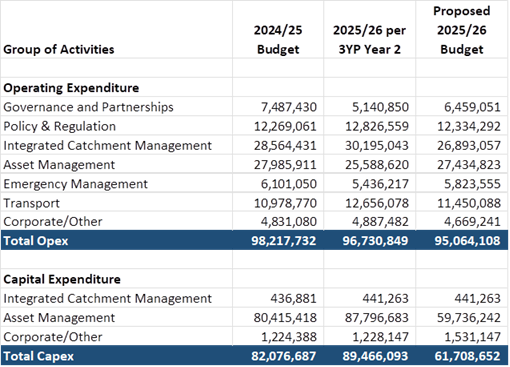
22. The table below summarises
the key financial movements for total expenditure (all revenue sources).
Operating
Expenditure (Opex)
23. Opex has seen a total
decrease of $3.2m from the 2024-25 budget to the proposed budget for 2025-26.
$1.5m of this decrease was approved as part of the Three-Year Plan and included
additional funding for Public Transport $1.7m and $1.6m added back into ICM for
several activities along with a number of other areas where savings made for
2024-25 were phased back into budgets. These were more than offset by the
removal of $1.5m funding for HB Tourism, the end of the UTT gravel extraction
opex funding of $2.7m and one off funding of $1.7m for NIWE scheme reviews.
24. The operating spend budgets
have then been further decreased by $1.7m to get to our proposed 2025-26 annual
plan budgets. The main areas where cuts have been made are: Public Transport
$1.2m to align to the reduced approved funding from Waka Kotahi; $3.3m of
reduced expenditure across ICM (resulting in $1.8m of rating savings); and
savings made across other areas. The opex budgets for three GOAs has increased
– Governance and Partnerships due to higher than expected final
applications in the wind up of sustainable homes (loan funded); Asset
Management for the one off work required on scheme reviews and reimagining
rivers (carbon credit and special dividend funded); and Emergency Management
for transformation costs.
Capital
Expenditure (Capex)
25. Capex has decreased by
$20.4m between the years. $18.5m of this is in relation to improved
understanding of the capital requirements for the Flood Protection schemes as
the preliminary work is completed. Other reductions in Asset Management for
Open Spaces $0.5m and Regional Water Security $1.6m were approved as part of
the Three Year Plan. The only other significant change is $300k added to
corporate for the replacement of the failing air conditioning system. This is
funded from depreciation reserves set aside over previous years.
Consultation
topics
26. Under the Local Government
Act 2002, Councils must prepare a consultation document when proposing
significant or material differences from the long-term plan for the financial
year covered by the proposed annual plan.
27. The Council agreed that
consultation is warranted, because the proposed rates increase of 9.9% plus a
new targeted rate to fund Mangarau Stream flood resilience is materially
different to the 18.3% average rates increase forecast for 2025-26 (Year 2) of the
Three-Year Plan 2024-2027.
28. Although the cumulative
impact of the $4.0 million of rate savings is material, the resulting level of
service impact on any one activity is not significant enough to trigger the
need to consult. However, all aspects that make up the proposed Annual Plan
2025-26 can be submitted on.
29. In addition, the council
must consult on setting a new targeted rate for flood resilience work for
Mangarau Stream, with the funds being passed to Hastings District Council who
own and manage the asset and who will undertake the work. Options for consultation
are the length of time for the rate to be collected.
30. The following are proposed
changes to policies and plans that are being consulted on concurrently:
30.1. Hawke’s Bay Regional
Public Transport Plan 2025-2035, specifically:
30.1.1. later than planned changes to public
bus services
30.1.2. methods for paying for bus
tickets
30.1.3. minor changes to our Total
Mobility Scheme.
30.2. Rates Remission and
Postponement Policies.
30.3. Revenue and Financing
Policy –
the new Mangarau Stream targeted rate, amendments to two targeted rates,
being Passenger Transport and the Upper Tukituki Flood Control Scheme, and
other minor changes.
31. The options (including
Council’s preferred option) to address each of the topics and the
implications in terms of impacts on rates and debt are set out in detail in the
consultation document.
Supporting information
32. Before adopting the
consultation document, the Council is asked to adopt the supporting information
on which the content of the consultation document relies. These documents will
be available to the public during the consultation process and can be submitted
on.
33. At the request of
Councillors, a legal review of the proposed changes to the Revenue and
Financing Policy has been sought. Feedback from the review is incorporated in
the attached version of the marked-up policy and associated Statement of
Proposal.
34. It is proposed that the
Council adopts the following documents as supporting information:
34.1. Statement of proposal to
amend the Draft Hawke’s Bay Regional Public Transport Plan 2025-2035 and
plan showing our proposed changes
34.2. Statement of proposal to
amend the Rates Remission and Postponement Policies and policy showing our
proposed changes
34.3. Statement of proposal to
amend the Revenue and Financing Policy and policy showing our proposed changes
34.4. Explanation of rating
methods.
Consultation and engagement plan
35. This consultation is part
of Regional Council’s broader cross-council engagement plan for 2025.
Consultation will be fit-for-purpose. We are trying to keep space for the
bigger conversations, such as reimaging flood resilience.
36. Section 82 of the Local
Government Act 2004 (LGA) provides the principles of consultation. To meet LGA
requirements and good consultation practice, we will make the consultation
document, draft policies and Draft Hawke’s Bay Regional Public Transport
Plan available to the public online on our new Engagement Hub and in hardcopy
at our Regional Council offices and libraries on or before public consultation
opens on 31 March 2025.
37. Ratepayers will be able to
look up their indicative rates for the coming year on a rates calculator.
Actual rates will not be known until the Annual Plan is adopted in June 2025.
38. We are sending targeted
letters to ratepayers most affected by changes to the Passenger Transport
targeted rate, Upper Tukituki Flood Resilience Scheme targeted rate, and the
new rate for flood resilience work to Mangarau Stream.
39. Consultation for the
Regional Public Transport Plan also includes targeted consultation with
communities and organisations more impacted by proposed route changes and/or
the minor changes to our Total Mobility Scheme.
40. Key dates
include:
|
Date
|
Milestone
|
|
26 March 2026 (today)
|
Council adopts for consultation
|
|
31 March to 2 May 2025
|
Public consultation
|
|
20-21 May 2025
|
Annual Plan hearings
|
|
16 May 2025
|
Regional Transport Committee hearings
|
|
28 May & 4 June 2025 (reserve day)
|
Annual Plan deliberations
|
|
6 June 2025
|
Regional Transport Committee deliberations
|
|
25 June 2025
|
Council adopts the Annual Plan 2025-26 and the Regional Public
Transport Plan.
|
Financial
and resource implications
41. The engagement for this
process is estimated to cost $9,550 excluding GST. Consultation expenses for
the draft RPTP are $3,840 excluding GST.
Decision-making process
42. Council and its committees
are required to make every decision in accordance with the requirements of the
Local Government Act 2002 (the Act). Staff have assessed the requirements in
relation to this item and have concluded:
42.1. The decision to adopt for
consultation is not significant under the criteria contained in Council’s
adopted Significance and Engagement Policy, however adopting the annual plan
and amending policies and the Regional Public Transport Plan is significant
therefore consultation to seek community views is required.
42.2. The decision does not
significantly alter the service provision or affect a strategic asset.
42.3. The decision to consult is
not inconsistent with an existing policy or plan. If Council decides to adopt
the changes proposed in the draft policy, it will replace the existing policy.
42.4. The persons directly
affected by this decision are all communities in Hawke’s Bay.
Recommendations
That Hawke’s Bay Regional Council:
1. Receives and notes the Annual
Plan 2025-26 Consultation staff report.
2. Adopts the following
documents for public consultation, for nearly five weeks from 31 March to 2 May
2025:
2.1. The suite of supporting
information relied on for the content of the consultation document, being:
2.1.1. Statement of proposal to
amend the Draft Hawke’s Bay Regional Public Transport Plan 2025-2035 and
plan showing our proposed changes
2.1.2. Statement of proposal to
amend the Rates Remission and Postponement Policies and policy showing our
proposed changes
2.1.3. Statement of proposal to
amend the Revenue and Financing Policy and policy showing our proposed changes
2.1.4. Explanation of rating
methods.
2.2. Consultation document,
entitled Our resilience-focused Annual Plan 2025-26
3. Delegates final approval of
any further minor editorial changes to the supporting information, amended
policies, draft HB Regional Public Transport Plan 2025-2035 and consultation
document prior to being made available for public consultation to the Chief
Executive.
Authored by:
|
Mandy Sharpe
Senior Corporate Planner
|
Desiree Cull
Strategy & Governance Manager
|
|
Chris Comber
Chief Financial Officer
|
|
Approved by:
Attachment/s online only
|
1⇨
|
AP2526 Statement of Proposal - Regional
Public Transport Plan
|
|
Under Separate Cover
|
|
2⇨
|
AP2526 Regional Public Transport
Plan 202-2035
|
|
Under Separate Cover
|
|
3⇨
|
AP2526 Statement of Proposal - Rates
Remission and Postponement Policies
|
|
Under Separate Cover
|
|
4⇨
|
AP2526 mendments to HBRC Rates
Remission and Postponement Policies
|
|
Under Separate Cover
|
|
5⇨
|
AP2526 Statement of Proposal -
Revenue and Financing Policy
|
|
Under Separate Cover
|
|
6⇨
|
AP2526 amendments to HBRC Revenue
and Financing Policy
|
|
Under Separate Cover
|
|
7⇨
|
AP2526 Explanation of rating method
2025-2026
|
|
Under Separate Cover
|
|
8⇨
|
AP2526 Annual Plan 2025-26
Consultation Document
|
|
Under Separate Cover
|
Hawke’s
Bay Regional Council
26 March
2025
Subject:
Annual Freshwater Science Charges 2024-2025
Reason for report
1. This report seeks a
decision from Council on the approach to take for the Low Flow component of our
Annual Freshwater Science Charges for the 2024-2025 financial year, given the
monitoring activities that HBRC performs.
Staff
recommendations
2. Council staff recommend a
66% remission to the 2024-25 low flow monitoring fee for this financial year,
based on reduced costs of monitoring low flows and limited expenditure for this
activity so far this year.
Executive
Summary
3. The annual fees are
established in the first year of the Long-Term Plan (2024-2025). They are based
on a user pays
system, by which the fees are only charged to cover the costs of the monitoring
activities carried out by HBRC.
4. The costs for monitoring
low river flows this year have been lower than expected, so less money has been
spent on monitoring these events.
Background
/Discussion
5. HBRC has spent less money
this year because it has worked on improving automated monitoring, which helps
lower costs. As a result, HBRC plans to spend less on monitoring in the 2024-25
year. Therefore, we suggest lowering the Low Flows Monitoring fee for 2024-25
to only cover the expected costs for that year.
6. Water science-related
consent charges are set by Section 36 of the Resource Management Act. While fee
reductions can be made under Section 36AAB(1), any lost revenue (beyond the
planned reductions) would need to be balanced by cutting back on water science
monitoring costs or using general funds.
7. Based on today’s
decisions, staff will prepare invoices for consent holders to be issued during
the month of April, with a due date of 20 May 2025.
Options
assessment
8. Two options for changes to
this year’s Low Flow monitoring fees are being proposed for the Council
to consider. These changes will impact the total income for the year. The proposed
fee reductions will align with our current policy, which aims to cover only the
costs directly related to water quality consents.
9. The estimate of the forfeit
revenue from each option is shown in Table 1. The estimate for the fee
reductions is based on the total number of low flow consents affected.
Table 1 – Estimated forfeit revenue from fee
changes.
|
Option
|
Estimate of forfeit revenue
|
|
1
|
Annual
Charges issued as scheduled, no fee remission
|
$0
|
|
2
|
Annual
Charges issued reduced by 66% for low flows monitoring fees and accept fee
remissions by exception from consent holders who are experiencing ongoing
financial hardship due to the cyclone.
|
$62,700
for low flows monitoring
|
Option 1: Annual Charge as scheduled,
no fee remissions
10. All eligible consent
holders are invoiced in line with the first year of the Long-Term Plan
(2024-2025) Fees and Charges schedule, with no fee remissions considered. This
option acknowledges the financial pressure HBRC is experiencing.
11. In addition to this,
consent holders would be advised that we will consider applications for a fees
remission for circumstances where they have experienced significant financial
hardship due to damage caused by Cyclone Gabrielle (e.g. they are physically
unable to exercise their consent and therefore cannot generate revenue).
Option
2: Annual Charge reduced by 66% for low flows monitoring, and remit fees by
exception
12. All eligible water take and
discharge consent holders are invoiced in line with the annual plan fees and
charges schedule of the 2024-27 Three Year Plan.
13. Low flows monitoring is
invoiced at $85 instead of $250 as per the first year of the Long-Term Plan
(2024-2025). This proposed reduction to the annual low flows monitoring charge
would forfeit ~$62,700 in revenue, though the income generated is still expected
to fully recover the current forecast costs incurred for the programme this
financial year.
14. In addition to this,
consent holders would be advised that we will consider applications for a fees
remission for circumstances where they have experienced significant financial
hardship due to damage caused by Cyclone Gabrielle (e.g. they are physically
unable to exercise their consent and therefore cannot generate revenue).
15. The advantage of this option
is that significantly affected consent holders will receive financial relief,
and the collection of fees and charges for low flow monitoring is in line with
the principles of user pays.
Financial
and resource implications
16. Hawke’s Bay Regional
Council is experiencing significant financial pressures as a result of Cyclone
Gabrielle. Any decision to reduce income from fees and charges will add
to this financial pressure.
17. Any agreed reduction in
fees from section 36 low flow charges would first be covered by cutting back on
spending for low flow monitoring activities. Any remaining balance would be
covered by general funds. Right now, there’s been some underspending on
low flow monitoring because of more efficient internal processes and a reduced
need for compliance monitoring.
Decision-making
considerations
18. Council and its committees
are required to make every decision in accordance with the requirements of the
Local Government Act 2002 (the Act). Staff have assessed the requirements in
relation to this item and have concluded:
18.1. The decision does not
significantly alter the service provision or affect a strategic asset, nor is
it inconsistent with an existing policy or plan.
18.2. The use of the special
consultative procedure is not prescribed by legislation.
18.3. The decision is not
significant under the criteria contained in Council’s adopted
Significance and Engagement Policy.
18.4. The persons affected by
this decision are those resource consent holders who pay freshwater science
charges.
18.5. Given the nature and
significance of the issue to be considered and decided, and also the persons
likely to be affected by it, Council can exercise its discretion and make a
decision without consulting with the community.
Recommendations
That Hawke’s Bay Regional
Council:
1. Receives and considers the Annual
Freshwater Science Charges 2024-2025 staff report.
2. Agrees that the decisions
to be made are not significant under the criteria contained in Council’s
adopted Significance and Engagement Policy, and that Council can exercise its
discretion and make decisions on this issue without conferring directly with
the community or persons likely to have an interest in the decision.
3. Agrees that all consent
holders liable for Annual Freshwater Science Charges are invoiced in accordance
with the first year of the Long-Term Plan (2024-2025) Fees and Charges schedule
and accepts requests only for annual freshwater science charges remission from
consent holders experiencing ongoing financial hardship due to Cyclone
Gabrielle.
OR
4. Approves the amendment of
the Annual Freshwater Science Charges approach for the 2024-2025 financial
year, to:
4.1. reduce the Low Flows
Monitoring annual fee for the 2024-2025 financial year to $85 plus GST.
4.2. Charge water take and
discharge consent holders in line with the 2024-27 Three Year Plan.
4.3. accept requests for annual
freshwater science charges remission from consent holders experiencing ongoing
financial hardship due to Cyclone Gabrielle.
Authored by:
|
James Park
Management Accountant
|
Megan McKenzie
Senior Business Partner
|
Approved by:
|
Susie Young
Group Manager Corporate Services
|
|
Attachment/s
There are no attachments for this
report.
Hawke’s
Bay Regional Council
26 March
2025
Subject: Reimagining flood resilience projects
for Upper Tukituki and Heretaunga Plains
Reason for report
1. This paper seeks a decision
from Council to confirm and adopt the updated project approach, timeframes and
structure for the Reimagining Flood Resilience project.
Background
/Discussion
2. Flooding is a significant
and increasing climate risk facing our region. Flooding could be caused by
river flooding, surface (rainfall) flooding, or coastal erosion and
inundation. Exposure and vulnerability to flooding varies depending on a
range of factors.
3. The Regional Council plays
an important role in communities feeling safer and being more resilient to
flooding. HBRC owns and manages 27 flood control, drainage schemes and
river maintenance schemes including river bar openings. Local councils also
play an important role through the provision of infrastructure, such as
stormwater networks.
4. The Regional Council is
working on a range of flood resilience projects at different locations and at
different project phases. For example, some of the ~$250 million NIWE-funded
projects are in the execution phase. The Re-imagining project, which is the
topic of this item, is in the initiation phase.
5. To communicate the
complexity of the Regional Council’s flood resilience work we have
grouped them under three headings:
5.1. North Island Weather Events
(NIWE) Flood Resilience Programme
5.2. Fundamentals
5.3. Planning for our future.
6. The Reimagining Flood
Resilience project sits within the third heading. The project was established
in direct response to the recommendations of the Hawke’s Bay Independent
Flood Review (HBIFR). It is intended to take a long-term view to determine what
flood resilience in Hawke’s Bay might look like in generations to come,
with a focus on the Upper Tukituki and Heretaunga Plains Flood Control Schemes.
7. Through a series of
workshops with Council and discussions with partners and key stakeholders held
from September to December 2024, a proposed approach for the Reimagining Flood
Resilience project was developed.
8. This approach was presented
to Council on 18 December 2024, in the report Reimagining flood Resilience
for the Upper Tukituki and Heretaunga.
9. At the 18 December meeting,
Council accepted the report and directed the Chief Executive to work with
Councillors to establish an effective project structure in collaboration with
staff and project partners.
10. Through further discussions
with Councillors and a workshop held on 26 February 2025, further detail was
developed for the project approach, structure and timeframes. This report
presents the outcome of this work.
Revisions
to project approach
11. The following key revisions
to the project approach emerged through work undertaken since the 18 December
2024 meeting:
11.1. As a significant project
for HBRC, Councillors as decision-makers need to be effectively embedded in the
project
11.2. Councillor Project
Champions (based on constituencies) are to be appointed
11.3. There is a practical need
to move from co-design with project partners (as originally envisioned) to a
collaborative approach in order to increase efficiency and progress
11.4. The Heretaunga Plains and
Upper Tukituki Flood Control Schemes are managed through the project in
separate workstreams to reflect the differences in communities of interest,
scale and complexity
11.5. Stakeholder Reference
Groups are to be formed for each scheme, to provide values-based advice and
guidance on options
11.6. A matrix approach of
high-level options is required to consider options, benefits and costs, and
that this should be utilised to ensure that cost and affordability
considerations are introduced early
11.7. Project timeframes need to
be condensed as much as possible in recognition of the significance and urgency
of this work
11.8. The Reimagining Project
sits within a significant programme of interrelated resilience work being led
by Council. The overall resilience programme and how each package of work fits
needs to be clearly communicated to project partners, stakeholders and communities.
Revised
timeframes
12. An update to project
phasing and timeframes has also been developed, as presented in Table 1.
Table 1: Updated Project Phasing and Timeline
|
Project Phase
|
Timeframe
|
|
Phase
1: Project Design (current phase)
|
September 2024
– June 2025
|
|
Phase
2a: Community socialisation
|
February 2025
– June 2026
|
|
Phase
2b: Stakeholder Reference Groups
|
July 2025 –
December 2025
|
|
Phase
3: Long-term Plan preparation and consultation
|
June 2026 –
June 2027 (HBRC LTP)
|
|
Phase
4: Implementation Programme
|
July 2027 onwards
|
Revised
project structure
13. Tamatea Pōkai Whenua
(TPW), Central Hawke’s Bay District Council (CHBDC), Hastings District
Council (HDC), Mana Ahuriri (MA), Napier City Council (NCC) and Ngāti
Kahungunu Iwi Incorporated (NKII) have been identified by Council as partners
in the Reimagining Project.
14. Two options for project
structure (that is, how project partners are involved and how decision making,
oversight, community input and technical support function together) were
considered at the 18 December 2024 meeting.
15. In accordance with the
resolution passed at that meeting, the Chief Executive, councillors and staff
have worked to further develop the project structure. The outcome of this work
is presented in Figure 1.
16. Discussions on project
structure have also been held with some project partners, are remain ongoing.
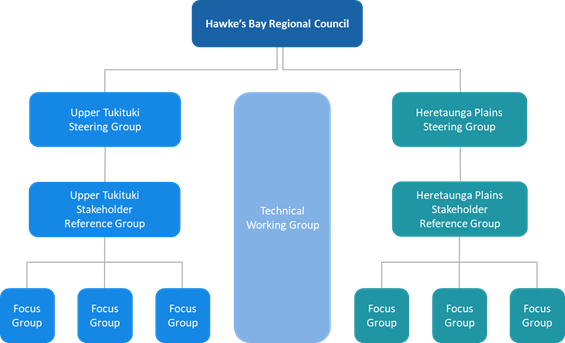
Figure 1: Reimagining Flood Resilience Project Structure
17. The membership and
functions of each element of the revised project structure are described in Table
2.
Table
2: Project Structure Elements
|
|
Membership
|
Role description
|
|
HBRC
|
HBRC elected representatives
|
• Overall
project governance and decision making
|
|
Upper Tukituki Steering Group
|
2 governors appointed from HBRC, TPW, CHBDC
|
• Provide
direct project governance, specific to each scheme
• Facilitate
clear community and partner-derived advice and guidance to HBRC
• Coordination
of Focus Group outputs
• Present
recommendations to HBRC
|
|
Heretaunga Plains Steering
Group
|
2 - 3 governors appointed from HBRC, 2 from TPW, MA,
HDC, NCC
|
| Stakeholder
Reference Group |
One formed for each scheme
Mana whenua and community member based.
Membership by invitation to form a broad representation
of skillsets and knowledge
|
• Provide
values-based advice, specific to each scheme to the relevant Steering Group
• Supported
by technical expertise to consider options (matrix approach)
• Review
and consider options including costs
|
|
Focus Groups
|
Number and membership to be confirmed through further
discussion with Steering Group and Stakeholder Reference Group.
|
• A forum
for detailed discussions with a particular community, place, landowner,
sector etc.
• Provide
advice to Stakeholder Reference Group
|
|
Technical Working Group
|
Senior staff (1-3) appointed from HBRC, TPW, NKII, MA,
NCC, HDC, CHBDC
Organisational Lead identified from each member
organisation
|
• Provide
technical guidance and support for SGs, SRGs and FGs
• Support
reporting and advice to HBRC
• Support
reporting and advice to TAs + PSGEs
|
|
Project Control Group (PCG)
|
Not shown in diagram.
Internal HBRC staff group
|
• Primary
project oversight and project management function
|
Strategic fit
18. This project directly
contributes to the achievement of Regional Council’s infrastructure and
services focus area, specifically sustainable and climate-resilient services
and infrastructure.
19. This project is also a
direct response to recommendations from the HBIFR.
Climate
change considerations
20. The Reimagining Project is
intended to take a long-term view, to determine what flood resilience in
Hawke’s Bay might look like in generations to come.
21. Any future options for
flood resilience in the region must take into account the impact of climate
change and mitigate against its effects on the economic, social and cultural
wellbeing of the Hawke’s Bay community wherever possible.
Considerations
of tangata whenua
22. Initial discussions have
been held with Tamatea Pōkai Whenua, Mana Ahuriri and Ngāti Kahungunu
Iwi Incorporated as the three PSGEs identified as project partners. Further
discussion is required to confirm preferences for project involvement.
23. On 6 March 2025 a
presentation and workshop was held with the Māori Committee, who have
requested a wananga on the project as a follow up action.
24. The Reimagining Project has
also been selected as a pilot for HBRC’s Mātauranga Framework.
25. Through these discussions,
and as highlighted by the HBIFR, effective engagement with tangata whenua will
be critical to project success. This is likely to involve engagement at
multiple levels, including Whenua Māori, marae, hapu, PSGE, etc.
26. HBRC’s Māori
Partnerships team are embedded in and supporting the project.
Financial
and resource implications
27. Project financial
requirements were presented and considered at the 19 December 2024 meeting.
28. There are no additional
financial or budget implications from the decisions sought by this agenda item.
Consultation
29. Further engagement is
required with all project partners to confirm their willingness and capacity to
participate as proposed in the revised project structure.
Decision-making considerations
30. Council and its committees
are required to make every decision in accordance with the requirements of the
Local Government Act 2002 (the Act). Staff have assessed the requirements in
relation to this item and have concluded:
30.1. The decision does not
significantly alter the service provision or affect a strategic asset, nor is
it inconsistent with an existing policy or plan.
30.2. The use of the special
consultative procedure is not prescribed by legislation.
30.3. The decision is not
significant under the criteria contained in Council’s adopted
Significance and Engagement Policy.
30.4. The persons affected by
this decision are the wider Hawke’s Bay Community and rate payers.
30.5. Given the nature and
significance of the issue to be considered and decided, and also the persons
likely to be affected by, or have an interest in the decisions made, Council
can exercise its discretion and make a decision without consulting directly with
the community or others having an interest in the decision.
Recommendations
That Hawke’s Bay Regional
Council:
1. Receives and considers the Reimagining
flood resilience projects for Upper Tukituki and Heretaunga Plains staff
report.
2. Agrees that the decisions
to be made today are not significant under the criteria contained in
Council’s adopted Significance and Engagement Policy, and that Council
can exercise its discretion and make the relevant decisions knowing that
consultation and engagement with the public will be undertaken throughout the
course of the Upper Tukituki and Heretaunga Plains flood resilience projects.
3. Confirms and adopts the
revised project approach, timeframes and structure as outlined in the Reimagining flood
resilience projects for Upper Tukituki and Heretaunga Plains staff report.
4. Appoints councillors
__________________ and __________________ to the Upper Tukituki Steering Group
5. Appoints councillors
__________________, __________________ and __________________ to the Heretaunga Plains Steering Group.
Authored by:
|
Simon Bendall
Project Lead - Traverse
Environmental
|
Desiree Cull
Strategy & Governance Manager
|
|
Louise McPhail
Manager Recovery (Asset Management)
|
|
Approved by:
|
Chris Dolley
Group Manager Asset Management
|
|
Attachment/s
There are no attachments for this
report.
Hawke’s
Bay Regional Council
26 March
2025
Subject: Draft HBRIC Statement of
Intent 2025-2026
Reason for report
1. Under the Local Government
Act 2002 (LGA), Section 64(1) and Schedule 8, every Council-Controlled Trading
Organisation (CCTO) is required to prepare and adopt an annual Statement of
Intent (SOI). The legislative timeframe for submission and approval is as
follows:
1.1. By 1 March 2025 –
HBRIC submits a draft SOI to HBRC for review
1.2. By 1 May 2025 – HBRC
provides feedback and proposed changes to HBRIC
1.3. By 30 June 2025 –
HBRIC submits the final SOI for HBRC’s approval.
2. The purpose of the SOI is
to outline HBRIC’s strategic objectives, financial and non-financial
performance targets, governance framework, and reporting obligations for the
2025/26 financial year.
Staff
recommendation
3. HBRIC invites HBRC
Councillors to review the draft Statement of Intent 2025/26 and provide any feedback
or suggested changes to HBRIC Directors.
Discussion
2025/26 Statement of Intent.
4. To meet Local Government
Act 2002 (LGA) legislative timeframes, the Hawke’s Bay Regional
Investment Company (HBRIC Ltd) is required to submit its Draft Statement of
Intent (SoI) to Council (as shareholder) by 1 March each year for feedback.
Key
Changes in the Draft 2025/26 SOI
5. A comparison of the current
(2024/25) and proposed (2025/26) SOI’s highlights several material
changes:
Expression
of more defined and specific Financial Performance Targets
5.1. A 7% total investment
return target for managed funds, with a 2.5% capital protection requirement to
preserve the real value of assets.
5.2. Dividend expectations for
FY26 set at $13.3 million, with a provisional contribution to the
Dividend Resilience Reserve [$1m.], subject to full year performance.
Expansion
of HBRIC’s Investment Oversight Role
5.3. The SOI extends beyond
HBRIC’s own investments to provide a ‘Group’ view of
Council’s investment assets.
5.4. This reflects the
recently-expanded investment mandate, which now includes HBRIC’s
oversight of Council-owned investment assets (e.g., financial and property
assets).
5.5. The Group Investment
Portfolio approach is designed to improve strategic asset management and
financial reporting across Council’s investments.
Strengthened
Governance & Reporting Framework
5.6. Formal annual investment
performance reviews are now required for managed funds, real
assets, and other investment assets.
Napier
Port Oversight & Reporting
5.7. HBRIC’s majority
shareholding (approx. 55%) remains unchanged
5.8. A requirement for 2
investor presentations annually by Napier Port representatives to HBRIC or HBRC
has been introduced.
Legislative Compliance
6. The proposed SOI is
compliant with the Local Government Act 2002, meeting all requirements
under Section 64(1) and Schedule 8, including:
6.1. Statement of strategic
objectives and governance approach
6.2. Performance measures and
financial targets
6.3. Distributions and dividend
expectations
6.4. Reporting obligations and
shareholder engagement processes
7. Per above, the SOI extends
beyond the strict statutory requirements by incorporating a Group-wide
perspective on investment management.
Suitability
of Performance Measures from a Commercial/Investment Perspective
Dividend and distribution expectations
8. The $13.3m dividend target
for FY26 provides a clear cash return expectation for Council
9. The ‘Dividend
Resilience Reserve’ ($1m minimum annual growth) provides Council with
greater resilience in the face of investment income volatility and sub-optimal
portfolio diversification due to the requirement to maintain majority ownership
of Napier Port.
Stronger
risk management & diversification approach
10. The requirement for annual
investment reviews ensures regular assessment of portfolio risk and
performance.
11. The SOI acknowledges the
need to diversify the portfolio over time, aligning with long-term financial
resilience goals.
Alignment
with Strategic Objectives
12. The commitment to
responsible investment principles aligns with HBRC’s strategic
vision.
Next steps
13. HBRIC invites HBRC
councillors to review the draft Statement of Intent 2025/26 and provide any feedback,
guidance or suggested changes to HBRIC Directors.
14. This feedback will be
incorporated into the final SOI, which will be submitted to Council for
approval before 30 June 2025.
Strategic fit
15. The SOI looks to deliver
Council’s investment strategy under their investment policy as outlined
in the 2024-27 Long Term Plan.
Financial
and resource implications
16. The SOI seeks to outline
the expected performance of the Group Investment assets as outlined in
Council’s Statement of Expectation and 2024-27 Long Term Plan.
Failure to deliver the proposed returns will impact on Council’s ability
to provide its BAU operations.
17. Should assets under-perform
it may be necessary to consider utilising capital to fund Council operations.
Decision-making considerations
18. Council and its committees
are required to make every decision in accordance with the requirements of the
Local Government Act 2002 (the Act). Staff have assessed the requirements in
relation to this item and have concluded:
18.1. The decision does not
significantly alter the service provision or affect a strategic asset, nor is
it inconsistent with an existing policy or plan.
18.2. The use of the special
consultative procedure is not prescribed by legislation.
18.3. The decision is not
significant under the criteria contained in Council’s adopted
Significance and Engagement Policy.
18.4. There are no persons
affected by this decision.
18.5. Given the nature and
significance of the issue to be considered and decided, and also the persons
likely to be affected by, or have an interest in the decisions made, Council
can exercise its discretion and make a decision without consulting directly with
the community or others
having an interest in the decision.
Recommendations
That Hawke’s Bay Regional
Council:
1. Receives and considers the draft
HBRIC Statement of Intent 2025-2026 staff report.
2. Agrees that the decisions
to be made are not significant under the criteria contained in Council’s
adopted Significance and Engagement Policy, and that Council can exercise its
discretion and make decisions on this issue without conferring directly with
the community or persons likely to have an interest in the decision.
3. Provides feedback on the
draft 2025-26 HBRIC Statement of Intent in accordance with requirements in the
Local Government Act (2002).
Authored by:
|
Tom Skerman
HBRIC Ltd Commercial Manager
|
Tracey O'Shaughnessy
Treasury & Investments
Accountant
|
Approved by:
|
Susie Young
Group Manager Corporate Services
|
|
Attachment/s
|
1⇨
|
Draft HBRIC SoI 2025-26 for HBRC
feedback
|
|
Under Separate Cover
|
Hawke’s
Bay Regional Council
26 March
2025
Subject: Wairoa NIWE project next
steps
Reason for report
1. This item provides the
Council with:
1.1. an update (as was requested
at the Council meeting on 13 February 2025) on the original proposed solution
of Option 1C for the flood mitigation in Wairoa, including a recommendation to
revise the adopted alignment solution for the proposed spillway to Option 1C
Plus (Option 1C+).
1.2. a request for approval to proceed
with a Project Delivery Plan submission to the Crown for approval and granting
the $70m funding reserved for the Wairoa Flood Protection Scheme.
1.3. Identification of the
critical next steps for the project, particularly regarding working with
landowners.
2. Given the project’s
scale and its potential to significantly enhance the safety and resilience of
Wairoa community, including the need to progress with the Crown funding
agreement with urgency to meet Ministerial funding timeframes, this decision is
of paramount importance to both the local community and the broader region.
Staff
recommendations
3. Staff recommend that
councillors consider the information presented in this agenda item to inform
the Council decisions necessary for the project to proceed.
4. Further, staff recommend
that Council adopts the refined Option 1C Plus as the updated and preferred
option for flood mitigation works for the area of the Wairoa township in
Category 2C. Noting this is a change to the adopted 1C solution adopted by
Council at their meeting on 13 February 2025.
5. The Council is also asked
to acknowledge that the preferred option will only proceed upon completion of:
5.1. The approval of a Project
Delivery Plan that satisfies the requirements of the Crown and relevant
Ministers.
5.2. Land access being secured
to enable the delivery of the preferred option.
6. Staff will report to
Council on the progress of key project milestones.
Executive
summary
7. On 13 February 2025,
Councillors resolved:
|
RC12/25
|
Resolutions
That Hawke’s Bay
Regional Council:
1. Receives and
considers the North Island Weather Events- Wairoa Flood Mitigation
staff report.
2. Agrees that
given the nature and significance of the issues to be considered and
decided, and reflecting on the community engagement to date, Council has sufficient
understanding of the views and preferences of interested parties and affected
persons to enable it to make the relevant decisions without consulting
further with the community at this time.
3. Notes that investigation of options for flood mitigation for North
Clyde (Category 2C) have been completed to a stage where a preferred option
has been identified.
4. Notes that work has been guided by the Tripartite Group, and the Crown
Manager supported by the Wairoa Flood Mitigation Project Stakeholder Group.
5. Adopts Option 1C as the preferred option for flood mitigation for the
Category 2C area of Wairoa as it provides the best possible mitigation within
budget.
6. Directs the project team to complete a Project Development Plan for
submission to the Crown based on Option 1C with sufficient scope for option
refinement to minimise the impacts on whenua Māori.
7. Agrees that
the next step in the project, working with the Crown Manager and the
Tripartite Partners, is to continue to refine the spillway profile and
alignment to minimise the impact of option 1C on impacted landowners so as to
maximise the probability of securing land access necessary to allow the
project to proceed, and then to engage with impacted landowners in the 1C
Option area to determine the probability of securing land access necessary to
allow the project to proceed.
8. Notes that
land access will be secured in accordance with the Public Works Act 1981.
9. Notes that
land access over Māori Freehold land will be secured in accordance the
Te Ture Whenua Māori Act 1993, and that the Māori Land Court and Te
Tumu Paeroa are already engaged in this process.
10. Thanks mana whenua, the Wairoa community,
landowners and homeowners, the Stakeholder Group, the Tripartite Group and
the Crown Manager for their work in reaching this step in the project.
11. Instructs the
Chief Executive, and requests that the Crown Manager, to regularly update
Council and other Tripartite Partners on the progress being made to minimise
the impact of option 1C on impacted landowners.
12. Instructs the
Chief Executive that any material changes to option 1C are to be further
considered by Council after consideration by the Tripartite Partners.
Roadley/Lambert
CARRIED
|
8. Over the last four weeks,
the project team and the Crown Manager have been working at pace to explore a
refinement to the spillway profile and alignment, to minimise the impact of
option 1C on impacted landowners so as to maximise the probability of securing
land access necessary to allow the project to proceed. Through this refinement
process, a refined option – being called Option 1C+ - has been
identified.
9. Option 1C+ has now been
supported by Wairoa District Council in a letter of endorsement from Mayor,
Craig Little, dated 19 March 2025, and a letter from the Crown Manager dated 18
March 2025 (attached).
10. The project team is now
seeking approval to proceed with a refined Option 1C+ as the preferred solution
for Wairoa’s flood mitigation based on the following reasons.
10.1. Hydraulic efficiency: Like Option 1C, Option
1C+ follows a similar direct overland path, aligning with historical flood
patterns and providing an efficient hydraulic solution.
10.2. Reduced impacts to whenua
Māori:
Option 1C+ impacts two hectares of whenua Māori, which is a third of the
total area of whenua Māori impacted by Option 1C, and only 7 parcels as
opposed to 20.
10.3. Reduced number of impacted
homes:
Option 1C+ impacts eight individual homes, which is half the number of homes
impacted by Option 1C.
10.4. Land Area: Option 1C+ currently
incorporates approximately 31ha of land as opposed to 24ha in Option 1C, but
most is rural farmland as opposed to smaller land blocks.
10.5. Cultural impact: Like Option 1C, Option 1C+
aims to avoid sites of cultural significance. There are two impacted urupā
in 1C+ and ongoing engagement is occurring as design plans progress. Further
cultural assessment activity is underway to ensure Option 1C+ continues to
appropriately protect marae, urupā and cultural taonga.
11. As such the project team
suggests that Council makes new resolutions to replace 5 and 6 of the original
resolutions as follows:
11.1. Adopts Option 1C+ as the
preferred option for flood mitigation for the Category 2C area of Wairoa as it
provides the best possible mitigation within budget and minimises impacts on
whenua Māori, whānau, home and landowners where possible.
11.2. Directs the project team to
complete a Project Development Plan
for submission to the Crown based on Option 1C+ with sufficient scope for
option refinement to minimise the impacts on whenua Māori and other
landowners.
12. The project team is
continuing to engage with all potentially impacted whānau, home and
landowners, and in particular engagement with whenua Māori with the
support of the Māori Land Court
Figure 1: Refined Option 1C+ alignment against Option 1C
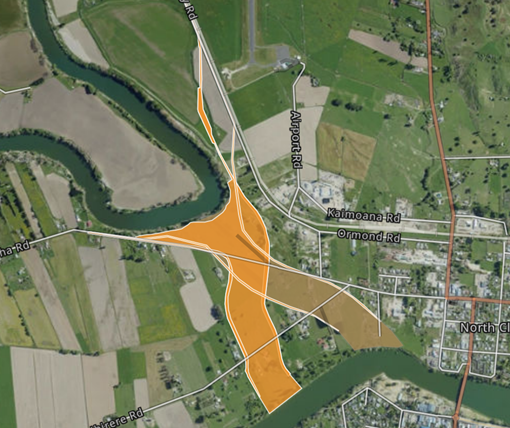
13. A comparison of key changes
from Option 1C to Option 1C+ is outlined Table 1.
Background
/Discussion
14. As part of the Flood
Mitigation programme of works with the Crown, the Wairoa Flood Mitigation
project was allocated $70 million, which is 100% Crown funded, with Council
taking the funding risk for actual project costs exceeding the Crown‘s
capped contribution.
15. The main purpose of the
funding allocation is to mitigate flood risk for Category 2C residential
properties, however, noting that 626 (residential, commercial, industrial and
rural) properties in North Clyde and Frasertown areas of Wairoa will receive the
benefit of the flood infrastructure.
16. The total property numbers
in the Category 2C Areas can be summarised as follows:
16.1. Number of properties = 626
(380 residential with dwellings, 120 residential with no dwelling, remaining
commercial, industrial and rural)
16.2. Number of residential
properties = 500 (approximately)
16.3. Number of residential
properties with dwellings = 380
16.4. Number of residential
properties with no dwelling = 120
16.5. Number of properties with
$0 improvement value = 140
16.6. Total Land Value =
$65,638,400
16.7. Total Capital Value =
$188,345,300
16.8. Total Improvement Value =
$122,706,900.
17. Since 2023, 18 long-list
options were identified, and then considered and assessed via a multi- criteria
analysis led by Council’s contracted engineering service providers. Of
these options, 6 were recommended from the long list, plus 4 additional floodway
options or combinations.
18. This has included seeking
input from subject matter experts and a peer review of short-listed options.
Subsequently the Crown is conducting its own independent peer review of the
Wairoa Flood Mitigation process also.
19. At the 15 August 2024
Stakeholder Group Meeting, the members considered the shortlist options, with
support from technical experts, resulting in their support for the 2 options of
Option 1C and a refined version of Option 1D where secondary inundation impacts
are minimised. It was agreed that these be forwarded to the Tripartite partners
for their consideration.
20. Option 1C has been
subsequently considered since the 13 February meeting primarily seeking to
mitigate further land-owner impacts. Thus, a refined option 1C which is now
called Option 1C+ and is the subject of this paper.
21. A summary of changes as a
full comparison of Option 1C to Option 1C+ is outlined below for Council
awareness of the proposed differences to the assessment criteria, such as cost,
constructability, effectiveness, overdesign events and climate change, cultural
impacts and consenting.
22. At the Council meeting on
13 February, the representative of the Board of Tātau Tātau o te
Wairoa advised that for reasons of tikanga (principally that landowners need to
speak for themselves about their whenua) that they did not support an option at
this stage but would continue to support Māori landowners through this
process. A change from Option 1C to Option 1C+ is not expected to change their
position.
Key Changes from Option 1C and 1C+
Comparison
23. Note: this analysis is as
at the time of this report being written. Staff continue fine tuning estimated
costs, designs and other project components.
24. It is also important to
note that the Ski Club stop bank/protective structures will be required for
both options and have been incorporated in the 6 key criteria.
25. Refer to Table 1:1 for
analysis.
Table 1 – Change Comparison 1C to 1C+.
|
Criteria
|
Option 1C (as noted 13
February 2025)
|
Option 1C+ (now proposed)
|
|
Cost comparison
Slight Change
|
Total project cost estimate of $69.7m, inclusive of
contingencies of 35% for construction and 25% for land access
|
Total project cost estimate of $70m inclusive of
contingencies of 35% for construction and 25% for land access
|
|
Constructability
Positive Change
|
Geotechnical investigations and material testing has
been conducted across the footprint and has been used to assess the
availability of suitable material, ground conditions, including water table
depth. Based on these reports there is sufficient suitable material for this
option. Due to the depth of excavation and high-water table, additional time
and cost is required. A cost-effective method has been found for the disposal
of the surplus cut to waste material.
|
Geotechnical investigations and material testing
completed for previous options across the footprint and has been used to
assess the availability of suitable material, ground conditions including
water table depth are expected to be comparable for this option. A
cost-effective method has been found for the disposal of the surplus cut to
waste material which is less than Option 1C and has a decrease in the depth
of cut of the spillway improving constructability and drainage concerns.
|
|
Effectiveness
The assessment considers the impacts of a 1 in 100 year
event on not only the area that receives the benefit of the flood
infrastructure but the remaining surrounding area.
No change
|
This option will result in 10ha of land negatively
(worse off) affected by flooding compared to doing nothing, 513ha of land
positively affected (better off) by flooding compared to doing nothing. It is
noted that the spillway in Option 1C is the closest to the natural course the
river is taking in flooding events.
|
Early Modelling shows similar results to 1C however
more detailed assessment is required to quantify results.
|
|
Overdesign and Climate Change
Cyclone Gabrielle was assessed as a 1 in 70 year flood
event in Wairoa, while other areas in Hawke’s Bay experienced much more
significant events. When modelling the options, we have allowed for a larger
event than what occurred during Cyclone Gabrielle, being a 1 in 100 year
(current climate, base on post cyclone)
Yet to be confirmed
|
This option, in a 1% AEP +12% climate change river flow
situation will result in a building flood hazard increase of 2 buildings in
North Clyde and 27 in Wairoa, whereas the number of buildings where the flood
hazard has decreased is 520 in North Clyde and 22 in Wairoa.
|
Early Modelling shows similar results to 1C, however,
more detailed assessment is required to quantify results.
|
|
Cultural impacts
Positive Change
|
Cultural Impact Assessment (CIA) highlights the impacts
of excavation and building work at or near the site of Pā Koutu (Kautu),
work occurring around the residence of Te Kautu and the exit of the spillway
occurring in the same area, and work in close vicinity to Tawhiti a Maru
Marae.
|
This option aims to avoid parts of the Takitimu Marae
complex and provide protection to 2 x urupā.
|
|
Consenting
Negative Change
|
The current Order in Council (OIC) allows for most of
the area required for this option. An -application to increase the boundary
may be required if the boundaries of the spillway cannot be adjusted to fall
within the OIC area.
|
This option is largely outside the OIC footprint
requiring a new OIC or alternative consenting pathway.
|
|
Land Access
Positive Change
|
Total impacted properties: 73
Māori Freehold parcels: 20
General Title parcels: 49
WDC parcels: 5
Other parcels: 4
No. of impacted houses: 16
Area of whenua Māori impacted: 6ha
Area of Gen. title land impacted: 18ha
Area of land impacted: 24ha
Area of whenua Māori protected: 46ha
Area of Gen. title land protected: 298ha
Area of land protected: 344ha
|
Total impacted properties: 56
Māori Freehold parcels: 7
General Title parcels: 41
WDC parcels: 5
Other parcels: 4
No. of impacted houses: 8
Area of whenua Māori impacted: 2ha
Area of Gen. title land impacted: 29ha
Area of land impacted: 31ha
Area of whenua Māori protected: 49ha
Area of Gen. title land protected: 302ha
Area of land protected: 351ha
|
Strategic fit
26. The Wairoa Flood Mitigation
project aligns with the Strategic Plan 2020-2025 Outcomes, Goals, and Actions
(pages 12-15). This project contributes towards achieving the strategic goal of
sustainable and climate-resilient services and infrastructure, through increasing
flood protection levels to provide practical and affordable protection to our
communities.
27. This project contributes to
Council’s community outcomes of
27.1. Resilient Community –
Our
communities are prepared for natural hazards, supported by planning and
infrastructure, partnerships and knowledge sharing on the increasing effects of
climate change.
27.2. Prosperous Community
– Our
communities thrive from high-performing regional infrastructure that enables
the region's natural and human resources to deliver goods and services that
underpin prosperity and wellbeing.
28. In addition to the
Strategic Plan 2020-2025, this project contributes towards achieving a
resilient and prosperous community as part of the Infrastructure Strategy in
our Three-Year Plan 2024-2027.
Significance
and Engagement Policy assessment
29. The Wairoa Flood Mitigation
project holds a high level of significance as it directly impacts the safety,
well-being, and economic stability of the Wairoa region. According to
Council’s Significance and Engagement Policy (SEP) contained in the Long
Term Plan (pg. 208), the significance of this project is assessed as high.
30. This high level of
significance necessitates extensive community engagement to ensure that the
views and concerns of all stakeholders are adequately considered.
31. The project has involved
extensive engagement and collaboration with various community groups, including
the Stakeholder Group, which provides a platform for representative views from
different sections of the community.
32. The Crown Manager’s
team has made substantial progress in this area with the full knowledge,
support and agreement of Council.
33. The project team and the
Crown Manager’s team acknowledge there is ongoing engagement required to
ensure full compliance with our policy and other statutory obligations,
including those under the Local Government Act 2002 (LGA), Public Works Act 1981
(PWA), Te Ture Whenua Māori Act 1993 and the Order in Council (OIC),
specifically in relation to land access and satisfy the conditions of the OIC.
Other considerations
34. The Crown Manager is
recommending to Council that it proceed, with a refined Option1C+ as the
preferred solution for Wairoa’s flood mitigation based on the following
reasons:
34.1. Hydraulic efficiency: Like
Option 1C, Option 1C+ follows the most direct overland path, aligning with
historical flood patterns and providing an efficient hydraulic solution.
34.2. Reduced impacts to whenua
Māori: Option 1C+ impacts two hectares of whenua Māori, which is only
a third of the total area of whenua Māori impacted by Option 1C.
34.3. Reduced number of impacted
homes: Option 1C+ impacts eight individual homes, which is half the number of
homes impacted by Option 1C.
34.4. Cultural impact: Like
Option 1C, Option 1C+ avoids sites of cultural significance, such as the
Makeakea urupā, as identified in the Cultural Impact Assessment (CIA). It
is worth noting that further cultural assessment activity is underway to ensure
Option 1C+ continues to protect marae, and take full account of urupā and
cultural taonga.
35. The Crown Manager also
wishes to acknowledge that the direct engagement with potentially impacted
whānau, home and landowners is ongoing. This includes engagement with
owners of whenua Māori, with the support of the Māori Land Court.
36. Furthermore, the Crown
Manager recommends, while this engagement continues, that Council proceed with
Option 1C+ and:
36.1. finalise a Project Delivery
Plan (PDP) based on this option,
36.2. submit the plan to the
Crown for approval, and
36.3. secure the $70 million of
funding allocated for flood mitigation in Wairoa.
Decision-making considerations
36.4. Council and its committees
are required to make every decision in accordance with the requirements of the
Local Government Act 2002 (the Act). Staff have assessed the requirements in
relation to the decisions for this item and have concluded:The decision does
not relate to a strategic asset, as listed in the Council’s Significance
and Engagement Policy.
36.5. The decision will involve
the commencement of a new significant activity, being flood protection works
for Wairoa. This type of decision needs to be provided for in the
Council’s Long-Term Plan (LTP), and for that reason – while the
Council had not yet determined its preferred option – it included
provision for this project, and others, in the 3-year LTP 2024-2027. As a
result, this decision is not inconsistent with any existing Council policy or
plan.
36.6. The use of the special
consultative procedure is not required in this situation, as provision for the
decision has been included in the existing LTP.
36.7. The decision is significant
under the criteria contained in Council’s adopted Significance and
Engagement Policy.
36.8. The persons affected by
this decision are the Wairoa residents, mana whenua, property and business
owners, whenua Māori owners and visitors to Wairoa.
36.9. Given the nature and
significance of the issue to be considered and decided, and reflecting on
the community engagement to date. It can be concluded that Council has
sufficient understanding of the views and preferences of interested
parties/affected persons so that it can make the decision without any further
consultation.
Recommendations
That Hawke’s Bay Regional
Council:
1. Receives and considers the Wairoa
NIWE project next steps staff report.
2. Agrees that the decisions
to be made are not significant under the criteria contained in Council’s
adopted Significance and Engagement Policy, and that Council can exercise its
discretion and make decisions on this issue without conferring directly with
the community or persons likely to have an interest in the decision.
3. Rescinds the 13 February
2025 resolutions 5 and 6, and:
3.1. Adopts Option 1C+ as the
preferred option for flood mitigation for the Category 2C area of Wairoa as it
provides the best possible mitigation within budget and minimising impacts on
whenua Māori, whānau, home and landowners where possible.
3.2. Directs the project team to
complete a Project Development Plan
for submission to the Crown based on Option 1C+ with sufficient scope for
option refinement to minimise the impacts on whenua Māori.
Authored by:
|
Andrew Caseley
Manager Regional Projects /
Programme Director IPMO
|
Jess Bennett
Programme Finance & Controls
Manager
|
Approved by:
|
Chris Dolley
Group Manager Asset Management
|
|
Attachment/s
|
1⇩
|
19 March 2025 Wairoa District
Council letter of support for option 1C+
|
|
|
|
2⇩
|
18 March 2025 Crown Manager letter
of recommendation - Option 1C+
|
|
|
|
19 March 2025 Wairoa District Council
letter of support for option 1C+
|
Attachment
1
|
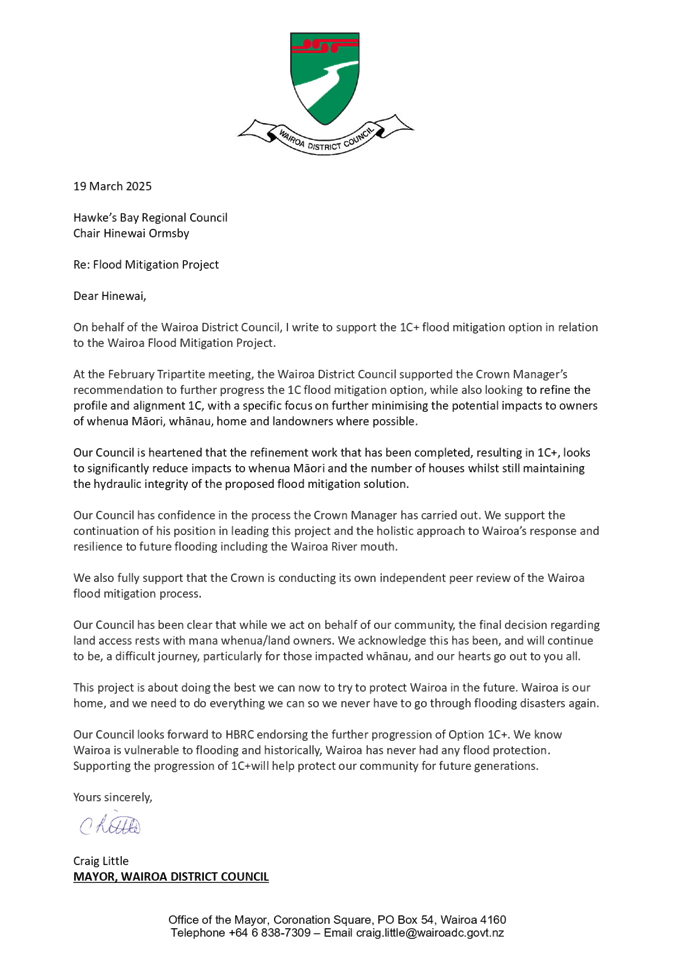
|
18 March 2025 Crown Manager letter of
recommendation - Option 1C+
|
Attachment
2
|
Hawke’s Bay Regional
Council
26 March 2025
Subject: Whirinaki NIWE project next
steps
1. That
Hawke’s Bay Regional Council excludes the public from this section of the
meeting, being Agenda Item 12 Whirinaki NIWE project next steps with the
general subject of the item to be considered while the public is excluded. The
reasons for passing the resolution and the specific grounds under Section 48
(1) of the Local Government Official Information and Meetings Act 1987 for the
passing of this resolution are:
|
General
subject of the item to be considered
|
Grounds
under section 48(1) for the passing of the resolution
|
Reason
for passing this resolution
|
|
Whirinaki NIWE project
next steps
|
s7(2)(c)(ii) Excluding
the public is necessary to prevent disclosure of information which is subject
to an obligation of confidence (or which any person has been or could be
compelled to provide) and would damage
the public interest.
s7(2)(j) Excluding the public is necessary to prevent the
disclosure or use of official information for improper
gain or improper advantage.
s7(2)(i) Excluding the
public is necessary to enable the local authority holding the information to carry out, without prejudice or disadvantage, negotiations (including commercial and industrial negotiations).
|
The public interest is served by
continuing negotiations. This process is confidential between the parties and
the information being made public would significantly prejudice those
negotiations and could lead to a poor outcome for ratepayers
The information could be exploited by
various parties for financial or other advantages, such as property
speculation on property values in the affected areas and market manipulation
by commercxial interests in contracts arising in associated industries.
Ongoing negotiations to achieve favourable
outcomes for HBRC ratepayers and communities could be jeopardised or unfairly
influenced.
|
2. That the outcomes of
negotiations are made public as soon as practicable once negotiations have
concluded.
Authored
by:
|
Andrew Caseley
Manager Regional Projects /
Programme Director IPMO
|
Jess Bennett
Programme Finance & Controls
Manager
|
|
Susie Young
Group Manager Corporate Services
|
|
Approved by:
|
Chris Dolley
Group Manager Asset Management
|
|
Hawke’s
Bay Regional Council
Wednesday
26 March 2025
Subject: Confirmation of Public Excluded Minutes
That
Hawke’s Bay Regional Council excludes the public from this section of the
meeting being Confirmation of Public Excluded Minutes Agenda Item 13
with the general subject of the item to be considered while the public is
excluded. The reasons for passing the resolution and the specific grounds under
Section 48 (1) of the Local Government Official Information and Meetings Act
1987 for the passing of this resolution are:
|
General
subject of the item to be considered
|
Reason
for passing this resolution
|
Grounds
under section 48(1) for the passing of the resolution
|
|
HBRIC Chair succession
|
In considering the
appointment of the HBRIC Chair’s successor, the experience and qualifications
of the candidate will be discussed.
|
s7(2)(a) Excluding the
public is necessary to protect the privacy of natural persons
|
|
Regional Water Security
|
Sensitive commercial and
pricing information in the report has the potential to adversely impact
commercial negotiations and, at this preliminary stage, may be misrepresented
publicly and negatively impact the project’s ongoing commercial
negotiations.
Further, deliberations
have the potential to impact the privacy of landowners, and commercial
arrangements between the Council and the Crown under current, amended or
future funding proposals.
|
s7(2)(f)(ii) Excluding
the public is necessary to maintain the effective conduct of public affairs
by protecting councillors and/or council employees and contractors/
consultants from improper pressure or harassment
s7(2)(i) Excluding the
public is necessary to enable the local authority holding the information to
carry out, without prejudice or disadvantage, negotiations (including
commercial and industrial negotiations)
s7(2)(j) Excluding the
public is necessary to prevent the disclosure or use of official information
for improper gain or improper advantage
|
|
Regional Deals -
Expression of Interest for Hawke's Bay
|
The Department of
Internal Affairs acknowledges that all parties are expected to treat
proposals in confidence as they may contain confidential and commercially
sensitive information. All parties will keep the information
confidential, unless obliged to disclose it (such as by law under the
Official Information Act 1982 (OIA) or the Local Government Official
Information and Meetings Act 1987 (LGOIMA)), or until it no longer remains
confidential (such as being agreed to in a Memorandum of Understanding).
Where a relevant OIA or LGOIMA request is received, each party must consult
with each other.
The information is still
the subject of further negotiations both regionally and with the Crown.
|
s7(2)(c)(ii) Excluding
the public is necessary to prevent disclosure of information which is subject
to an obligation of confidence (or which any person has been or could be
compelled to provide) and would damage the public interest
s7(2)(i) Excluding the
public is necessary to enable the local authority holding the information to
carry out, without prejudice or disadvantage, negotiations (including
commercial and industrial negotiations)
|