Meeting of the
Hawke's Bay Regional Council
Date: 25 January 2023
Time: 1.30pm
|
Venue:
|
Council
Chamber
Hawke's
Bay Regional Council
159
Dalton Street
NAPIER
|
Agenda
Item Title Page
1. Welcome/Karakia/Apologies/Notices
2. Conflict
of Interest Declarations
3. Confirmation of Minutes of
the Regional Council meetings held on 30 November and 14 December 2022
4. Call
for minor items not on the Agenda 3
Decision
Items
5. Climate
Action Joint Committee Terms of Reference 5
6. Hearings
Committee 15
7. Council
submissions on the Spatial Planning Bill and the Natural & Built
Environments Bill 21
8. Register
of members’ pecuniary interests 27
9. Affixing
of Common Seal 41
Information
or Performance Monitoring
10. Strategic
projects report for the period 1 - 31 December 2022 43
11. Significant
organisational activities looking forward through February 2023 53
12. Discussion
of minor items not on the Agenda 61
Decision
Items (Public Excluded)
13. Confirmation
of Minutes of the Public Excluded meeting held on 14 December 2022 63
Hawke’s Bay Regional
Council
25 January
2023
Subject: Call for minor items not on
the Agenda
Reason for Report
1. This item provides the
means for councillors to raise minor matters relating to the general business of
the meeting
they wish to bring to the attention of the meeting.
2. Hawke’s Bay Regional
Council standing order 9.13
states:
2.1. A meeting may discuss an
item that is not on the agenda only if it is a minor matter relating to
the general business of the meeting and the Chairperson explains at the
beginning of the public part of the meeting that the item will be discussed.
However, the meeting may not make a resolution, decision or recommendation
about the item, except to refer it to a subsequent meeting for further
discussion.
Recommendations
3. That Council accepts the
following Minor items not on the Agenda for discussion as Item 12.
|
Leeanne
Hooper
Governance
Team Leader
|
James
Palmer
Chief
Executive
|
Hawke’s Bay Regional
Council
25 January
2023
Subject: Climate Action Joint
Committee Terms of Reference
Reason for Report
1. This report presents the
Terms of Reference (TOR) for the Climate Action Joint Committee for the
Council’s consideration and adoption.
Officers’
Recommendations
2. Staff recommend that
Council considers and adopts the attached proposed TOR as the next step toward
the appointment of the Climate Action Joint Committee as a joint committee in
accordance with Local Government Act (the Act) clauses 30(1)(b) and 30A.
3. Further, staff request that
the elected members appointed to the Joint Committee collaborate with staff to
engage with Territorial Authorities to secure cross-council adoption of the
TOR, as required by the Act, to enable the formal (appointment) establishment
of the joint committee.
4. Council is asked to note
that the TOR initially adopted to establish the joint committee are open to
amendments for further refinement through the joint committee itself, for
recommendation to all of the participating councils for adoption.
Executive
Summary
5. At its meeting on
16 November 2022, the Regional Council resolved that it:
5.1. Supports the establishment of
the Climate Action Joint Committee subject to confirmation of the
Terms of Reference
5.2. Appoints councillors
Hinewai Ormsby and Xan Harding as HBRC’s representatives on the Climate
Action Joint Committee, and Di Roadley as alternate.
6. The Terms of Reference
(Attachment 1) must be adopted by all the partner councils prior to the joint
committee’s first meeting. To allow time for that to happen, the meeting
previously scheduled on 27 February 2023 will be rescheduled to early April.
Background
/Discussion
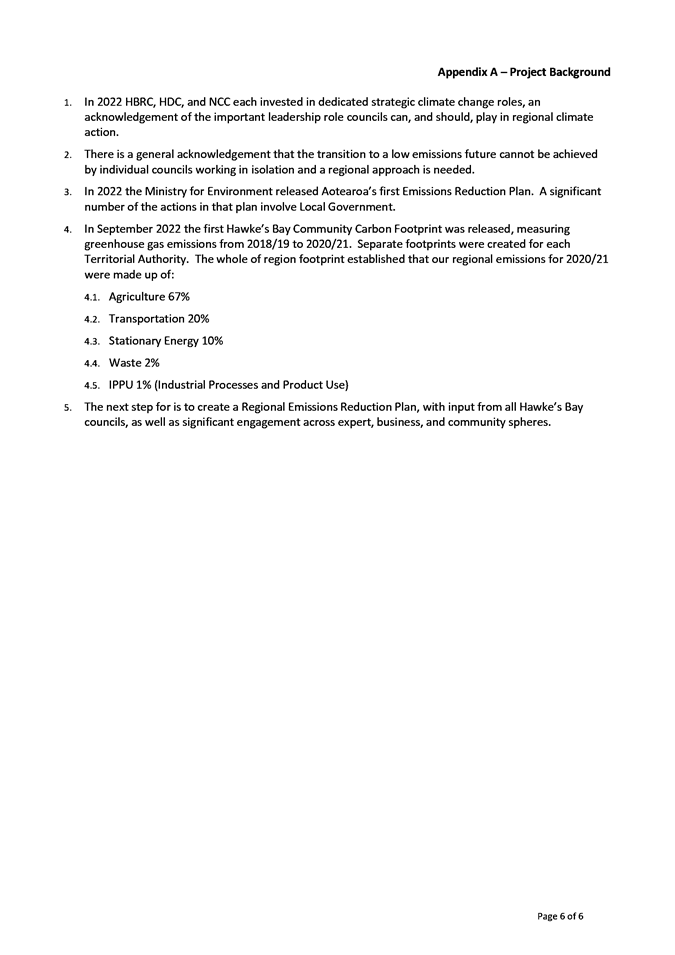
7. The desire to establish a
Joint Committee to oversee climate mitigation and adaptation work first arose
at the Hawke’s Bay Local Government Leaders (and CEs) Forum meeting on
31 October 2022. It was agreed that a joint committee provides an effective
vehicle for a coordinated response to climate change which will be identified
in the Triennial Agreement as a significant cross-council priority affecting
all communities in the Hawke’s Bay region.
8. It will also provide a
platform for the work required of councils in meeting their statutory
obligations to “have regard to” the National Emissions Reduction
Plan and National Adaptation Plan, as well as meet obligations under
the Spatial Planning and Natural & Built Environments legislation.
9. Since the Council agreed in
principle to establish a climate action joint committee, the HBRC Chair and
Deputy Chair presented to a Central Hawke’s Bay District Council meeting
on 8 December discussing the objectives and underpinning values of the
work proposed for the committee. Further work to socialise the objectives
of the Joint Committee is needed with the partner councils.
10. A decision on
membership from the Māori Committee and Regional Planning Committee
appointed tangata whenua members will be sought on 8 and 15 February
respectively.
Membership
and meeting frequency
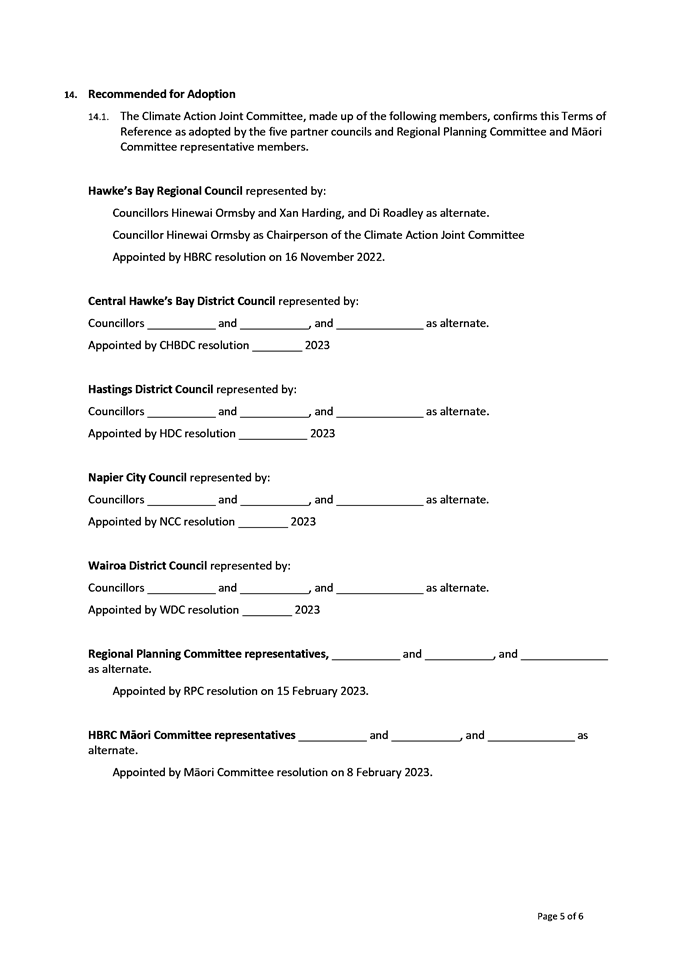
11. The Terms of Reference
(TOR) provide for:
11.1. Up to two Regional Council
elected members including the HBRC Chair and one alternate. The HBRC chair will
be the appointed as the Chair of the Joint Committee.
11.2. Up to two elected members
from each Territorial Authority within the Hawke’s Bay region, and one
alternate.
11.3. Up to two members and one
alternate appointed by the HBRC Regional Planning Committee (RPC) to represent
Post [Treaty] Settlement Governance Entity (PSGE) representatives on the RPC.
11.4. Up to two members and one
alternate appointed by the HBRC Māori Committee to represent the Ngati
Kahungunu Taiwhena and Board representatives on the committee.
12. HBRC will be the
administering authority for the Climate Action Joint Committee with
administrative support (convening meetings, keeping minutes, etc) provided by
the Hawke’s Bay Regional Council’s Governance team.
Technical
Advice
13. A Technical Advisory Group
(TAG) will comprise of staff members from the member councils who are working
in climate mitigation and adaptation and will involve subject matter experts as
required to ensure linkages with other workstreams, such as the work of the
Regional Transport Committee and the Clifton to Tangoio Coastal Hazards and
Napier-Hastings Future Development Strategy joint committees. Hawke’s Bay
Regional Council’s Climate Action Ambassador, along with the dedicated
roles at Napier City and Hastings District councils will lead this work.
Options
Assessment
14. The Council has previously
agreed to support formation of a climate action joint committee, subject to an
agreed terms of reference. The Council could still choose to:
14.1. adopt the terms of
reference as proposed, for proposing to the member councils for adoption
(meeting in February-March)
14.2. make amendments to the
attached proposed terms of reference, which will then flow through to the
member councils for adoption, or
14.3. revoke its earlier support
for establishing the joint committee (this option is not favoured by staff).
Financial
and Resource Implications
15. Councillor members of the
joint committee will not receive extra remuneration for their membership but
will be entitled to reimbursement of associated costs such as for travel which
will be funded by the Council they represent.
16. HBRC, as the administering
authority, will cover the costs of administration and tangata whenua
representatives’ remuneration. It is estimated to cost around
$8,000 per annum as detailed in the table following. Costs assume three
meetings per year, held in the HBRC Chamber and not livestreamed or recorded.
Livestreaming would cost an additional $700 + GST per meeting. These costs can
be accommodated within the existing HBRC climate change engagement and
governance budgets.
|
Description
|
|
Per meeting
|
Per year
|
|
Travel allowance reimbursement
|
$0.83 x
250km
|
$207
|
$622
|
|
Catering
|
25 x $23 pp
|
$575
|
$1,725
|
|
RPC rep – Additional meeting fee
|
$452 x
2 members
|
$904
|
$2,712
|
|
MC rep – Additional meeting fee
|
$452 x
2 members
|
$904
|
$2,712
|
|
|
Total
|
$2,590
|
$7,771
|
17. Funding for technical
inputs will predominantly come from the existing HBRC budget with contributions
on a case-by-case basis from member councils, as per the status quo.
18. Consideration could be
given to sharing the costs for tangata whenua participation and technical
inputs, similar to the Napier-Hastings Future Development Strategy Joint
Committee, between all the member councils as part of the next LTP.
Decision Making Process
19. Council and its committees
are required to make every decision in accordance with the requirements of the
Local Government Act 2002 (the Act). Staff have assessed the requirements in
relation to this item and have concluded:
19.1. Council is required to (LGA
sch.7 cl.19(1)) hold the meetings that are necessary for the good government of
its region
19.2. Council may appoint (LGA sch.7 cl. 30(1)(a)) the committees,
subcommittees, and other subordinate decision-making bodies that it considers
appropriate, including joint committees
19.3. Given the provisions above,
Council can exercise its discretion and make these decisions without consulting
directly with the community or others having an interest in the decision.
Recommendations
That Hawke’s Bay Regional
Council:
1. Receives and considers the Climate
Action Joint Committee Terms of Reference staff report.
2. Agrees that the decisions
to be made are not significant under the criteria contained in Council’s
adopted Significance and Engagement Policy, and that Council can exercise its
discretion and make decisions on this issue without conferring directly with
the community or persons likely to have an interest in the decision.
3. Adopts the Terms of
Reference for the Climate Action Joint Committee as proposed.
4. Invites the Regional
Planning Committee to appoint up to two members and one alternate to represent the Post [Treaty]
Settlement Governance Entity representatives on the Regional Planning Committee
as provided
for in the Terms of Reference.
5. Invites the Hawke’s
Bay Regional Council’s Māori Committee to appoint up to two members and one
alternate to represent the Ngāti Kahungunu Taiwhenua and Ngāti
Kahungunu Board representatives on the HBRC Māori Committee.
6. Subject to the agreement of
all member councils, appoints the Climate Action Joint Committee, under Clause
30 of Schedule 7 of the Local Government Act 2002 with the Central
Hawke’s Bay District, Hastings District, Napier City and Wairoa District
councils
Authored by:
|
Leeanne Hooper
Team Leader Governance
|
Pippa McKelvie-Sebileau
Climate Action Ambassador
|
|
Desiree Cull
Strategy & Governance Manager
|
|
Approved by:
|
James Palmer
Chief Executive
|
|
Attachment/s
|
1⇩
|
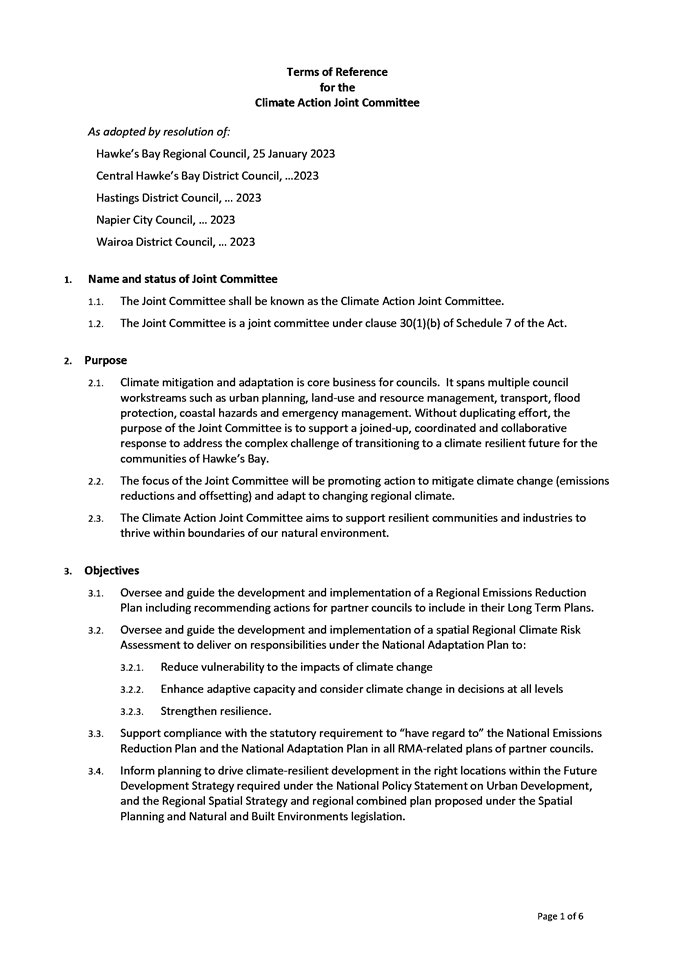
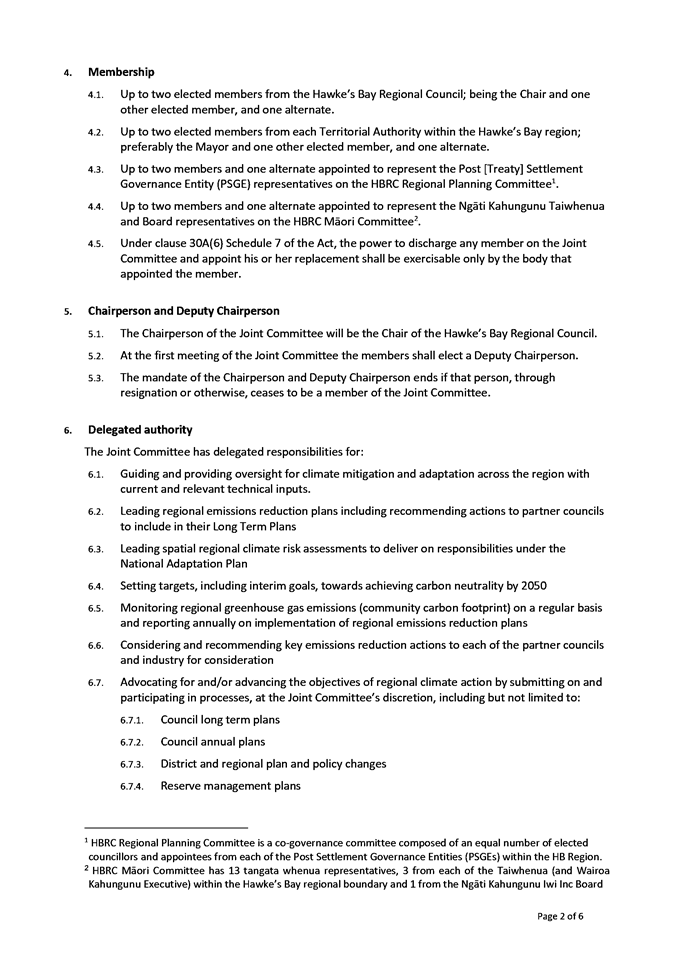
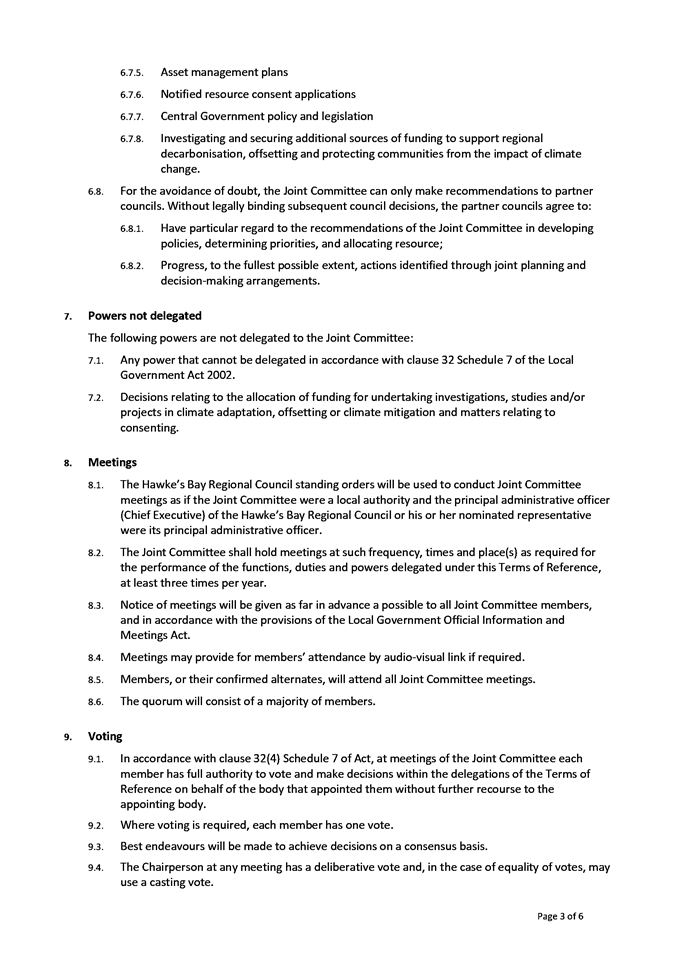
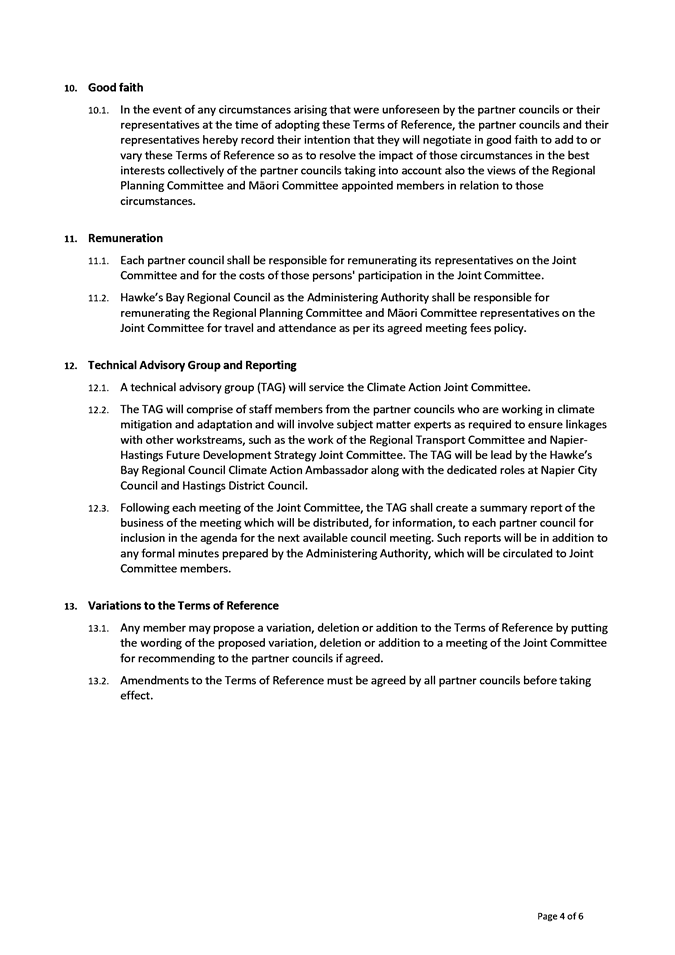
Climate Action Joint Committee ToR
proposed for adoption 25Jan23
|
|
|
|
Climate Action Joint Committee ToR
proposed for adoption 25Jan23
|
Attachment
1
|
Hawke’s Bay Regional
Council
25 January
2023
Subject: Hearings Committee
Reason for Report
1. This report proposes that a
Hearings Committee is not established for the 2022-2025 triennium, and that the
functions and powers carried out by previous Hearings committees are
transferred to the Council or a Council committee and that further delegations
are made to staff and/or a pool of commissioners.
Officers’
Recommendations
2. It is proposed that the
Hearings Committee is not established and the functions delegated to previous
Hearings committees be transferred to and carried out by Council or a Council
committee and by further delegations to staff and/or a pool of commissioners.
Executive
Summary
3. There is limited need for a
Hearings Committee. It currently functions to appoint hearing commissioners for
resource consents hearings and for Pest Management Plan hearings.
4. The meetings are infrequent
and principally only occur when there is a need to appoint commissioners.
5. It is proposed that the
Hearings Committee is not established for the 2022-25 triennium and its
functions be carried out by the Council or another committee, and by increased
delegations to staff and/or a pool of commissioners.
Background
/Discussion
6. HBRC has previously had a
Hearings Committee as part of its Council committee structure. Over the past
few years this committee has met occasionally, mostly to appoint resource
consent hearings panel members. On one occasion, in February 2018, it was
convened to appoint the members of the Biosecurity Working Party to review and
make recommendations to the Council on the Regional Pest Management Plan.
7. The Hearings Committee has
previously been delegated the following functions by the Council. In relation
to resource consents its functions are to hear and make decisions on:
7.1. notified applications where
submissions have been made and submitters wish to be heard
7.2. reviews of conditions
(s.128) where consent holder and/or submitters wish to be heard
7.3. notified applications where
submissions have been made and where the Committee considers it necessary to
hold a hearing
7.4. objections to decisions
made under delegated authority by staff, where the applicant wishes to be heard
(s.357, s357A, s357AB, s357B, s357C, s357CA and s357D)
7.5. where the staff
recommendation is to decline any application for reasons other than inadequate
information
7.6. on objections against costs
under Section 36(6) of the Act and objections to the levying of Financial
Contributions under Section 108 of the Act
7.7. on lapsing of consents
under Section 125 of the Act where Council Policy directs; or staff elect not
to make a decision under delegated authority, or where a decision of an officer
acting under delegated authority is subject to an objection
7.8. To authorise the resolution
and settlement of appeals on resource consent decisions (where this is not
already delegated to staff)
7.9. The appointment of Hearings
Committee members or independent commissioners to a Hearing Panel to undertake
the functions set out above pursuant to s 34A RMA and the appointment of the
Chairperson of the Hearing Panel.
8. There is provision for the
Hearings Chairperson to sit alone to hear objections made under s.357, s357A or
s357B in accordance with s357C and s 357D. These are objections to decisions
made by staff under delegation.
9. In addition to RMA resource
consent hearings and related processes listed above the Hearings Committee has
the function of hearing and deciding on submissions on any statutory documents
prepared under the Biosecurity Act (such as the Regional Pest Management Plan)
prepared by Council. It also has the function of hearing and deciding on
submissions on special consultative matters notified under the Local Government
Act 2002 on a case by case basis as and when delegated by Council.
10. Over the past 5 years the
Hearings Committee has met on nine occasions as follows.
10.1. three meetings in February, March
& October 2018
10.2. one meeting in June 2019
10.3. two meetings in February
& September 2020
10.4. two meetings in April &
June 2021
10.5. two meetings in March &
September 2022.
11. The meeting in February
2018 was used to appoint the members of the Biosecurity Working Party to review
and make recommendations to the Council on the Regional Pest Management Plan.
The meetings in 2021 included reports on the Hearings Committee Terms of Reference,
staff delegations and management of conflict of interests. All the meetings
have been used to appoint Commissioners to resource consent hearing panels.
12. While the Hearings
Committee can hear and make decisions on consent applications without appointing
commissioners, consent hearings are usually held for applications that are
complex and technical in nature. Commissioners have been sought with technical
expertise in engineering, coastal processes, air quality, fresh water and
ecology. Such technical expertise is generally not held by our Hearings
Committee members and to avoid additional costs to the applicant, officers will
often attempt to keep commissioner numbers to a practical minimum. This
will often include one or two technical members and a Hearings Committee member
usually as Chair. The most recent hearings have included two councillors,
one as Chair, one to provide cultural expertise and a technical member in
addition.
13. The meetings are generally
brief and where possible are included as a follow on to other Council meetings
although not all members of the Hearings Committee would necessarily be present
at the preceding meeting. It can be necessary for some members to travel
to attend the meeting or to join via video link. This may be for a matter of
ten minutes.
14. There are time limits for
processing consents which can necessitate the need to convene the Hearing
Committee quickly in order to appoint commissioners and then to organise and
schedule a hearing within the time limits. Circumstances can change and there
can be a need to amend commissioner appointments. The process needs to be
reasonably quick and agile. Unfortunately, calling a Hearings Committee meeting
can not be done quickly given the requirements of the Local Government Official
Information and Meetings Act 1987 to provide adequate notice of meetings and
publish agendas etc. As a consequence, officers are often seeking decisions
from the Chair and Deputy Chair to be made without a meeting. An email
conversation with the entire committee has facilitated this to
happen.
15. There is cost to maintain
and support the Hearings Committee and it is considered that there are more
efficient and effective options for carrying out the necessary functions
currently assigned to the Hearings Committee. These options include referring
matters to full Council or to another more regular committee as and when
required and for Council to increase staff and commissioner delegations. There
are limits however to how delegations can be made under the RMA.
16. The provision to appoint
commissioners to hear submissions on the Pest Management Plan has occurred once
in the past five years. On this occasion commissioners were appointed to hear
submissions and to make recommendations to Council. Having appointed the panel
via the Hearings Committee, the appointments were later amended and powers and
functions were delegated via the Regional Council meeting. (April 2018). The
hearing or appointment of commissioners to hear special consultative matters
has not occurred via the Hearings Committee in the past five years.
Options
Assessment
Option 1: Council to appoint hearing commissioners
and delegate further powers to staff
17. The first option is for the
Council to make hearing commissioner appointments and also to delegate more
powers to staff and to independent commissioners. The Council would appoint
commissioners from time to time for specific applications and could also
delegate more powers to staff and/or commissioners to process lower level
hearings that are considered to be at the less contentious end of the scale, on
a standing or enduring basis.
18. This would lessen the need
for involving the Council in minor matters including objections to staff
decisions and to costs. In this situation there could be a pool of
commissioners already appointed and reasonably available to proceed when
requested.
19. If this option is chosen
staff will come back to Council with a list of people that they recommend are
delegated the powers of commissioner on an enduring basis on a specified range
of matters. This list could include councillors, PSGE representatives on the
RPC and Taiwhenua representatives on the Māori Committee who are
accredited decision makers. They will also bring back some recommended additional
delegations for staff.
Option 2: Council transfer the
Hearings Committee functions and powers to another more regular committee
20. An alternative option is to
delegate the relevant powers and functions of Council to a different committee
that meets on a regular basis such as the Environment and Integrated Catchment
Committee or the Regional Planning Committee. There would be a standing item on
the agenda for the appointment of commissioners. If this was done there would
still be merit in delegating more functions to staff. Also, or instead, the
Committee could appoint a pool of commissioners to be available on a continuing
basis to hear the less contentious matters that need to be heard. If this
option is chosen staff will come back to the Committee with a list of people
that they recommend are delegated the powers of commissioner on an enduring
basis.
Option 3: S tatus quo retain the
Hearings Committee
21. The status quo is to
continue with the current arrangement and maintain a Hearings Committee. This
would see the appointment of a Chair and up to eight people onto the committee.
The frequency of meetings will depend on the nature of applications coming into
Council. Only a few of the 500 plus resource consent applications received each
year are notified and not all of these require a hearing. The retention of the
Hearings Committee seems unnecessary given its limited workload. If it is
retained, officers recommend a review of officer delegations and also to
appoint commissioners to a pool of commissioners to increase efficiency of
consent processes.
Further
discussion relevant to all options
22. Delegation of more powers
to staff is proposed in all options. For example more of the minor hearing
matters could be delegated to staff. These could include changes to specific
wording of conditions agreed to without the need for further dispute or to
costs. In this situation an alternative staff member the Group Manager Policy
and Regulation or the Chief Executive, who is not directly involved in the
decision could be appointed to hear the objections. Alternately an independent
commissioner from the proposed pool of delegated commissioners could be invited
to hear the matter. Before commencing, the objector could be offered the
choice of an elected member or an independent commissioner to hear the matter.
23. There is a Delegation
Manual which delegates all the day-to-day decision-making functions and powers
to staff. It is proposed that some more functions and powers are delegated to
staff. These include the hearing of objections to certain decisions.
24. Note that the power of
delegation is not something that can be delegated to staff. Staff cannot be
delegated the authority to delegate decision making powers to hearings
commissioners.
Strategic Fit
25. The Hearings Committee can
be involved in appointing hearings commissioners to hear matters that relate to
any of the HBRC strategic goals. Resource Consent hearings can be required for
matters involving water, land, biodiversity or infrastructure, independently or
in combination. The Hearings Committee can also be involved in appointing
people to hear Biosecurity Plans.
26. Whichever way the
committees are set up and the powers and functions of the Council are assigned,
the RMA resource consenting functions of the Council will need to be carried
out, as will the biosecurity functions.
27. If the Hearings Committee
is not established its functions will need to be distributed in a different way
to ensure that the Council’s functions and powers are still correctly and
effectively exercised.
Significance
and Engagement Policy Assessment
28. There will be no change to
what Council must do in terms of processing and hearing resource consents or
preparing and hearing submissions on plans prepared under the Biosecurity Act.
This discussion is about how the Council will go about seeing that this is
done. There will be no change to the service that is provided by the Council.
The significance of this review is low in terms of Council’s Significance
and Engagement Policy.
Climate
Change Considerations
29. The Council will need to
ensure that policies and rules that address climate change and sea level rise
are recognised and given effect to. They will need to ensure that there is a
clear process for appointing resource consent hearing panel members to hear and
consider applications which apply and test these policies and rules.
30. Whatever option is chosen
this should remain the case.
Considerations
of Tangata Whenua
31. Resource consent
applications can often be notified and go to a hearing because of the effects
of the proposal on tangata whenua values. Tangata whenua often need to be
represented on a hearing panel in light of the expertise in cultural matters
required. The RMA, the RPS for Freshwater and the pending Natural and Built
Environments Act all require tangata whenua involvement in decision making
where appropriate.
32. The hearings committee has
had Māori Committee and RPC appointees on it to guide and assist in
appointing commissioners with an understanding of tikanga Māori and of the
perspectives of local iwi or hapu. Members have often undertaken the
“Making Good Decisions” course to become accredited as commissioners.
This has been with the thought that they could be appointed to hearing panels.
However, this has not occurred very often and often an independent commissioner
has been appointed to provide this expertise. The Hearings Committee
undertook to clarify what constitutes a conflict-of-interest process last year,
this was to help with the appointment of Māori Committee and RPC
appointees on the Hearings Committee to be appointed to consent hearings.
Councillor Ormsby has been appointed in this capacity and sat as a commissioner
on two hearing panels recently.
33. The consideration of and
appointment of Māori Committee and RPC members who have Making Good
Decisions qualifications as a commissioner or commissioners to provide tikanga
Māori, Matauranga Māori and perspectives of local iwi or hapu will
not change if the Hearings Committee is disestablished. This can be supported
with the development of protocols guiding how and when tangata whenua will be
involved or appointed as Commissioners.
Financial
and Resource implications
34. The costs of hearings are
borne by the applicants. There are time limits and if these are exceeded
without agreement or justification, Council can be required to discount the
costs up to 50%. There is a risk of Council bearing some costs if they are not
efficient and timely in the processing of resource consents. This change of
approach is likely to reduce the risk of this and will also remove the cost of
remunerating a committee chair and convening and supporting a Hearings
Committee. The time taken by the hearings committee would be included in the
Council or committee meetings.
Consultation
35. This matter was discussed
by Council at its 4 December 2022 meeting with a request for staff to bring
this report back to this meeting for a decision. The matter does not require
consultation with the external community.
Decision-making process
36. Council and its committees
are required to make every decision in accordance with the requirements of the
Local Government Act 2002 (the Act). Staff have assessed the requirements in
relation to this item and have concluded:
36.1. The decision does not
significantly alter the service provision or affect a strategic asset, nor is
it inconsistent with an existing policy or plan.
36.2. The use of the special
consultative procedure is not prescribed by legislation.
36.3. The decision is not
significant under the criteria contained in Council’s adopted
Significance and Engagement Policy.
36.4. The persons affected by
this decision are all persons with an interest in the region’s management
of natural and physical resources under the RMA.
36.5. Given the nature and
significance of the issue to be considered and decided, and also the persons
likely to be affected by, or have an interest in the decisions made, Council
can exercise its discretion and make a decision without consulting directly
with the community or others
having an interest in the decision.
Recommendations
That Hawke’s Bay Regional
Council:
1. Receives and considers the Hearings
Committee staff report.
2. Agrees that the decisions
to be made are not significant under the criteria contained in Council’s
adopted Significance and Engagement Policy, and that Council can exercise its
discretion and make decisions on this issue without conferring directly with
the community or persons likely to have an interest in the decision.
3. Agrees not to establish a
Hearings Committee for the 2022-2025 triennium.
and
4. Agrees that the Hearing
Committee functions and powers will be retained and administered by Hawke’s
Bay Regional Council
or
5. Agrees to transfer the
Hearings Committee functions and powers to another more regular committee, to
be determined by the Regional Council and that the committee’s Terms of
Reference be amended accordingly.
and
6. Agrees that officers will
prepare a report for the Council’s consideration to delegate more
Resource Management Act consent decision functions to staff.
and
7. Agrees that officers will
prepare a report to either Council or the relevant committee to identify a pool
of commissioners to be appointed as standing commissioners by the Council or
the relevant committee.
Authored by:
|
Malcolm Miller
Manager Consents
|
Leeanne Hooper
Team Leader Governance
|
Approved by:
|
Katrina Brunton
Group Manager Policy &
Regulation
|
|
Attachment/s
There are no attachments for this
report.
Hawke’s
Bay Regional Council
25 January
2023
Subject: Council submissions on the Spatial
Planning Bill and the Natural & Built Environments Bill
Reason for Report
1. The purpose of this report
is to outline a process and approval of delegation for a submission to be
prepared and lodged on the Council’s behalf in relation to:
1.1. the Natural and
Built Environment Bill and
1.2. the Spatial
Planning Bill.
2. This report also suggests
several key matters that ought to be covered in a focussed submission on the
Regional Council’s behalf.
3. This report does not
provide a summary of the Bill’s extensive features nor the
Government’s rationale for those proposals.
Officers’
Recommendations
4. Officers are recommending
that a focussed submission be prepared and lodged on behalf of the Regional
Council.
5. It is also recommended that
given there are no Council meetings scheduled prior to the submission deadline,
the Regional Chair is delegated authority to approve that submission after
input and feedback from several other councillors (namely the Deputy Chair, the
Deputy Co-chair of the Regional Planning Committee and the Chair of the
Regional Transport Committee).
Summary
6. Government’s
comprehensive reform of the resource management system will repeal the Resource
Management Act 1991 (RMA) and replace it with three new pieces of legislation:
6.1. the Natural and Built
Environment Act (NBA)
6.2. the Spatial Planning Act
(SPA)
6.3. Climate Adaptation Act
(CAA).
7. The Natural and Built
Environment Bill (NBE Bill) and Spatial Planning Bill (SP Bill) were introduced
to Parliament on 15 November 2022 and have been referred to the Environment
Select Committee. Submissions on both Bills close on 5 February 2023, although
the Environment Committee has signalled that it will consider receiving late submissions
on a case-by-case basis up to 19 February 2023. A letter has been sent to the
Environment Committee Chair requesting an extension up to 19 February 2023, but
at time of writing this report, a response had not been received.
8. The NBE Bill will replace
the RMA. The SP Bill will work in tandem with the NBE Bill and focuses on
requirements for the preparation of a regional spatial strategy for each
region. The scale of reform is substantial and will have significant
impacts on the Hawke’s Bay Regional Council and local government
generally.
9. Various other local
government representative bodies are already preparing comprehensive
submissions on the two Bills. Given that is the case plus the tight submission
deadlines, Regional Council’s submission should focus on those particular
key matters that are unique to the Hawke’s Bay Regional Council.
10. A delegated authority to
approve the council’s submission is required because the deadline for
submissions falls between scheduled Council meetings.
Submission
preparation
11. Any person or organisation
may make a submission on one or both of these Bills. A number of other key
organisations with local government and resource management practice interests
are already preparing reasonably thorough submissions, such as:
11.1. Te Uru Kahika, (i.e. the
collective of regional councils and unitary authorities of New Zealand)
11.2. Local Government New
Zealand
11.3. Taituara – Local
Government Professionals Aotearoa
11.4. resource management
professional bodies (e.g. NZ Planning Institute and Resource Management Law
Association) plus
11.5. numerous businesses, lobby
groups, non-governmental organisations and research entities.
12. To inform their respective
submissions, Te Uru Kahika, LGNZ and Taituara have each commissioned additional
analysis and evaluation (and on several matters, legal opinions).
13. There is no requirement for
the Council to involve other organisations when preparing its own
submission. Realistically, limited time constrains who, how and when the
Council might engage with, and involve, other parties when preparing its
submission. There are no further ordinary Council meetings scheduled
between now and 5th February (or even 19th February if the Environment Select
Committee grant an extension).
14. Senior staff consider that
a pragmatic approach to these compressed timeframes and vast range of issues
arising from these Bills is as follows:
14.1. submission to be on behalf
of Hawke’s Bay Regional Council – not a joint submission
14.2. submission be authorised by
the Regional Council Chair (Councillor Ormsby)
14.3. during preparation of the
submission, a small group of councillors are involved and their feedback can
help further shape the submission prior to finalising
14.4. HBRC’s submission aligns
with (to the extent possible) submissions being prepared by Te Uru Kahika,
Local Government New Zealand and Taituara
14.5. HBRC’s submission
focusses on key issues that are relatively unique to Hawke’s Bay and
HBRC’s particular interests (i.e. the submission would not attempt to
cover each and every general issue arising, nor repeat what other local
government sector body submissions might contain)
14.6. HBRC’s draft
submission could be circulated to city and district councils in Hawke’s
Bay, plus members of the Regional Planning Committee so sharing does not create
‘surprises’ when final submission is lodged.
Key
issues/principles for potential submission
15. Te Uru Kahika had
commissioned a report by Tregaskis Brown on the impacts of resource management
reforms on regional council functions. The report was underpinned by the
following principles:
15.1. Clarify and strengthen the
role of regional councils’ s30 [RMA] functions, with the objective of
reinforcing the concept of local democracy
15.2. Ensure that public good
interests are not subsumed by private interests, noting that this is currently
achieved through the concept of the hierarchy of instruments
15.3. Support the continuation
and further development of integration of functions of regional councils to
ensure that a full range of tools (not just regulatory tools) are available to
support improved natural resource management
15.4. Provide a practical
approach to introduction of changes to ensure that the changes are
appropriately sequenced, are implementable and flexible enough to consider any
reform of the local government sector
15.5. Protect the relationships
with tāngata whenua that have developed both through Treaty Settlement
processes and other formal agreements with Iwi, and not undermine the role of
Iwi in local place-based decision making that has been established through
these relationships
15.6. Ensure that a focus on
community needs that aligns to the democratic role of regional councils is
maintained or strengthened.
16. We think those principles
remain valid for shaping preparation of HBRC’s submission on the Bills,
although with the addition of several extra guiding principles.
16.1. Hawke’s Bay region
needs bespoke governance arrangements to uphold existing Treaty settlement
arrangements described in the Hawke’s Bay Regional Planning Committee Act
2015 (HBRPC Act), particularly:
16.1.1. the purpose of the Hawke’s
Bay Regional Planning Committee (as per s9 of HBRPC Act) which is to oversee
the development and review of the Regional Policy Statement and regional plans
prepared in accordance with the RMA for the Hawke’s Bay region
16.1.2. strong representation of natural
resource and environmental management interests by members of elected regional
councillors and tāngata whenua members
16.1.3. HBRC being responsible for
providing necessary technical and administrative support of the
committee’s functions.
16.2. Hawke’s Bay Regional
Council should retain real influence over the strategic direction and policy
direction for management of natural resources in the Hawke’s Bay region.
16.3. With the various
decision-makers’ roles and responsibilities in the new system, there
should be commensurate accountabilities.
16.4. Transitional arrangements
constructively prime the new system for success. Transition timeframes should
not be so pressing that perverse incentives arise to pause or cease existing
workstreams, particularly those relating to management of freshwater, climate
action and addressing the biodiversity ‘crisis’ we face.
Options
Assessment
17. Options considered include
not lodging a submission on the Regional Council’s behalf; making a
comprehensive submission; preparing a submission that would be approved by the
full Council; and preparing a submission to be approved under delegated
authority.
18. Time and resourcing
constraints, plus other priorities mean preparation of a comprehensive
submission on both Bills is not viable.
19. Given there are no Council
meetings scheduled between now and the submission deadline, a submission being
prepared and requiring approval of the full council before it is lodged is not
viable.
20. A submission focussed on a
few key matters and authorised by delegation to the Regional Chair is a more
viable option.
Strategic Fit
21. The SPA and NBEA will be
hugely influential on the way natural and physical resources are managed in
Hawke’s Bay when the RMA is repealed. Consequently, lodging a
focussed submission on these Bills does fit with a number of the Strategic Plan
Goals. The SPA and NBEA will set up a new system within which HBRC’s
resource management activities will need to fit.
Significance
and Engagement Policy Assessment
22. Any person may make a
submission on one or both of the Bills currently under consideration by the
Environment Select Committee. The Government’s resource management
system reforms will have significant impacts for how natural and physical resources
are used, managed and protected across New Zealand.
23. A decision by the Regional
Council to lodge a submission on the Bills is not a significant decision under
the criteria contained in the Council’s adopted Significance and
Engagement Policy.
Financial
and Resource Implications
24. Making a submission on
legislation proposed by the Government falls within under the Council’s
‘Statutory Advocacy’ project. Several years ago, the
Government had announced its intentions to repeal the RMA and reform the
resource management system. The financial and resource implications of
preparing a submission on these Bills is within the Statutory Advocacy
project’s budgets.
25. This report does not assess
the financial and resource implications of the new legislation (if and when
passed by Parliament). Those implications will require thorough evaluation and
appropriate budget decision-making in future long term plan processes.
Decision Making Process
26. Council and its committees
are required to make every decision in accordance with the requirements of the
Local Government Act 2002 (the Act). Staff have assessed the requirements in
relation to this item and have concluded:
26.1. The decision does not
significantly alter the service provision or affect a strategic asset, nor is
it inconsistent with an existing policy or plan.
26.2. The use of the special
consultative procedure is not prescribed by legislation.
26.3. The decision is not
significant under the criteria contained in Council’s adopted Significance
and Engagement Policy.
26.4. The persons affected by
this decision
are all persons with an interest in the region’s management of natural
and physical resources.
26.5. Given the nature and
significance of the issue to be considered and decided, and also the persons
likely to be affected by, or have an interest in the decisions made, Council
can exercise its discretion and make a decision without consulting directly
with the community or others
having an interest in the decision. Furthermore, any person may make their own
submission on the NBE Bill and/or the SP Bill.
Recommendations
That Hawke’s Bay Regional
Council:
1. Receives and considers the Council
submissions on the Spatial
Planning Bill and the Natural & Built Environment Bill staff
report.
2. Agrees that the decisions
to be made are not significant under the criteria contained in Council’s
adopted Significance and Engagement Policy, and that Council can exercise its
discretion and make decisions on this issue without conferring directly with
the community or persons likely to have an interest in the decision.
3. Delegates authority to the
Chair of the Regional Council for authorising a submission on behalf of the
Hawke’s Bay Regional Council.
4. Agrees that at least the
following councillors will be invited to provide input and feedback in
preparation of a submission on the Natural and Built Environment Bill and
Spatial Planning Bill.
4.1. Councillor Will Foley
(Deputy chair, Hawke’s Bay Regional Council)
4.2. Councillor Thompson
Hokianga (Deputy Co-chair of the Regional Planning Committee)
4.3. Councillor Martin Williams
(Chair of the Regional Transport Committee).
Authored by:
|
Gavin Ide
Principal Advisor Strategic Planning
|
|
Approved by:
|
Katrina Brunton
Group Manager Policy &
Regulation
|
|
Attachment/s
There are no attachments for this
report.
Hawke’s
Bay Regional Council
25 January
2023
Subject: Register of members’
pecuniary interests
Reason for Report
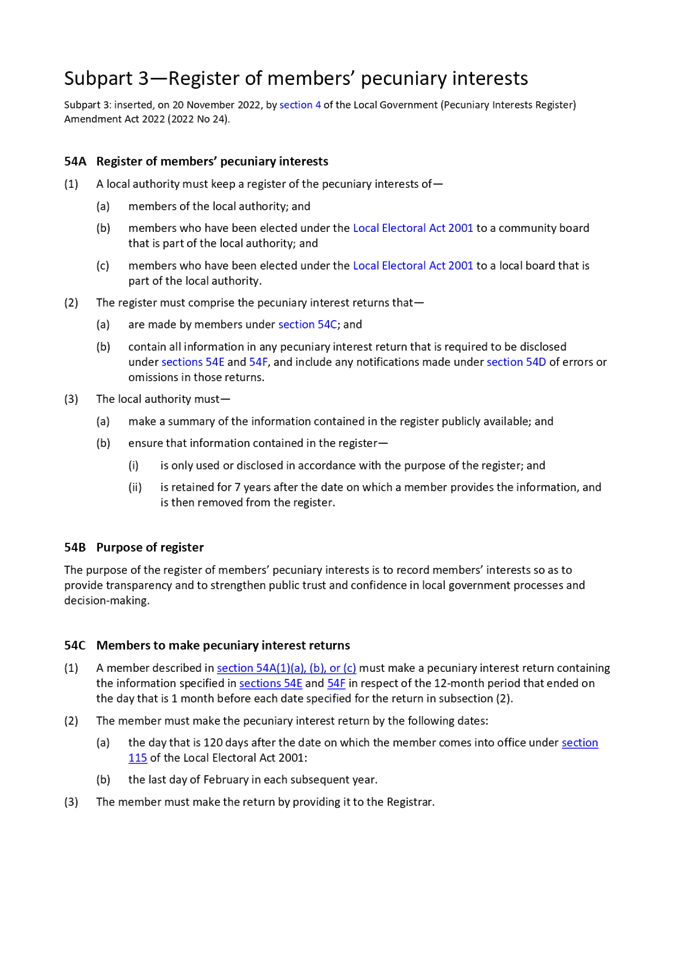
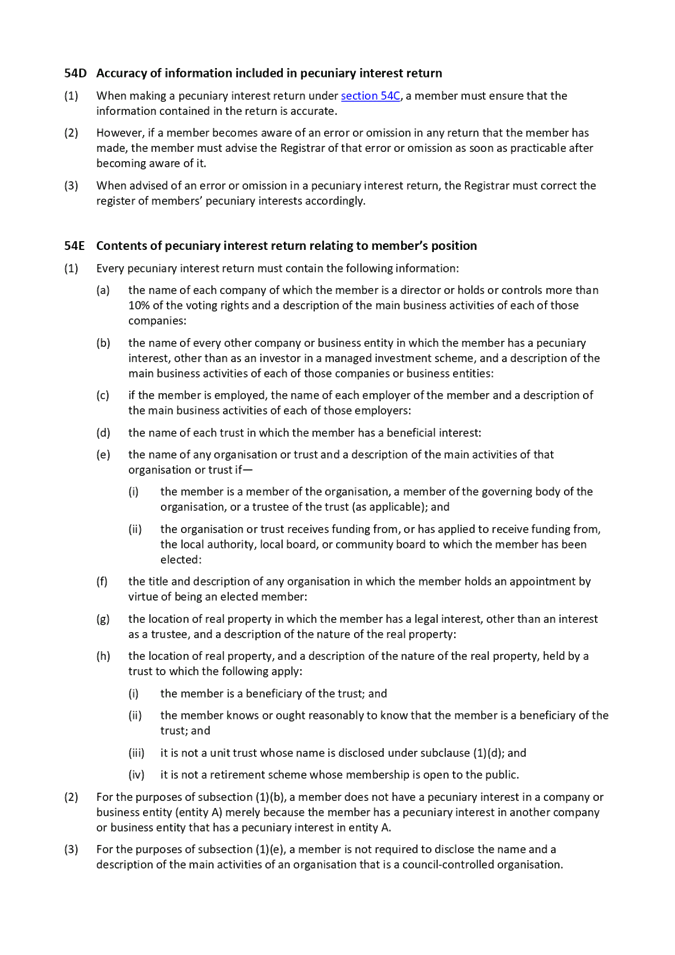
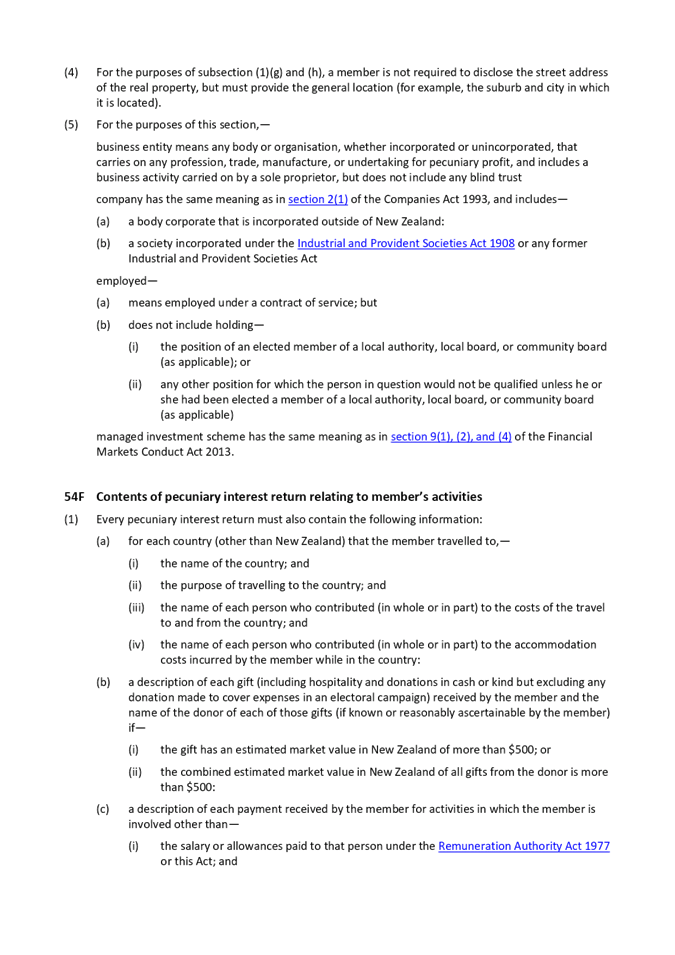
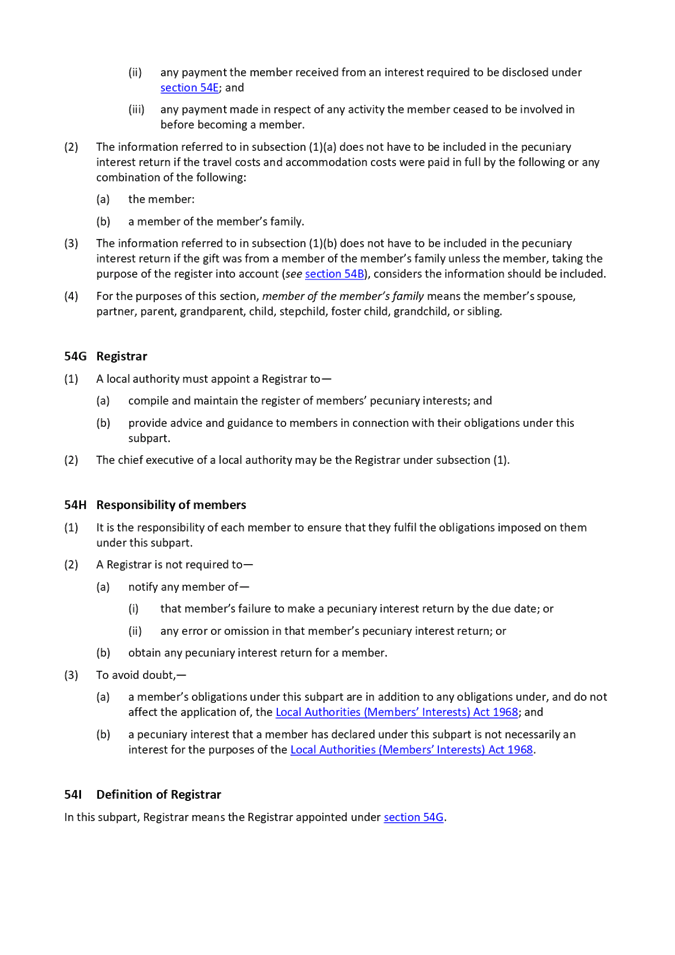
1. This agenda item informs
councillors of recent changes to the Local Government Act (LGA) as the result
of the Local Government (Pecuniary Interests Register) Amendment Act 2002
(2022 No 24) which came into force on 20 November 2022, and provides the
means for councillors to fulfil their obligations in accordance with those
changes, being Subpart 3 – Register of members’ pecuniary
interests (attached).
Officers’
Recommendations
2. Because the requirements
and obligations for councillors are set in statute, Council staff recommend
that the process (for councillors) of making and submitting their pecuniary
interest return is efficient and uncomplicated.
3. Subpart 3 clause 54G
stipulates a new requirement that the Council appoints a Registrar, and staff
recommend that Council appoints the Chief Executive to that role.
Executive
Summary
4. In November 2022 the LGA
was amended to include new requirements for councillors to provide a pecuniary
interest return to a Registrar to be appointed by the Council for that
purpose.
5. The new Subpart 3
prescribes when the pecuniary interest return must be submitted, what
period it is to cover, and what it must contain as well as the requirement for
the appointment of a Registrar and the duties of that role in relation to the Register of
members’ pecuniary interests.
Discussion
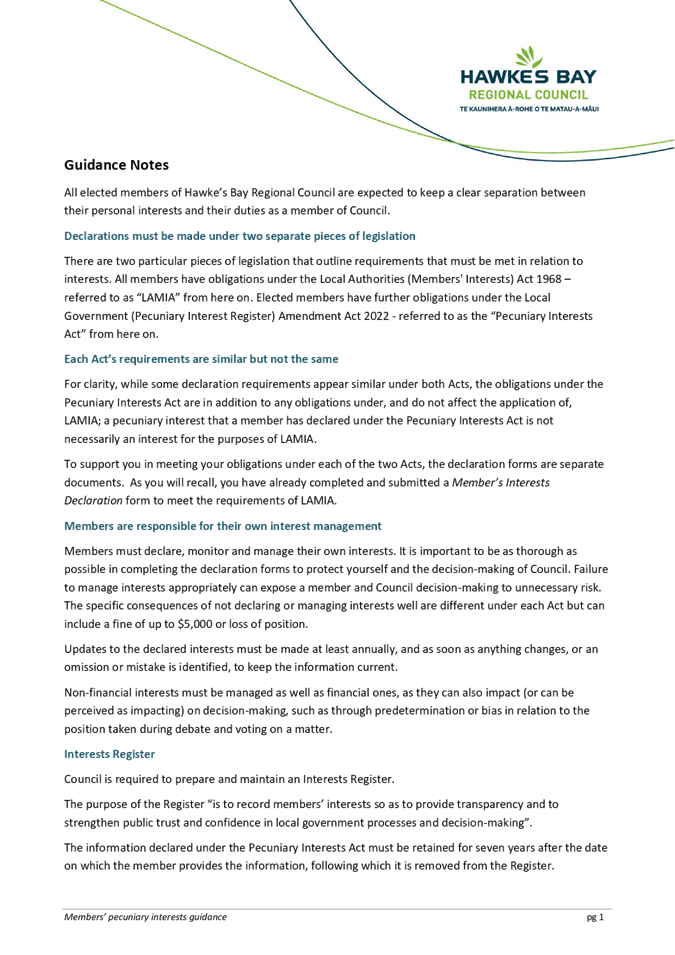
6. To facilitate the process
of councillors’ providing a pecuniary interest return, staff have
developed the attached form which includes guidance in a way similar to the Member’s
Interests Declaration form that councillors previously provided to the
Governance Team. Because this is the first of its type for this Council we are
keen for feedback on how the form might be improved for future use.
7. The reason councillors are
being asked to complete an ‘additional’ return or declaration is
because the new legislative requirements specifically require it, stating:
7.1. a
member’s obligations under this subpart are in addition to any
obligations under, and do not affect the application of, the Local Authorities (Members’ Interests) Act 1968;
and
7.2. a pecuniary
interest that a member has declared under this subpart is not necessarily an
interest for the purposes of the Local Authorities (Members’ Interests) Act 1968.
8. Staff have also
calculated that the due date for councillors’ first return is Monday, 13
February 2023, being the day that is 120 days after the date on which
councillors came into office (15 October 2022).
Financial
and Resource Implications
9. There are no financial
implications arising from this paper as the role of Registrar will not be
remunerated in addition to the CE’s other duties and responsibilities.
Decision Making Process
10. Council and its committees
are required to make every decision in accordance with the requirements of the
Local Government Act 2002 (the Act). Staff have assessed the requirements in
relation to this item and have concluded:
10.1. The decision is not
significant under the criteria contained in Council’s adopted
Significance and Engagement Policy.
10.2. The only persons affected
by this decision are the councillors themselves.
10.3. Given the nature and
significance of the issue to be considered and decided, and also the persons
likely to be affected by, or have an interest in the decisions made, Council
can exercise its discretion and make a decision without consulting directly
with the community or others
having an interest in the decision.
Recommendations
That Hawke’s Bay Regional Council:
1. Receives and considers the Register
of members’ pecuniary interests staff report.
2. Agrees that the decisions
to be made are not significant under the criteria contained in Council’s
adopted Significance and Engagement Policy, and that Council can exercise its
discretion and make decisions on this issue without conferring directly with
the community or persons likely to have an interest in the decision.
3. Appoints the Hawke’s
Bay Regional Council’s Chief Executive to the role of Registrar of
Members’ Interests.
4. Notes the new requirements
of Local Government Act Subpart 3 – Register of members’
pecuniary interests for elected members to declare pecuniary interests and
that the coouncillors’ first pecuniary interest return covering
the period 13 January 2022 through 13 January 2023 is due for submission
to the Registrar on or before Monday, 13 February 2023.
Authored by:
|
Leeanne Hooper
Team Leader Governance
|
|
Approved by:
|
James Palmer
Chief Executive
|
|
Attachment/s
|
1⇩
|
LGA Subpart 3 - Register of members
pecuniary interests
|
|
|
|
2⇩
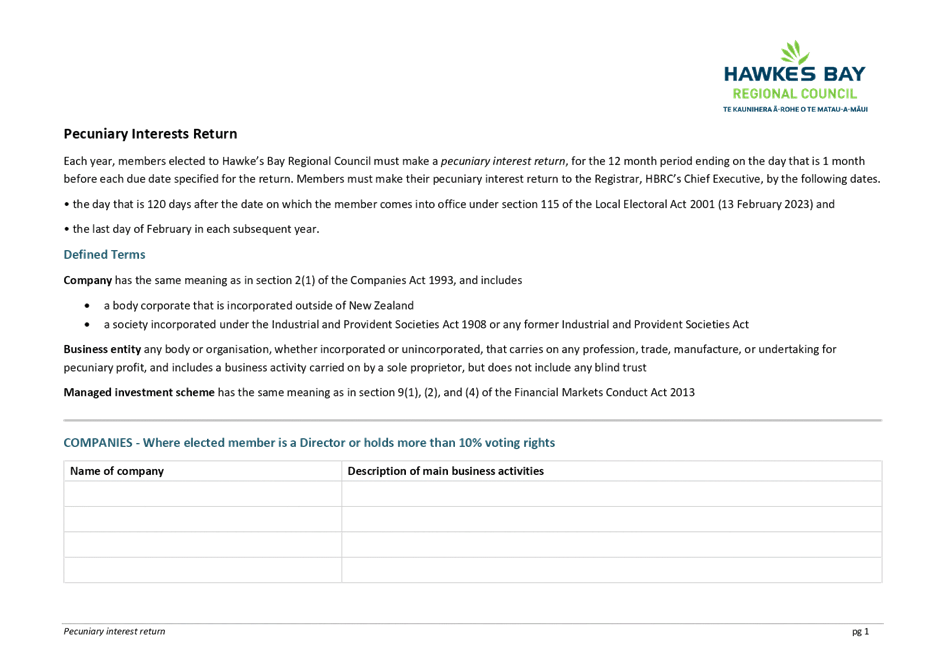
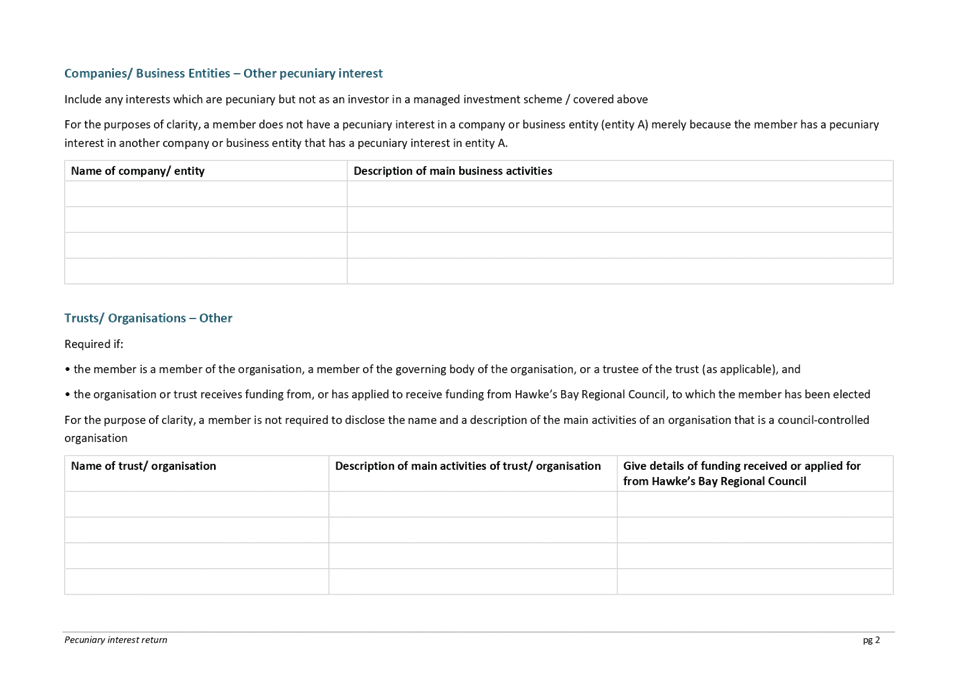
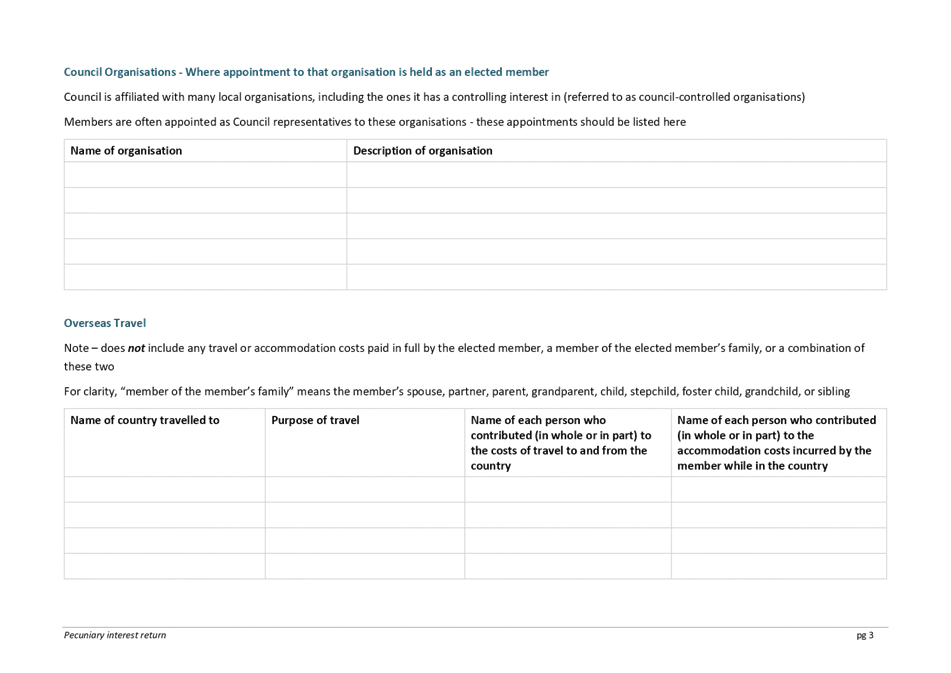
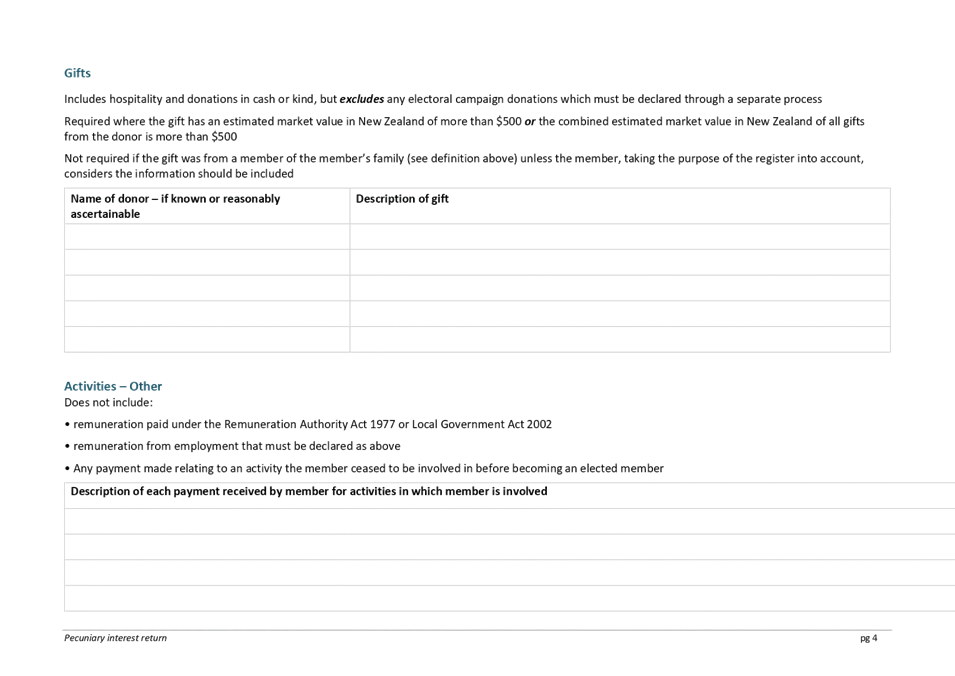
|
Members pecuniary Interests guidance
and Return form
|
|
|
|
LGA Subpart 3 - Register of members
pecuniary interests
|
Attachment
1
|
|
Members pecuniary Interests guidance and Return form
|
Attachment
2
|

Hawke’s Bay Regional
Council
25 January
2023
Subject: Affixing of Common Seal
Reason for
Report
1. The Common Seal of the
Council has been affixed to the following documents and signed by the Chair or
Deputy Chair and Chief Executive or a Group Manager.
|
|
|
Seal
No.
|
Date
|
|
1.1
|
Staff Warrants
1.1.1 L.
Scrimgeour
(Delegations
under Resource Management Act 1991 (Sections 34A(1) and 38(1); Maritime
Transport Act 1994 (Section 33G(a); Building Act 2004 (Section 317B);
Biosecurity Act 1993 (Sections 103 and 105); Civil Defence Emergency
Management Act 2002 (s.86-92) and Local Government Act 2002 (Section 177))
1.1.2 A.
Tolua
(Delegations
under the Civil Defence Emergency Management Act 2002 (s.86-92 inclusive) and
Local
Government Act 2002 (section 177))
|
4531
4532
|
16
January 2023
16
January 2023
|
2. The Common Seal is used
twice during a Leasehold Land Sale, once on the Sale and Purchase Agreement and
once on the Land Transfer document. More often than not, there is a delay
between the second issue (Land Transfer document) of the Common Seal per property.
This delay could result in the second issue of the Seal not appearing until the
following month.
3. As a result of sales, the
current numbers of Leasehold properties owned by Council are:
3.1. 1 cross lease property was
sold, with 63 remaining on Council’s books
3.2. No single leasehold
properties were sold, with 75 remaining on Council’s books.
Decision
Making Process
4. Council is required to make
every decision in accordance with the provisions of Sections 77, 78, 80, 81 and
82 of the Local Government Act 2002 (the Act). Staff have assessed the
requirements contained within these sections of the Act in relation to this
item and have concluded the following:
4.1. Sections 97 and 88 of the
Act do not apply
4.2. Council can
exercise its discretion under Section 79(1)(a) and 82(3) of the Act and make a
decision on this issue without conferring directly with the community or others
due to the nature and significance of the issue to be considered and decided
4.3. That the decision to apply
the Common Seal reflects previous policy or other decisions of Council which
(where applicable) will have been subject to the Act’s required
decision-making process.
Recommendations
That Hawke’s Bay Regional
Council:
1. Agrees that the decisions
to be made are not significant under the criteria contained in Council’s
adopted Significance and Engagement Policy, and that Council can exercise its
discretion and make decisions on this issue without conferring directly with
the community or persons likely to have an interest in the decision.
2. Confirms the actions to
affix the Common Seal.
Authored by:
|
Diane Wisely
Executive Assistant
|
Vanessa Fauth
Finance Manager
|
Approved by:
|
James Palmer
Chief Executive
|
|
Attachment/s
There are no attachments for this
report.
Hawke’s Bay Regional
Council
25 January
2023
Subject: Strategic projects report for
the period 1 - 31 December 2022
Purpose of
agenda item
1. This agenda item presents
the Project Management Office’s (PMO) Strategic projects report for
December 2022 for councillors’
information.
2. HBRC’s key strategic
projects are tracked by the Project Management Office
(PMO) and reported monthly throughout their lifecycle. These projects were
selected because of their significance in terms of investment, risks, benefits,
and interdependencies.
Key
*Risk status is inherent (eg. prior to
mitigations and controls implemented) vs residual.
Performance Indicators (RAG): Red = Off Track, Amber
= At Risk, Green = On Track, (Grey = Not started/ On hold)
Status Change Keys: é improved since last
report, è unchanged
since last report, ê worsened since last report
|
|
Project/Programme Title
|
Schedule
|
Risk*
|
Budget
|
Comment
|
Status Change
|
|
1
|
Land for Life
(formerly Right
Tree Right Place Pilot)
|

|
  
|
|
1.1 Farm
plans for 12 farms are being finalised. Follow-up for feedback with farmers
is planned in Jan-Feb 2023. Delays due to illness in the project team are
impacting several of the farm plans and will likely delay the financial
modelling process. Consulting with HBRC Catchment Team and other partners
about the Extension Programme.
1.2 Steering
Group agreed to proceed to Request for Information to progress the monitoring
framework that has been developed. Project brand and messaging change to
‘Land for Life was also signed off after farmer sounding validated
name.
1.3 Impact
caused by delays to finalising the last of the project plans is being
assessed. Supply chain risks for seedlings and labour, and the supply of
poles. Risks will be reassessed once feedback from farmers about the farm
plans is collated and actual demand is understood.
|
Updated since
8 Dec 2022
|
|
2
|
Regional Water
Security Programme: (Heretaunga Water Storage, Managed Aquifer
Recharge, and Regional Water Assessment)
|
|

|
|
2.1 CHB MAR:
Heretaunga Tamatea Settlement Trust provided written support for resource
consent application. Consent decision expected mid-Jan 2023.
2.2 Heretaunga
Water Storage: Final round of advanced pre-feasibility Geotech investigations
on preferred dam completed. Landslide and seismic assessments received, and
peer review process commenced.
2.3 RWA:
Final report completed and presented to All Governors and Regional Leaders
Forum in Dec 2022. Hardcopies provided to key stakeholders for feedback.
2.4 Timelines
have slipped due to a number of factors, but all projects continue to
progress with the Regional Water Assessment and CHB MAR both achieving important
milestones, and the conclusion of a significant body of technical work for
Heretaunga Water Security.
|
Updated since
8 Dec 2022
|
|
3
|
Ahuriri Regional
Park
(Quarterly
reporting)
|
|
|
|
3.1 On 9 Dec
2022 the first Ahuriri Regional Park Joint Committee meeting of the triennium
was held. The Joint Committee is hosted by Napier City Council. Annette
Brosnan was elected Chair with Tania Eden elected as deputy chair.
Procurement of a project manager was discussed. TAG will shortlist and
recommend a project manager to the next Joint Committee meeting for approval.
3.2 The
project is behind schedule in appointing a suitable project manager. This is
a key role in developing the project schedule, resources and risk assessment.
The next Joint Committee meeting is scheduled 24 Feb 2023.
3.3 Budget
expenditure for the FY is at risk as it is dependent on the project manager
being appointed to set the project in motion. Financial performance is within
budget; however, project launch and recruitment of resources may lead to
under expenditure for FY22/23.
3.4 Risks
are being managed by the host organisation Napier City Council. The
appointment of the project manager will see the development of project risk
assessment as one of the foundation project management artifacts.
|
Updated since
8 Dec 2022
|
|
4
|
Clifton to Tangoio
Coastal Hazards Strategy Implementation
|
|
|

|
4.1 The
Westshore drop in session held on 6 Dec 2022 was very well attended. The
focus was on northern units within the Strategy area. A southern-focused drop
in session at Haumoana has been called on 7 Feb, following a deferral
late last year due to COVID impacts. These sessions are an important
opportunity to re-engage with the community in the lead-up to the Strategy
being notified for public consultation later in the year. The Joint Committee
will hold its first meeting of the new triennium on 17 Feb. A full
complement of Tangata Whenua and Council members have been appointed. An
invitation will be extended to all Partner Council councillors to attend a
Strategy orientation briefing session immediately preceding this first Joint
Committee meeting. The key focus for the Strategy over the coming months is
funding model development. This is a challenging and complex piece of work
that Hawke’s Bay is at the forefront of nationally.
|
Updated since
8 Dec 2022
|
|
5
|
Kotahi Plan
|
|
|
|
5.1 An All
Governors Kotahi Forum was held on 7 Dec 2022 followed by the first
Technical Advisory Group (TAG) workshop on 15 Dec 2022. Subsequent meetings
between the Chair/Co-Chair & executive also highlighted a mindset to have
more place-based meetings. The practicalities of how this might look are still
being worked through.
5.2 The TAG
meeting was successful with 19 organisations (from a total of 28 invitees)
represented. The Terms of Reference and principles by which the group
operates was also adopted at this meeting.
5.3 Risk
highlighted at the All Governors Kotahi Forum was the lack of tangata whenua
contracts in many of the catchments. This issue will be put on the agenda
again at the next forum scheduled 1 Feb 2023.
|
Updated since
8 Dec 2022
|
|
6
|
TANK Plan Change
(Quarterly
reporting)
|
|

|
|
6.1 17 Appeals
have been submitted to the Environment Court on the TANK decision. The Court
required the Council to consult with the parties to the appeals in preparing
the response to its directions. The Council circulated a draft of this
memorandum to the parties on 23 Dec 2022 and invited parties to comment by 18
Jan 2023 on its proposed approach to managing the appeals.
6.2 Mediation
with Appellants remains a known and likely risk. Successful mediation could
result in the Plan not being heard by the Environment Court, however given
the complexity of the Plan and number of polarising submissions received this
is unlikely. However, the process of seeking to mediate is required to
satisfy the Court.
6.3 Delays
throughout the process have extrapolated the timeframe and programme for the
TANK plan change, meaning that it has cost more in terms of time and staff
effort, as well as consultancy fees.
6.4 Mediation
could take a considerable amount of time prior to the appeals being heard by
Court. Change in Government could potentially lead to further delays such as
RM reform, timeframe changes, policy direction changes. Team staffing changes
resulting in intellectual knowledge loss. We have to accept that these risks
are largely outside of our control. Staff retention is within our scope to
address.
|
Updated since
28 Sep 2022
|
|
7
|
Farm Environmental
Management Plans (FEMP) Programme Update
|
|
|
|
7.1 FEMP
project manager is on medical leave. This has delayed the finalisation of the
project plan with actions and team structures. Survey and interview findings
are being adopted into the project plan and key findings have been shared
with relevant Council teams. The Comms Plan due end of Dec has been delayed
because of new staff joining that team. 20 desktop audits carried out and
field assessments of FEMPs with landowners completed. All FEMP Providers
contacted with project update and asked to attend mandatory face to face
workshop early 2023.
7.2 Properties
without a FEMP but on Compliance radar is main risk. Lesser is properties no
longer meeting Low Intensity classification and needing a FEMP. The national
rollout of new Freshwater Farm Plans requirements due early this year may
create challenges around resourcing needed to clearly communicate the new
requirements to landowners.
|
Updated since
8 Dec 2022
|
|
8
|
IRG Flood Control
& Drainage Programme
-Heretaunga Flood
Control & Drainage
- Upper Tukituki
Flood Control Scheme
- Wairoa River,
River Parade Erosion (completed)
|
|
|
|
8.1 Ngatarawa
paused while land related matters with Iwi are resolved. Additional costs are
being incurred while paused.
8.2 Moteo
preferred contractor confirmed. Consulting with Iwi on Earthworks resource
consent will delay award of contract. Tenders represent higher than previous
stopbank tenders because sizeable component of vehicle access related work.
8.3 Omarunui
detailed design underway. Delays due to design resource availability, and
potentially further delayed while offsite source of appropriate fill is
identified. Resource consent application for fill import being developed.
Attempts to progress consultation in a timely fashion are being made.
8.4 UTT
Gravel Extraction Tranche 2 extraction commencing. Schedule impacted by
regular rainfall and resource availability. Risk of contractor non-compliance
with extraction consent conditions resulting in target extraction volumes not
being achieved. Higher level of attendance on site being planned for
extraction sites to counter this. Additional Gravel Assurance Officer
appointed to assist with this.
|
Updated since
8 Dec 2022
|
|
9
|
Revenue &
Financing Policy/ Rates Review (incl. Scheme Rating Reviews)
|
|
|
|
9.1 Work has
continued on developing an Excel model to model the changes across all
ratepayers. The size of the model is causing some issues, but we are looking
at an alternative subset of data and improved IT to support modelling.
|
Updated since
8 Dec 2022
|
|
10
|
Enterprise Asset Management
|
|
|
|
10.1 Development
of asset registers continued through Dec 2022. A pilot register of an
example small flood and drainage scheme was created in SEAM. This was
demonstrated to the business reference group and was well received, especially
when referencing HBRC infrastructure assets for the first time within SEAM
system. System design workshops have commenced, and business processes and
reporting requirement workshops continue into Jan 2023. Hiring of earmarked
Project Manager was unsuccessful. Re-advertising underway. This escalates the
risk level as project heads towards a complex configuration and delivery
cycle. The lack of a suitable PM and Senior BA is problematic.
|
Updated since
8 Dec 2022
|
|
11
|
Urban Catchment
Plans (Te Karamū Catchment Plan/ Ahuriri Catchment Plan)
(Quarterly
reporting)
|
|
|
N/A
|
11.1 Project
placed on hold due to the departure of the Urban Catchment Advisor (Karamu).
The Urban Catchment Advisor (Ahuriri) role remains unfilled. Reporting will
cease until further notice.
|
Updated since
28 Sep 2022.
|
|
12
|
Emissions Reduction
Plan (formerly Climate Action Plan)
|
|
|
|
12.1 Successful
practitioner meeting held for waste on 6 December. Methodology trialled at
this meeting will be used for remaining themed meetings. Draft chapter on
waste in progress. Key task for January is to confirm the TOR prior to the
first meeting of the Climate Action Joint Committee. Schedule on track but an
ambitious timeframe risk remains hence yellow traffic light for risks.
Workload spread amongst NCC, HDC and HBRC climate staff to mitigate risk.
Complimentary community engagement in design phase.
|
Updated since
8 Dec 2022
|
|
13
|
Synergy
|
|
|
|
13.1 Work has
progressed on the Fixed Assets, Budgeting and Payroll workstreams. All of
which are expected to be completed over Jan and Feb 2023. Planning has
started on the next workstreams – Accounts Payable, Legacy Solution
Retirement and Accounts Receivable, which will also be kicking off over the
next two months.
13.2 The
schedule is evolving. As we start each new workstream we are better able to
clarify what needs to be completed and the timeline can be refined.
13.3 A number
of risks actively being managed. Project resourcing is a key issue with lack
of dedicated project team members, high demand for resource support to
complete project tasks, and BAU priorities making availability of Finance and
ICT staff to support the project low. This is impacting the Project Schedule.
TechOne consultant support is poor with low availability, which is why Attura
consultants have been brought in for additional technical support.
|
Updated since
8 Dec 2022
|
|
Project Summaries
|
|
1
|
Land for Life
A pilot on up to five farms with loans offered to
landowners to plant trees on marginal land that can earn a return and enhance
regenerative farming practices. Run in collaboration with The Nature
Conservancy and the Ministry for Primary Industries to accelerate erosion
control work and extend the programme to more farms.
|
|
2
|
Regional Water Security Programme
Investigating water supply options aiming to ensure
Hawke’s Bay has long-term, climate-resilient, and secure supplies of
freshwater for all. This supports the Kotahi Plan and includes:
2.1 exploring
above ground, medium-scale water storage options in the Ngaruroro catchment
for and on behalf of the community
2.2 setting
up a Managed Aquifer Recharge (MAR) trial in Central Hawke’s Bay to
determine whether MAR is a viable water storage option and can contribute to
water security in the area
We will also work with water users to drive more
efficient and effective use to complement water storage following the
completion of a comprehensive 40-year Regional Water Assessment.
|
|
3
|
Ahuriri Regional Park
Working alongside Napier City Council and Mana Ahuriri
Trust to redevelop the Lagoon Farm site into a Regional Park to address water
quality issues in the Ahuriri Estuary, as well as enhance biodiversity, and
cultural and recreational benefits for the community.
|
|
4
|
Clifton to Tangoio Coastal Hazards Strategy
Working in collaboration with coastal communities and
local entities for more than eight years to develop the Clifton to Tangoio
Coastal Hazards Strategy 2120. We now need to confirm which council or
councils will take charge and lead this work, and are undertaking
consultation, proposing that HBRC should take charge of coastal hazard
adaptation between Clifton and Tangoio, as recommended by an independent
Funding Review. This would give the Regional Council the mandate to finalise
the Strategy. This includes consulting the community on the full implications
of implementation, such as the timing and detailed costs of physical works,
and who pays for what through the Long Term Plan 2024-2034 process.
|
|
5
|
Kotahi Plan
Developing a combined resource management plan for the
Hawke’s Bay region. It will refresh how we manage the use and
protection our natural and physical resources looking at all aspects of the
environment. This includes land and freshwater, air, the coastal and marine
area, climate change, biodiversity, urban form and development, natural
hazards and risks, energy, transport, and infrastructure. Kotahi will combine
and update the existing Regional Policy Statement, the Regional Resource
Management Plan, and the Regional Coastal Environment Plan into one, while
also giving effect to the new policies, planning and technical standards from
central government.
|
|
6
|
TANK Plan Change (Policy)
Proposed TANK Plan Change (PPC9) will add new
rules to the Regional Resource Management Plan to manage water quality and
quantity for the Tūtaekurī, Ahuriri, Ngaruroro and Karamū
(TANK) catchments.
TANK Plan Change (Implementation): TANK
Subcatchments Community Engagement
An external communications project, intended to inform
rural landowners about the Proposed Plan Change 9 (PPC9) framework and to
promote catchment group formation. It is a precursor to the overall
PPC9 Implementation, the latter contingent on a decision awaited from
Hearings Commissioners and any subsequent appeals.
|
|
7
|
Farm Environmental Management Plans (FEMPs)
These aim to address environmental outcomes and actions
to improve environmental performance on properties over 4 hectares initially
within the Tukituki region in three-yearly submission cycles.
|
|
8
|
IRG Flood Control and Drainage Programme
Project 1: Heretaunga Flood Control & Drainage
Scheme
We
are reviewing and upgrading flood protection assets across the
Tūtaekurī, Ngaruroro, Lower Tukituki and Clive rivers, to increase
flood protection across the scheme from a 1 in 100 to a 1 in 500-year event.
Project 2: Upper Tukituki Flood Control Scheme: Gravel
Extraction
We
are removing gravel from the Upper Tukituki River to improve flood protection
in Central Hawke’s Bay. Decreased demand for gravel has seen a build-up
of gravel (aggradation). Extracting gravel from the riverbeds helps increase
river capacity and reduces the risk of water inundation of neighbouring
properties during a flood.
Project 3: Wairoa River, River Parade Erosion
(completed)
We installed sheet piles to protect Wairoa District
Council roading and Wairoa River Bridge from further erosion. In winter 2022
we will be planting trees for further protection and to enhance the area and
increase biodiversity.
|
|
9
|
Revenue & Financing Policy/ Rates Review (incl.
Scheme Rating Reviews)
First
principles review of our Revenue and Financing Policy, and full review of our
rating system. The aim is to improve transparency for who pays what, ensure
legal compliance, simplify the Policy and provide more flexibility in
applying the Policy. Consultation is planned to take place towards the end of
2023 prior to the next Long Term Plan when the amounts rated for many Council
services will likely change.
|
|
10
|
Enterprise Asset Management
Aims to embed an Asset Management Information System
that integrates into and expands on the Enterprise Resource System (ERP) that
was introduced during the Finance Upgrade Systems & Efficiency (FUSE)
project. The goal is to improve efficiency, allowing us to confidently
identify assets (both spatially and uniquely within a register), manage and
maintain our current infrastructure through whole-of-life, and assess risk to
determine when changes or additions are required.
|
|
11
|
Urban Catchment Plans (Te Karamū Catchment Plan/
Ahuriri Catchment Plan)
Plans will be developed with stakeholders to provide
coordination of activities within the Ahuriri and Te Karamū catchments,
and identify options to help improve water quality, particularly in relation
to land drainage and stormwater management, and to improve biodiversity.
|
|
12
|
Emissions Reduction Plan (formerly Climate Action Plan)
Development of an inaugural Regional Emissions
Reduction Plan by July 2023 with broad community involvement, support, and
engagement, which will integrate with the next long term plans of the
region’s councils. The Emissions Reduction Plan will be informed by a
greenhouse gas emissions inventory to establish the carbon footprint at the
city, district, and regional level, a first for Hawke’s Bay.
|
|
13
|
Synergy
The
enhancement of already implemented TechnologyOne modules to ensure a stable
foundation for the future stages of the TechnologyOne ERP deployment at HBRC.
|
|
Key Strategic Projects
Pipeline
|
|
Title
|
Group
|
Estimated Start Date
|
|
Regional Water Efficiency Programme (‘Future
Water Use’)
|
Asset Management (Water Security)
|
TBC
|
|
Biosecurity Information System
|
Integrated Catchment Management
|
TBC
|
|
Clive River Dredging 2030
|
Asset Management (Regional Assets)
|
TBC
|
|
On Demand Public Transport (Napier trial)
|
Policy & Regulation (Transport)
|
TBC
|
Decision Making Process
3. Staff have assessed the requirements
of the Local Government Act 2002 in relation to this item and have concluded
that, as this report is for information only, the decision-making provisions do
not apply.
Recommendation
That the Hawke’s Bay
Regional Council receives and notes the Strategic projects report for the
period 1 - 31 December 2022 staff report.
Authored by:
|
Julie-Anne McPhee
Senior Project Manager
|
|
Approved by:
|
Desiree Cull
Strategy & Governance Manager
|
|
Attachment/s
There are no attachments for this
report.
Hawke’s
Bay Regional Council
25 January
2023
Subject: Significant organisational
activities looking forward through February 2023
Purpose of
agenda item
1. The following commentary is
for Councillors’ information to highlight significant areas of Council
activity. Resources are directed toward various initiatives which reflect the
Council’s evolving agenda, and it is important that Council is
consistently informed of progress in areas that have created or may create a high
external profile.
Significant
activities by group
Asset Management Group
|
|
Project /Activity description
|
Significant
upcoming milestone(s)
|
Team or Section
|
|
Ahuriri Regional Park
|
1. Refer to Strategic projects report for December 2022 agenda item
|
Regional Projects
|
|
Waitangi Regional Park
|
2. Funding agreement with MBIE executed for toilet block and
associated facilities
3. Funding agreement for Pou for the Waitangi wetland being
developed with the Eastern and Central Community Trust
4. Public access upgrades to river deferred until the end of summer
due to recent flooding and wet ground conditions
|
Regional Projects
|
|
Hawea Historic Park
|
5. Earthworks and revetment works complete at the confluence of
Karamu and Raupare Stream
6. Planting program for left and right banks under development for
autumn planting
7. Geotechnical investigation for Pou foundations complete
|
Regional Projects
|
|
Clive River dredging
|
8. Paper being prepared for March EICC meeting to outline options
and funding requirements for land based discharge
|
Regional Projects
|
|
Global gravel extraction consent
|
9. Extraction for flood control scheme areas transitioned to the
new global consent on 15 Dec 2022, and authorisations are
in place until 30 June 23.
10. There
have been no compliance issues to date, and Industry remains communicative
with regards to change in consenting regime
11. As at 19
Jan 2023, there are 10 sites with active extraction activities.
12. Due to wet conditions and high river levels over the last month
minimal extraction has been undertaken.
13. We are
working with priority through consent conditions pertaining to the formation
of Tangata Whenua Management Advisory groups.
14. Allocations
for sustainable gravel extraction for the 2023-2024 FY will be finalised in
May 2023.
|
Regional Assets / Operations
|
|
IRG Flood Control
-Heretaunga Flood Control & Drainage
- Upper Tukituki (UTT) Flood Control Scheme
|
15. Refer to Strategic projects report for December 2022 agenda item
|
Regional Projects
|
|
Urban Catchment Plans (Te Karamū / Ahuriri)
|
16. Refer to Strategic projects report for December 2022 agenda item
|
Regional Assets
|
|
Cycle Networks
|
17. Damage
caused by Cyclone Hale is being assessed and repairs being undertaken.
18. HB
Trails Ngaruroro Explorer – finishing detailed feasibility and
costings.
|
Regional Assets
|
|
Clifton to Tangoio Coastal Hazards Strategy
|
19. Refer to Strategic projects report for December 2022 agenda item
|
Regional Assets
|
Corporate Services Group
|
|
Project /Activity description
|
Significant
upcoming milestone(s)
|
Team or Section
|
|
Revenue & Financing Policy (Rates) review (incl.
Scheme Rating Reviews)
|
20. Step one analysis due to be presented on 22 February to a
Council workshop.
21. Step two will commence with full day workshops, the first of
which is scheduled on 22 March.
22. Refer to Strategic projects report for December 2022 agenda item for further detail.
|
Finance
|
|
Synergy
|
23. Refer to Strategic projects report for December 2022 agenda item
|
Information & Communications Technology
|
|
IRIS
|
24. The design and build of the regional sector software solution
has started (this is an 80 week phase).
25. Implementation planning and sequencing will be refined during
February and March. There is a 3 year window (2024-2026), to implement IRIS
at the participating Councils. HBRC are attempting to be at the front end of
the implementation schedule.
26. During February and March, the ‘implementation
readiness’ of each participating Council will be assessed to determine
the sequencing. The assessment factors are: technical readiness, project
management capabilities, organisational change management, risk factors and
council commitment.
27. Process excellence groups are being formed to establish the
regional sector reference model. This model defines and establishes the
‘consistent good practice processes’ that underpin the IRIS
programme.
|
Information & Communications Technology
|
Integrated Catchment Management Group
|
|
Project /Activity description
|
Significant
upcoming milestone(s)
|
Team or Section
|
|
Erosion Control Scheme
|
28. Completion and implementation of the ECS – Monitoring and
Review programme
29. 20 & 21 January, Wairoa A&P Show stand and presence
30. 22 & 23 February, East Coast Farming Expo stand and
presence. We will showcase our 3D
31. Wetland planting, team day, Whatuma.
32. Hosting the national annual pole nursery managers workshop
|
Catchment Management
|
|
Hill Country Erosion
|
33. Complete and sign off the 2023-27 contract between MPI and HBRC
34. Extend all HCE staff contracts for the following 4 years
35. Transport the newly built 3D table from MPI in Wellington to
Wairoa East Coast Farming Expo and then into HBRC Dalton Street.
|
Catchment Management
|
|
Farmer Workshops – Hill country
Erosion
|
36. Developing a series of farmer/landowner workshops – Hill
Country Erosion, five farmer/Landowner workshops across Hawke’s Bay
(two in Northern, one in Central, two in Southern) and one staff workshop.
Being delivered by Simon Stokes and Tom Fraser supported and hosted by
Catchment Advisors. Dates are 21st, 22nd, 23rd March and then 3rd, 4th, 5th
April. Working with Catchment Groups and Catchment Operations networks for
engagement & attendance.
|
Catchment Management / Catchments Policy
Implementation
|
|
Possum Control Area programme
|
37. On 14 December 2022, the Biosecurity Working Party presented
their findings on the PCA review hearings and deliberations to Council.
Council resolved to adopt the amended Regional Pest Management Plan (RPMP)
and this was publicly notified on 15 December 2022.
38. Submitters have until 31 January 2023 to lodge an appeal with
the Environment Court. If no appeals are lodged, the amended RPMP comes into
effect on 2 February 2023.
39. Rating splits for the delivery of possum control will be decided
through Step 2 of the Revenue & Finance Policy (Rates) review scheduled
to begin in March 2023.
|
Biosecurity
|
|
Predator Free Mahia
|
40. Continue with the mop-up of the remaining possums in Phase 2.
41. Proof of absence camera network will be activated.
42. Result of funding decision from PF2050 Ltd expected. (To fund
the project extension from 1 January to 30 June 2023).
|
Biosecurity
|
|
Plant Pests
|
43. Chilean
needle grass control work has drawn to a close for the season, with saffron
thistle control work not far behind.
44. Managing
Old mans beard north of the Napier-Taupo Road and in the Ruahine Forest Park
buffer zone began in January and will continue into February and March.
45. The team
is halfway through the allotted land areas to survey and control in the
Rangitaiki and Kaimanawa areas for the MPI funded pinus contorta work.
46. A
fishing vessel in the Inner Harbour was encapsulated in December as it was
found to have the marine pest Clavelina lepadiformis. This
encapsulation was in place for one month and was removed from the vessel
mid-January
|
Biosecurity
|
|
Whakakī Freshwater Improvement Fund
Project
|
47. Completing the final stage of construction of the weir will begin
30 January. A seven-week construction period has been estimated, with
completion 17 March.
48. Due to the ongoing Covid-19 situation impacting staff
availability, these dates may be subject to change.
49. An external project manager has been contracted to deliver the
project's re-scoped fencing and planting component over the next two years,
and on-ground works are now underway.
|
Biodiversity
|
|
Priority Ecosystems
|
50. Deer
fencing of priority ecosystem sites continues across the region, including
one coastal gully remnant forest site where fencing is due to begin
mid-February.
51. The SOE
Wetland Monitoring project this summer is focussed on remeasuring wetlands in
the Tukituki catchment, with fieldwork intended to be completed by the end of
February.
52. The
Biodiversity team are planning for the impending gazettal of the NPS-IB.
|
Biodiversity
|
|
TANK (Tūtaekurī, Ahuriri,
Ngaruroro, Karamū) Dashboard
|
53. Water
quality dashboards have ben developed for the Heretaunga / Ahuriri (TANK)
subcatchments to make catchment information accessible at the subcatchment
scale for catchment communities and landowners. TANK
Water Quality | Hawke's Bay Regional Council (hbrc.govt.nz)
54. Next
month, work will look at how to make this more visible on the website.
|
Catchments Policy Implementation
|
|
Tukituki Farm Environmental Management
Plans (FEMPs)
|
55. A
workshop with FEMP providers on the 20th of February will begin
work to prepare them for FEMP revisions and submissions which are due for
Tukituki farms by May 31 2024. This meeting will cover improvements to the
FEMP process ahead of the portal opening for resubmissions in June.
|
Catchments Policy Implementation
|
|
Massey University Catchment Solutions Project
|
56. Project
launch in late January with Advisory Group workshop to identify proposed
trial design and potential trial sites in Porangahau and Maharakeke
sub-catchments (Tukituki Sub-catchments). Also including Iwi engagement,
(through Roger Maaka) and the work around Lake Whatuma, which will be aligned
to this project.
|
Catchments Policy Implementation
|
|
Kotahi Plan
|
57. Refer to Strategic projects report for December 2022 agenda item
|
|
Policy and Regulation Group
|
|
Project /Activity description
|
Significant
upcoming milestone(s)
|
Team or Section
|
|
Large, high profile and/or complex resource consent
applications
|
58. HB Water Holdings – Makaroro water storage scheme. Lapse
date extension was withdrawn 29 November. The lapse date remains as June
2025.
59. Decision on the applications for Ruataniwha Tranche 2
groundwater are expected by the end of January.
60. Ravensdown resource consents for discharges to air, land and
water and wetland enhancement were granted 19 December 2022.
61. Wastewater discharge resource consents for 41 lots at Tangoio
were granted 15 December 2022.
|
Consents
|
|
Plan Change 9 (TANK plan) appeals
|
62. 17 Appeals have been submitted to the Environment Court on the
TANK decision.
63. The Court required the Council to consult with those party to
the appeal in preparing the response to its directions.
64. The Council circulated a draft of this memorandum to the parties
on 23 December 2022, and invited parties to comment by 18 January on its
proposed approach to managing the appeals.
65. Mediation is expected to commence in the first half of 2023.
|
Policy
|
|
Plan Change 7 (Outstanding waterbodies)
appeals
|
66. Four appeals were lodged with the Environment Court. During
2022, a number of meetings occurred striving to reach agreement on various
appeal points.
67. Late 2022, parties asked the Environment Court to set a hearing
date in mid 2023 for those matters where agreements could not be achieved.
|
Policy
|
|
Kotahi Plan
|
68. Refer to Strategic projects report for December 2022 agenda item
|
Policy
|
|
Napier-Hastings
Future Development Strategy (FDS)
|
69. HBRC, HDC and NCC adopted the Terms of Reference as proposed and
agreed to appoint the Napier-Hastings Future Development Strategy Joint
Committee and appointed their respective members.
70. Invitations have been sent to Mana Ahuriri Trust, Maungaharuru
Tangitū Trust and Heretaunga Tamatea Settlement Trust to participate in
FDS Joint Committee and appoint respective members.
71. Joint Committee meeting dates tentatively scheduled during 2023
are 27 April, 3 August, 26 October and 12 December, with further meetings to
conduct hearings in April/May 2024. These will function alongside council
workshops as relevant.
|
Policy
|
|
Resource Management
System Reforms
|
72. Environment Select Committee has invited submissions on the
Natural and Built Envronments Bill and the Spatial Planning Bill. Submissions
close 5 February 2023.
73. An outlined approach to preparing HBRC’s submission is the
subject of a separate item on today’s Agenda..
|
Policy
|
|
Transport Choices
Package
|
74. Subject
to a final project plan, central government has indicated that it will grant
$1.39 M to implement a Transport Choices Package (TCP) to achieve an
improved bus stop network with real time information. The TCP project will be
100% funded by Waka Kotahi and is the result of a partnership between
Waikato, Horizons and Hawke’s Bay regional councils. Expected delivery
of the TCP is between the end of 2023 and mid-2024.
|
Transport
|
Executive Advisory Group
|
|
Project /Activity description
|
Significant
upcoming milestone(s)
|
Team or Section
|
|
Corporate Planning and reporting
|
75. Opal3 reporting open for Q2. Work underway to integrate
financial and non-financial reporting from Q3 onwards
76. Project planning for Strategic Plan refresh and Long Term Plan
|
Strategy & Performance
|
|
2023 meetings
|
77. Scheduling and extending invites to Council and Committee
meetings, workshops and briefings
78. Creating draft, proposed agendas and Committee work programmes
79. Working with subgroup of RPC to agree scope of independent
review of TWR remuneration and process steps
|
Governance
|
|
Climate Action
|
80. TOR for Joint Committee to be socialised with TAs with the aim
to have all 5 partner councils and Tangata Whenua representation secured by
early March prior to the first meeting in early April.
81. Preparing for upcoming Practitioner Group meetings on the
following themes for the Regional Emission Reduction Plan - Working with
Nature (31/1); Planning and Infrastructure (14/2), Agriculture (2/3),
Building and Construction (20/3) and Transport (3/4).
82. Spatial Regional Risk Assessment underway by consultant. Stage
one delivery date March 2023
83. Speech to Ahuriri Group
|
Climate Action Ambassador
|
|
Statutory
|
84. Implementing updated legislative requirements for pecuniary
interests
85. Coordinating implementation of the Remuneration Authority
Determination of councillors’ remuneration and allowances with Finance
and Payroll
86. 2022-25 Triennial Agreement adopted by 1 March
87. Update HBRC local governance statement for publication by 1
April
|
Governance
|
|
LGOIMA
|
88. Received and coordinating responses to 12 LGOIMA requests.
|
Governance
|
Decision Making Process
89. Staff have assessed the requirements
of the Local Government Act 2002 in relation to this item and have concluded
that, as this report is for information only, the decision-making provisions do
not apply.
Recommendation
That the Hawke’s Bay
Regional Council receives and notes the Significant organisational
activities looking forward through February 2023 staff report.
Authored by:
|
Mell Anderson
Project Manager Hill Country Erosion
Scheme
|
Andrew Burton
Catchment Management Lead - Central
|
|
Desiree Cull
Strategy & Governance Manager
|
Peter Davis
Manager Environmental Information
|
|
Harry Donnelly
Project Engineer
|
Ceri Edmonds
Manager Policy & Planning
|
|
James Feary
Regional Asset Manager
|
Sandy Haidekker
Team Leader Fresh Water &
Ecology
|
|
Simon Harper
Team Leader Hydrology &
Groundwater Science
|
Leeanne Hooper
Team Leader Governance
|
|
Mark Hudson
Senior Engineering Officer - Schemes
|
Gavin Ide
Principal Advisor Strategic Planning
|
|
Jon Kingsford
Project Manager
|
Dr Kathleen Kozyniak
Team Leader Marine Air & Land
Science
|
|
Anna Madarasz-Smith
Manager Science
|
Malcolm Miller
Manager Consents
|
|
Ken Mitchell
Asset Management Engineer
|
Mark Mitchell
Team Leader Principal Advisor
Biosecurity Biodiversity
|
|
Katie Nimon
Transport Manager
|
Harsheel Patel
Project Manager
|
|
Thomas Petrie
Programme Manager Protection &
Enhancement Projects
|
Brendan Powell
Manager Catchments Policy
Implementation
|
|
Matthew Short
Biosecurity Advisor Plant Pests
|
Andrew Siddles
Chief Information Officer
|
|
Jolene Townshend
Manager Catchment Operations
|
Louise van Jaarsveldt
Environmental Engineer
|
Approved by:
|
Katrina Brunton
Group Manager Policy &
Regulation
|
Chris Dolley
Group Manager Asset Management
|
|
Iain Maxwell
Group Manager Integrated Catchment
Management
|
James Palmer
Chief Executive
|
Attachment/s
There are no attachments for this
report.
Hawke’s
Bay Regional Council
25 January
2023
Subject: Discussion of minor items not
on the Agenda
Reason for Report
1. This document
has been prepared to assist Councillors note the Minor items not on the
Agenda to be discussed as determined earlier in Agenda item 4.
Hawke’s Bay Regional
Council
25 January
2023
Subject: Confirmation of Public Excluded Minutes of
the meeting held on 14 December 2022
That
Hawke’s Bay Regional Council excludes the public from this section of the
meeting, being Agenda Item 13 Confirmation of Public Excluded Minutes of the meeting held on
14 December 2022 with the general subject of the item to be considered while the
public is excluded. The reasons for passing the resolution and the specific
grounds under Section 48 (1) of the Local Government Official Information and
Meetings Act 1987 for the passing of this resolution are:
|
General
subject of the item to be considered
|
Reason
for passing this resolution
|
Grounds
under section 48(1) for the passing of the resolution
|
|
Confirmation of Public
Excluded Meeting held on 14 December 2022
|
s7(2)(h) That the public
conduct of this agenda item would be likely to result in the disclosure of
information where the withholding of the information is necessary to enable
the local authority holding the information to carry out, without prejudice
or disadvantage, commercial activities.
|
The Council is specified,
in the First Schedule to this Act, as a body to which the Act applies.
|
Authored by:
|
Leeanne Hooper
Team Leader Governance
|
|
Approved by:
|
Desiree Cull
Strategy & Governance Manager
|
|